The Orange Democratic Movement (ODM) has settled on President William Ruto as its 2027 presidential candidate and agreed with the United Democratic Alliance (UDA) to run a single campaign committee and treasury account, but the parties are yet to agree on sharing government positions, including the Deputy President’s post, as talks on a formal coalition agreement gather pace.
National Assembly Minority Leader and ODM Director of Elections Junet Mohamed said the negotiations would now focus on positions below the presidency, the distribution of elective seats and the structure of a joint campaign machinery.
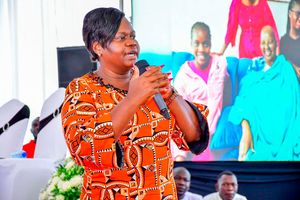
Member of Parliament for Suna East Junet Mohamed speaks during ODM party's Youth Convention at Jamhuri showgrounds in Nairobi on April 20, 2026.
Photo credit: Billy Ogada | Nation Media Group
“We have agreed that President Ruto will be our presidential candidate in 2027. That one is sorted. We are not searching for any presidential candidate. Anything below the presidency is up for grabs,” Mr Mohamed said in an interview.
The endorsement settles one of the most consequential questions in ODM’s engagement with the ruling party, even as divisions persist within the Orange party over whether to support Dr Ruto’s re-election unconditionally or first secure guarantees on power-sharing.
Mr Mohamed said the parties had also agreed to set up a single campaign committee and treasury account to finance candidates from the grassroots to the presidential level, in what he described as preliminary agreements ahead of a formal coalition expected to be concluded in February 2027.
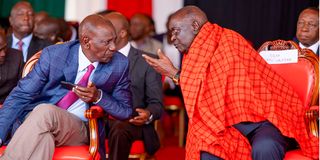
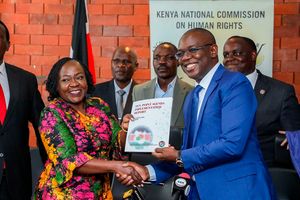
Kenya National Commission on Human Rights (KNCHR) Claris Ogangah (left) NADCO Vice chair Javas Bigambo after addressing journalists in Nairobi on March 16, 2026. The NADCO report recommended electoral and governance reforms that remain central to UDA-ODM cooperation ahead of the 2027 General Election.
Photo credit: Lucy Wanjiru | Nation Media Group
The negotiations, he said, would be anchored on a written coalition agreement, with ODM insisting that the partnership must be formally documented rather than founded on political goodwill or verbal assurances.
“ODM and UDA will have a properly documented coalition government as two parties partnering together to form the next government. There is nothing like goodwill. There is nothing like unconditional support. It must be written,” he said.
He said the parties would form a coalition without dissolving their individual political parties, and dismissed suggestions that ODM should back Dr Ruto without conditions, arguing that political parties, unlike communities or individual leaders, must follow the legal framework governing coalitions.
“You can say your community will support the President unconditionally, but political parties have their own mode of engagement. The law provides for how they engage, so they must have a coalition document and a coalition agreement,” he said.
The proposed arrangement will be supported by a joint campaign financing structure, with a single treasury account to fund candidates across the political divide, from Members of County Assemblies to governors, MPs and the presidential candidate.
“We have agreed to have one single campaign committee. We are going to have a single treasury account, a single campaign account for both parties, which will fund our campaigns from MCA to the President,” he said.
He added that the parties would rely on their existing grassroots and national structures to mobilise voters and coordinate campaigns, rather than operate separate campaign machinery.
The two parties have also established a joint manifesto team, which held meetings in Naivasha and is expected to complete its work by January 2027, after which a political committee will be constituted to consolidate the coalition arrangements.
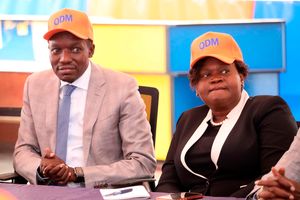
Kisii Governor and ODM deputy party leader Simba Arati (left) confers with Homa Bay Governor and ODM national chairperson Gladys Wanga (centre) alongside Mining Cabinet Secretary Hassan Joho during a mega rally in memory of Raila Odinga at Jacaranda Grounds on October 31, 2026.
Photo credit: Bonface Bogita | Nation Media Group
They have ruled out zoning, which would involve allocating particular constituencies or electoral areas to either ODM or UDA, opting instead for what Mr Mohamed described as a policy of complementarity. Under the arrangement, the parties would assess their respective political strengths in different regions and leverage each other’s support to secure parliamentary and county seats rather than compete against one another.
“We are not targeting any zoning. We have agreed to work on the policy of complementarity. If one party is strong in one area, we leverage on the support of that party to get our numbers. We are not going to compete with each other so that we disadvantage ourselves to the advantage of our opponents,” he said.
The parties have also agreed to establish teams to determine how they can secure sufficient numbers in Parliament, with the objective of retaining the majority in both the National Assembly and the Senate.
The stakes are high given ODM’s current representation in Cabinet, where it controls four of the 22 slots. The party is seeking to retain the plum dockets it already occupies, including the National Treasury, Energy, Mining and Cooperatives, while negotiating for additional positions in the next administration.
The four ministries give ODM influence over key areas of economic policy, public spending, energy security, mining and enterprise development, making their retention central to its bargaining position. Mr Mohamed said the talks would begin from the parties’ existing positions in government.
“We are going to negotiate from the known to the unknown. The known is what we already occupy in government, while the unknown is what we intend to get more. We are not relinquishing anything that we occupy at the moment,” he said.
Although ODM leaders have previously floated a 50-50 power-sharing arrangement with UDA, including the Deputy President’s position, Mr Mohamed said the specific positions and their distribution had yet to be negotiated.
“Those are the details we are getting into. We will make sure that we have a win-win solution for both parties. We cannot negotiate in public. Negotiations are done in private, and what people have agreed is shared with the public,” he said.
The question of who will occupy the Deputy President’s position remains unresolved, with Mr Mohamed indicating that the current officeholder, Prof Kithure Kindiki, could retain the position if UDA convinces ODM that such an arrangement would not cost the coalition the election.
A section of UDA leaders has maintained that the positions of President and Deputy President are not negotiable, pushing back against ODM’s demands for an equal share of government in the proposed coalition.
UDA Secretary-General Hassan Omar said Prof Kindiki remained the party’s preferred running mate for the 2027 General Election, although other positions would be open to negotiations.
“As other people might have opinions, opinions are welcome; that’s part of negotiations. I have heard those opinions. But as UDA, Professor Kindiki is our Deputy President and running mate in 2027,” Mr Omar said in a previous briefing at the party headquarters.
Nyaribari Chache MP Zaheer Jhanda also insisted that ODM could negotiate for other government positions but would not be allowed to dictate who occupies the country’s two top executive offices.
“We are partners. We agree and disagree on a number of issues. Those are internal issues. But from where I sit, the position of the Presidency is non-negotiable. The position of Dr William Samoei Ruto, non-negotiable. The position of His Excellency Deputy President Kithure Kindiki is non-negotiable. That one I can tell you for free. Anything else we can discuss, but those two positions we are not going to discuss,” Mr Jhanda said.
The planned agreement is expected to address the concerns of ODM leaders who have questioned the wisdom of committing the party’s support to Dr Ruto without securing binding guarantees on representation.
The debate has exposed divisions within ODM, with some leaders arguing that the party should embrace the President’s development agenda and cooperate with his administration, while others insist that a formal agreement is necessary to protect its interests.
ODM party leader Oburu Oginga has dismissed calls to support Dr Ruto’s re-election unconditionally, insisting that the party’s participation in the broad-based government must be anchored on negotiations and a formal agreement.
Addressing supporters virtually at Jacaranda Grounds yesterday, Dr Oginga said ODM had not entered the arrangement blindly and would not surrender its political interests on the basis of goodwill, warning members against taking positions that undermine the party’s negotiating position.
“We are not in the broad-based government blindly. Whoever is thinking that we are here blindly is misguided. We are here consciously and we know what we are doing. Broad-based government is different from a coalition government. You cannot go into a coalition without negotiations. We are negotiating according to the laws of the country,” he said.
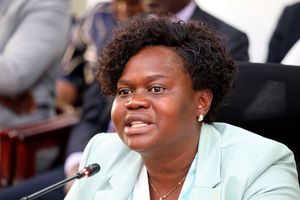
Kisii Governor and ODM deputy party leader Simba Arati addresses party supporters during a mega rally in memory of Raila Odinga at Jacaranda Grounds on October 31, 2026.
Photo credit: Bonface Bogita | Nation Media Group
Deputy Party Leader Simba Arati has also backed calls to negotiate favourable terms with UDA before committing the party’s support to Dr Ruto’s re-election, dismissing demands from some government officials that the party should support the President unconditionally.
“They are saying that we should not have conditions, but as ODM we have said we will have conditions. We will have conditions before we join government,” he said. He told those opposed to ODM’s demands to stop questioning the party’s negotiating position, saying it would not abandon the principles upon which Mr Odinga built the movement.
Mombasa Governor and ODM Deputy Party Leader Abdulswamad Nassir has insisted that the Deputy President’s position must form part of the party’s demands, saying ODM has capable leaders to occupy the office.
Mr Nassir said the party would front former Mombasa Governor Hassan Joho for the position, arguing that he had the experience and political credentials to serve as Dr Ruto’s deputy. “We must have the Deputy President position. We have said that we also have all that it takes and we will second Hassan Joho for that position. He is able. We will do it,” he said.