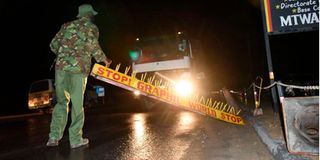
A roadblock outside Mtwapa Police Station in Kilifi County to check on those flouting curfew rules on September 20, 2020.

A day short of six years ago today (March 27, 2020), Kenya imposed easily the most life-changing national curfew in 38 years.
The distant global event leading to the curfew could be traced to China in early January. Still, the immediate local development was the Sunday, March 23, 2020, arrival in Nairobi of a young Kenyan woman from London via Chicago. She became the first official face of the Covid-19 pandemic that would eventually change the collective Kenyan conscience.
By March 15, President Uhuru Kenyatta stood before a large array of microphones to issue directives that ended much of the old Kenya. He suspended travel from all Covid-impacted nations and ordered every school in the country to shut its gates by the following Friday.
Six years later, as we look back from 2026, it is clear that those few days in March changed how the country moves, pays, and how society views the people who govern it.
For example, before the pandemic, traffic bribery was a high-volume retail business built on small bills. Public service vehicle drivers and private motorists often handed over Sh50 or Sh100 to cops to have minor faults like a cracked mirror or a wrong turn ignored. It was a predictable, almost weary ritual of the road.
Nationwide curfew
The nationwide curfew introduced on March 27, 2020, disrupted this flow. With the streets empty, the police faced a sudden shortage of customers. To make a living, they adopted a high-priced model. They began charging higher prices to the few individuals caught on the road. What made this work was the threat of mandatory quarantine. Under emergency rules, being caught outside after 7pm could result in a 14-day stay in a government facility at the citizen's own expense. Faced with a quarantine bill that could reach Sh28,000, motorists lost all bargaining power. A bribe of Sh5,000 instead was a big discount.
The March 15 directive to move to cashless transactions to prevent the spread of the virus via paper money helped modernise this “chai”. As the State pushed for the use of M-Pesa, the roadside bribe moved into the cloud. Officers stopped touching physical notes.
This digital transition made the process faster and more distant, even as it created a traceable record. It meant that enforcement could be managed with the same efficiency as a modern tech company, removing the human shame of the physical exchange and replacing it with the cold logic of a digital transaction.
The pandemic also triggered a geographic shift that remains a permanent feature of the Kenyan landscape in 2026. The remote work order allowed a professional class of "Covid exiles" to flee the capital. Towns such as Nanyuki, Naivasha, and Kilifi boomed as residents realised they could escape the daily predations of Nairobi while working online. This created a near-permanent decentralisation of the middle class.
Unexpected explosion
This migration fuelled an unexpected explosion in the creative economy. By 2025, the creative sector's contribution to Kenya's GDP had climbed to five per cent. With bars closed during the lockdown, musicians and artists moved to home studios and digital platforms like TikTok and YouTube. This created a new electropop subculture and a deeper form of storytelling that focused on socio-cultural values rather than only entertainment.
In Kilifi and Nanyuki, digital nomad hubs emerged. These towns are no longer just tourist destinations but primary residences for a creative class that generates billions in value annually. The government has responded by allocating Sh138 billion in the 2025/2026 budget to the digital superhighway.
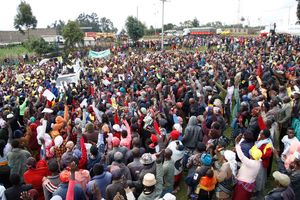
However, one of the most profound transformations was the radicalisation of Kenya's youth. The Gen Z protesters who would eventually paralyse Nairobi in June 2024 were forged in the digital isolation of 2020. They are the children of the lockdown. These teenagers were locked in their rooms with smartphones as their only window to the world.
Covid billionaires
They saw a sharp contrast between the struggle of their families and the wealthy "Covid billionaires" on social media who flaunted money stolen from government funds meant for masks and medicine. The pandemic stripped away the myth of a shared sacrifice. Young people watched as the law was used to protect the powerful while being used to beat down the poor. They became the "Patient Zero" of a new political consciousness.
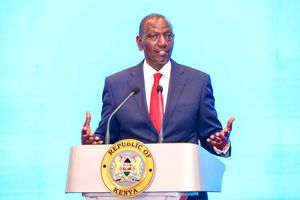
The 2024 uprising has to be seen as partly the delayed explosion of a pressure cooker that was shut on March 15, 2020. It would likely still have happened, even if Raila Odinga, not President William Ruto, had been the winner in the August 2022 election.
For this generation, the State became a predatory machine that had cancelled their youth. Having seen their social lives and graduations taken away, they returned to the streets four years later to demand an accounting of how the government spends the nationmoney. The feeling of being orphaned echoed in the new "leaderless, partyless, and tribeless" political identity they birthed.
Today, the lockdowns are a memory, but the professionalised roadside and the radicalised youth are the daily realities we inherited from that quiet and terrifying Sunday in March 2020.
Follow our WhatsApp channel for breaking news updates and more stories like this.
The author is a journalist, writer and curator of the Wall of Great Africans. X@cobbo3