This is a farewell message to my esteem readers and fans. Adieu.

There are no eternal cocktails, now we know. Exactly 12 years and four months ago, I joined the larger family of the Nation Media Group as a columnist.
Over that period, I penned 712 articles—approximately 200,000 shy of a million words. More than 600 of these were published for the Nation and The EastAfrican. This article is my last as a columnist.
As I bow out of the columnist stage, it is delightful to reflect on the eventful intellectual odyssey. Why, may I ask, did I take the column? And why have I stayed the course for over a decade as one of Sunday Nation’s longest serving columnist?
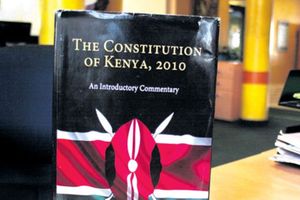
If Kenya’s first liberation was won through the barrel of the gun, it is the barrel of the pen that delivered victory in the second liberation. The 2010 constitution was a historic victory through the barrel of the pen in Kenya’s ‘quiet revolution’. Democracy without knowledge is a dangerous cesspit. A public intellectual is the ultimate warrior in the defence of freedom.
On February 14, 2013, a few months before I took up the space in the Nation, I woke up to the sad realisation that I was a lonely intellectual orphan of the Mwai Kibaki presidency. For a while, I contemplated going into politics as Kangema MP like my intellectually inclined colleagues in the presidential advisory team, Prof Kivutha Kibwana and Alfred Mutua. But I opted to walk the straight and narrow path as a public intellectual, fearless, free and frank, but sober. I re-embraced Antonio Gramsci’s idea of an organic intellectual.
Trusted intellectual
In September 2013, Dr Mukhisa Kituyi, a trusted intellectual member of President Kibaki’s advisory team, joined the United Nations Conference on Trade and Development as Secretary-General. Eric Obino, editor with the Sunday Nation at the time, invited me to be a columnist. I agreed, and took over Dr Kituyi’s 600-words column.
I was already an Adjunct professor at the University of Nairobi and chief executive at the Africa Policy Institute. With the university, the think tank and a media platform, I completed the trinity of my public intellectual career for the next decade.
I had learned that the deadline is to the Fourth Estate what discipline is to the soldiery. I had always written as an academic—sometimes feeling dutiful to supply the glorious footnote, the holy grail of the intelligentsia. The Sunday Nation helped me learn to write for multiple audiences while remaining true to the canons of my academic career.
As an opinion writer, I knew I had the rare licence to express my personal viewpoint on any issue or topic. But as a scholar in the knowledge industry trained in research and analysis, I chose to do things differently. I eschewed deep personal opinion and indulgence. Instead, I opted to take the harder odious path of having my nose steeped in data and facts.
But I also drew the red line in the sand, guarding my freedom with my life. “What are you writing on this Sunday?” my wife once asked. “Wait, darling. You will read my article like other Kenyans,” I answered. As an academic couple, we had co-authored articles and books. I also knew it is a Christian value for a family to share. But it is also true that Interior PS, and CSs for Defence or Foreign Affairs, who sat in the National Security Council, could easily chip away the freedom of a spouse with obligations to his readers!
Mt Kenya kingpin
During our forums, David Ndii and others would remind me of my role to bring the balance in the columns by writing for the government. “I am not in the government, it is the government that is in my house,” I would retort. But it was not all bliss. There were moments of bare knuckled brawls and no-holds-barred. There were ugly moments with fellow columnist, Makau Mutua. And Nation’s public editor at the time, Peter Mwaura, was not happy that I did not disclose in my article that I was at the centre of the coronation of Justin Muturi as Mt Kenya kingpin.
I am a strong believer in the principle of “peaceful transfer of power” as the lynchpin of democracy. After President William Ruto was declared winner in August 2022, I had proclaimed that he had won fair and square. My editor was concerned that I was not sticking to my stance as “opposition” to ensure balance.
There is one place where neutrality counts for nothing: analysis of dynamics in Somalia. All my articles on Somalia and the Greater Horn of Africa attracted praise and condemnation with equal measure.
There were blips of nastiness, when blood was drawn. “Kenya’s foreign policy was a pillow talk” in my house, prominent lawyer Ahmednasir Abdullahi, once posted on X.
I crossed swords with Ethiopian PM Abby Ahmed who came to power in 2018. In a 2019 article, I introduced the theory of “Cushitic Alliance” (involving Abby’s Ethiopia, Isaias Afwerki’s Eritrea and Mohamed Farmajo’s Somalia) as an existential threat to peace in the Horn of Africa. I later learned that the article infuriated the Ethiopian State. “How can a husband of a Foreign Minister of a friendly country be so irresponsible”?
Democratic revolution
A week later, I sat next to his Minister of State during a dinner to launch Kenya’s campaign for UN Security Council seat in Addis Ababa. She insisted the article was irresponsible. “Unlike diplomats who would tell you to go to hell in such a way that you look forward to the trip, intellectuals are not always politically correct,” I answered. In some of the articles, I questioned the evidential basis for his much touted “democratic revolution” in Ethiopia.
I also argued that his peace with Eritrea for which he received the 2019 Nobel Peace Prize was not peace but a military pact between Addis Ababa and Asmara against the powerful Tigrayan elite, who had lost national power, and retreated to Mekele. This came to pass when the second Ethiopian civil war broke out in November 2020.
A decade later, I have become my own man. I have proudly joined politics and taken position as Deputy Party leader of the People’s Liberation Party. But the barrel of the pen will never run dry.
Many thanks to my editors over the years: Eric Obino, Murithi Mutiga, Mugumo Munene, Enoch Wambua (now Kitui Senator), Fred Mutiso — and current editor Mike Owuor. This is a farewell message to my esteem readers and fans. Adieu.
Prof Peter Kagwanja is the Chief Executive at the Africa Policy Institute and Former Government Adviser.