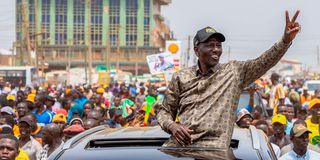
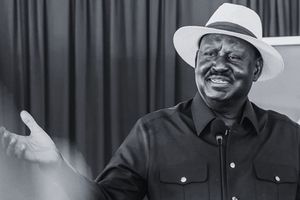
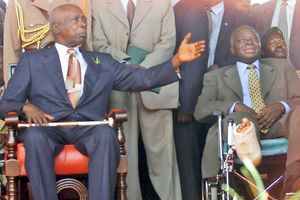
His erstwhile deputy, Rigathi Gachagua , ever the agent provocateur, saw it as evidence of his opponent unravelling from fatigue. Politics is, however, rarely that careless.
Long before Donald Trump appeared on the world stage, a character in Ola Rotimi’s Our Husband Has Gone Mad Again , used the appearance of madness to bend reality to fit his ambition.
When Ruto goes on the offensive — sharp, dismissive, combative — we have to ask whether he is exposing hidden truths or asserting control in a space where control is slipping.
Noise is often a cover for insecurity. If you hear shouting and posture, it is a rearranging of relationships. If delivery is thin, the theatrics need to be loud.
Madness, when performed rather than suffered, has long been one of politics’ most effective but least acknowledged strategies for courting public attention. The careful staging of madness unsettles opponents, lowers public expectations, evades accountability and creates room to act without constraint.
Traditionally, the performance of madness as a weapon of the weak has employed the chaos it creates to expose power. Dario Fo’s Maniac in The Accidental Death of an Anarchist does just that by using madness as a subversive tool for truth-telling. But the weak do not have a monopoly on the use of madness.
Beyond Ruto’s outburst, hard questions must be asked about the public’s role in it — laughing at the chaos, sharing it, upbraiding, praising and defending in different measures.
The instinctive reaction — outrage, condemnation, analysis paralysis — often plays directly into the strategy. Outrage is emotionally satisfying; restraint is not.
But politics that is shaped by performance rather than policy ultimately impoverishes public life. It reduces citizens to spectators, reacting to a drama whose script they do not control. In the end, the performance of madness is not about madness at all. It is about power — how to acquire it, how to wield it, and how to shield it from scrutiny.
Supporters will often reinterpret erratic behaviour as authenticity. In a world where polished politicians are distrusted, the “crazy” leader appears genuine, unfiltered, even courageous. The very traits that alarm critics become sources of loyalty among die-hard supporters. One man’s instability is another’s honesty.
The aim of the person performing madness is to sow confusion. The performance is meant to instil fear, to force concessions from opponents who prefer caution over catastrophe.
The logic is quite practical. First, unpredictability disrupts the opposition. Politics thrives on pattern recognition: if a rival can anticipate your next move, they can prepare for it. But if you appear erratic, you become difficult to counter. Opponents spend time and energy unpacking whether you are serious or just bluffing.
Second, it lowers expectations. A politician who consistently behaves outrageously benefits from reputational cushioning. When they commit a lesser offence, it is judged against their own inflated baseline rather than against objective standards. What would destroy a conventional leader becomes, for the “mad” one, just another Monday at the office.
Third, it creates plausible deniability. Outrageous statements can be walked back as jokes, metaphors, or ‘misreporting’. The ambiguity is the shield. Supporters hear what they want to hear; critics are left arguing against something that can always be reframed.
Finally, the performance of madness shifts the arena of politics from substance to spectacle. Once discourse is dominated by shock and reaction, issues disappear. The public conversation becomes a cycle of outrage and defence, leaving little room for scrutiny.
Outrage travels faster than reason. A carefully costed policy proposal will struggle to compete with a deliberately incendiary remark. In such an environment, the politician who appears “mad” is not handicapped — but is instead optimised for visibility.
Each outraged response feeds the cycle, granting the performer exactly what they seek: attention, relevance, and control of the narrative. It works because it exploits predictable human responses: fear, curiosity, and indignation. The line between performed madness and actual loss of control is thin. A politician who leans too heavily into unpredictability may begin to appreciate the reputation it earns.
And there is always the danger of escalation. If one actor benefits from shock tactics, others have the incentive to outperform them. The political arena becomes a contest not of ideas but of extremity — who can say the most outrageous thing and generate commensurate attention.
At some point, tactics grow into habits. Politicians provoke; audiences react. They escalate; people amplify. The problem is not just that politicians are trading insults. It is the insults that are working on the audience. They are entertaining. Like fast food, insult easy to consume but barely beneficial.
The writer is a board member of the Kenya Human Rights Commission and writes in his individual capacity. @kwamchetsi; [email protected]