Imagine waking up, opening your banking app, and seeing that the Sh15,000 you sent your spouse for groceries has somehow morphed into a Sh80,000 withdrawal. You rub your eyes. You check again. Then you notice the Sh100,000 school fees wire you authorised is reflecting as Sh200,000.
In that moment, you wouldn’t calmly call the bank to ask about a “clerical error”. You would be at the nearest branch with a lawyer and a police officer, demanding to know who is raiding your life savings. You wouldn’t accept a shrug and an “oops” from the teller.
Yet, this is exactly the kind of gaslighting the National Treasury expects the Kenyan taxpayer to swallow regarding the budget outturn.
For those who don’t spend their Sundays reading the Kenya Gazette, the budget outturn is, quite simply, the government’s bank statement. It is a monthly record published by the Treasury Cabinet secretary that tracks every single cent moving in and out of the Consolidated Fund at the Central Bank of Kenya.
Because it shows actual cash flow rather than just “plans,” the budget outturn is the Holy Grail of financial transparency. It is the single source of truth. Or at least, it is supposed to be.
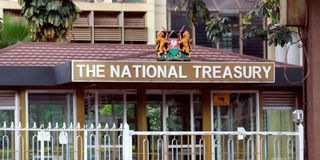
On April 17, the National Treasury published the March outturn numbers. A few days later, they realised they had a problem. In a move that defines “sloppiness”, they wrote to the Government Printer claiming the numbers were “erroneous” and demanded a correction.
The Treasury even had the audacity to tell the Government Printer to “ensure such errors do not occur in future”, effectively blaming the person operating the printing press for the billions of shillings in the spreadsheets.
Let’s look at the “gravity” of these errors: out of 88 entries, 84 were wrong. In any private corporation, a finance team that gets 95 per cent of its bank statements wrong would be cleared out by security before lunchtime.
The most damning indictment of this “clerical error” defence lies in the surreal symmetry of the mistakes.
The first Gazette recorded that the Executive Office of the President (Vote R1011) received exactly Sh3,465,596,507.50 in March. Curiously, this exact figure—to the very cent—was also listed as the amount spent by the Independent Policing Oversight Authority.
This isn’t a typo; it’s a mathematical impossibility. It suggests a “copy-paste” governance style where figures are moved around like shells in a street game. How does an oversight body—a relatively small agency—end up with the identical monthly expenditure of the highest office in the land?
The drama reached a peak of absurdity in the “corrected” special Gazette published on April 21. Even after promising to fix the mess, the new document managed to commit a cardinal sin of accounting: it deleted an entire department.
The Performance and Delivery Department—housed under the Office of the President at Vote 1015—simply vanished. One day the government is spending hundreds of millions on monitoring performance, the next, the department doesn’t exist in the records.
A Gazette notice is not a draft. It is not internal correspondence. It is law. To “accidentally” drop a whole vote from the Office of the President suggests a document that was fabricated—whether through negligence, incompetence, or something worse.
Beyond the “typos” lies a deeper, more systemic illegality. Article 206 of our Constitution is clear: every shilling borrowed in the name of the Kenyan people must be deposited into the Consolidated Fund.
Yet, in both the first and the “corrected” gazettes, the government disclosed that it has kept Sh150 billion in a “sovereign bond proceeds account”—outside the Consolidated Fund and away from the sight of the Controller of Budget.
At the height of the 2014 Eurobond scandal, the then Controller of Budget, Agnes Odhiambo, was clear: If the government wants to keep proceeds from Eurobonds off the books, let them go to Parliament and change the law.
The National Treasury owes Kenyans a third Gazette notice. It must tell us, clearly and without ambiguity, how much public money was spent on performance and delivery in March 2026. It cannot simply erase a vote and call it a correction.
Errors of this magnitude do not happen in institutions that take accountability seriously. They happen in institutions that have stopped believing anyone is watching. Unfortunately for them, some of us still follow and track movements in the Consolidated Fund Account every month.