In reality, it sits at the centre of a high-stakes dispute between two major Chinese firms—China Road and Bridge Corporation (CRBC) and China Civil Engineering Construction Corporation (CCECC)—over a multi-million railway station project in Nairobi, funded by the British Government.
Kenya Railways initially awarded the contract to CRBC. CCECC challenged the award before the Procurement Appeals Board, which nullified it. Yet, despite this ruling, Kenya Railways proceeded to re-award the contract to CRBC.
CCECC returned to the Appeals Board, which scheduled a fresh hearing. CRBC, in turn, moved to the High Court and obtained a temporary injunction blocking those proceedings.
In the midst of this legal contest, key personnel from CCECC involved in the dispute were deported. The implications go beyond the fate of a single contract.
First, there is the issue of value for money. CCECC’s bid was cheaper by approximately Sh7 billion. While CRBC may have scored higher in technical evaluation, both firms met the required threshold. In a system that purports to balance technical competence with cost efficiency, such a price differential should not be casually dismissed.
Second, and more fundamentally, there is the question of institutional integrity. What is the role of the Procurement Appeals Board if its decisions can be effectively ignored? What does it mean for the rule of law when parallel processes—legal injunctions, administrative actions, and immigration enforcement—intersect in ways that appear to disadvantage one party in an ongoing dispute?
These are not abstract concerns. They go to the heart of public procurement as a system designed to safeguard transparency, fairness, and accountability in the use of public resources.
The deportation of individuals linked to an active procurement dispute introduces a deeply troubling dimension. Whether justified or not on independent grounds, such actions risk creating the perception—if not the reality—of a process that can be influenced through extra-legal means.
Ultimately, the issue is not about one contractor or another. It is about whether Kenya’s institutions can withstand the pressures exerted by high-value infrastructure deals and the networks of influence that surround them.
If decisions of oversight bodies can be circumvented, if price differentials of billions can be overlooked without clear justification, and if parties to a dispute can be removed from the jurisdiction at critical moments, then the credibility of the entire procurement system is at stake.
Until these questions are addressed, the language of governance and due process will ring hollow—drowned out by the quieter, more decisive battles being fought behind the scenes.
Here historical context and background to the saga playing out here. There is a shadow economy that runs alongside Kenya's infrastructure boom, and it has made certain men extraordinarily wealthy. It does not appear in any official register. It is not governed by any law. But it is arguably more consequential than the formal procurement system it parasitises.
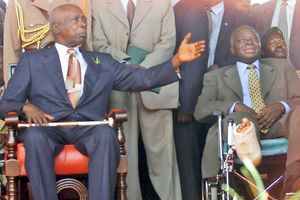
It began in earnest during the Mwai Kibaki era. As Chinese contractors flooded into Kenya bearing financing from State-backed lenders like China Exim Bank, a new class of middleman emerged — well-connected local operatives whose singular value was access.
Their job was to hold the Chinese contractor's hand through the labyrinth of Kenyan officialdom: to negotiate with ministers and principal secretaries, to deliver those infamous Memoranda of Understanding, to bring State corporations and the National Treasury to the table. In return, they were handsomely rewarded. Overnight billionaires were made. The system, informal and unacknowledged as it was, worked for those inside it.
What was less visible then is plainly visible now: when two large Chinese contractors compete for the same contract, the middlemen behind each of them go to war. These are not gentlemanly disagreements. They play out in courts, before the Public Procurement Appeals Board, and at the Court of Appeal. And, as a disturbing recent episode demonstrates, they play out in immigration offices.
But the deeper and more corrosive issue is what the deportations represent. Kenya's Immigration Department carries enormous discretionary power. When that power is deployed to remove foreign nationals who are active participants in a live procurement appeal — removed precisely at the moment their presence is most inconvenient to the opposing party — it ceases to be immigration enforcement and becomes something else entirely. It becomes a weapon.