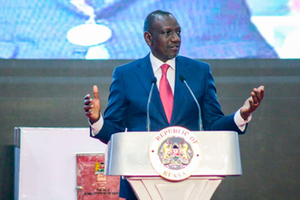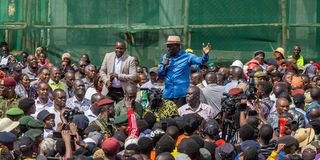
President William Ruto and Deputy President Kithure Kindiki address Nyeri town residents after inspecting affordable housing units on the final day of his Mt Kenya development tour on April 5, 2025.

Decoding a political shift requires great dexterity. This is because political changes can be so subtle and “unseen”. A political order can sometimes realise shifts when it is too late.
Take for example, the political relationship between white settlers and the Kikuyu community in pre-independence Kenya. Just like most African communities, pre-colonial Kikuyu had little contact with the world beyond their immediate surroundings.
They knew their kin Akamba of Chief Kivoi Mwendwa in the lowlands, who spoke an almost common language. They knew the Masaai (Ukabi) with whom they had a love-hate relationship — a relationship of raids and fights interfaced with trade and marriage.
Hence, the Nyokabis (women) and Mukabi (men) born out of those liaisons. That’s why there have been the likes of the late Chief Waiyaki wa Hinga aka Koiyaki ole Kumale and former vice President George Saitoti aka George Kinuthia Kiarie. The furthest the Kikuyu knew westwards was Meru — inspiring the saying “why are you late as if you are from Meru?” And God must be residing on top of Mt Kenya, their highest geographical point in their lands. The other contact was with Ndorobos - Athi and Gumba - who disappeared mysteriously.
That is why Kikuyus were surprised when they first noticed white men on top of horses traversing their land heading towards Karuri wa Gakure village in Tuthu. Mugo wa Kibiru from Murang’a (Metumi) Gatanga had prophesied a strange race whose skin colour was that of a small pale frog that lives in water (Kiengere) coming with a snake emitting smoke (railway).
The Kikuyu decided to kill this strange thing to have a better look. The white men evaded and came back with a revenge expedition.
The greatest witch
They gathered the villagers and inquired, "Who is a witch doctor here?” An old mzee raised his hand. He was shot immediately with a “stick emitting smoke” — a clear message the white man was “the witch of all witches”. That act sold fear.
The people began to think the white man was a god - How could they point a stick and kill the greatest witch? Many thought the white man never emptied his bowels — that was for mere black mortals.
This mythology of white man’s supremacy and deference lasted for over 60 years. That was until an accidental historical event happened far away from Kikuyuland that caused a seismic political shift: World War 2.
The white man was engaged in battles in Asia and Europe. He hired Kikuyu men as carrier corps (hence modern Kariokor) and shipped them to Burma. On their return, the corps spread propaganda that the white man was a normal human being and could die like everyone else.
That birthed a revolutionary spirit that undermined the mythical status of the white man, precipitating the independence struggle. The white man did not foresee how the African Burmese sojourn as carrier corps undid 60 years of mesmerisation and had the unintended effect of opening the eyes of Africans. It was a hidden political shift. As Kenya heads towards 2027, three forces are combining to trigger a similar but hidden political shift. Those in leadership need to study these shifts and align adequately. The first shift is the explosion of the Internet and mobile phones.
The ordinary voter has become more educated and informed. Traditional gatekeepers of information, such as legacy media, have been bypassed. Traditional media did this gatekeeping through editing. Probably mirroring the Kikuyu proverb “information should never be thrown like a rod”. Modern social media has no such. It creates echo chambers and filter bubbles.
Political promises
Voters can compare first and third-world countries in real time. And Internet never forgets political promises made. The other shift is the expanding diaspora community. Kenya has been encouraging its young people to seek employment overseas.
The Kenyan diaspora is not only sending money; it is exporting back to Kenya political ideas. The 2027 politicians will have to campaign beyond Kenyan borders.
Then youth numbers are expanding. Youth are the backbone of any political and social shift. Luke 3:23 states that Jesus was 30 when he started his ministry. Alexander the Great was 20 when he pushed Macedonia ahead. Napoleon Bonaparte rose to power in France at 35. Whichever side is able to correctly read these signs of the times will get ahead.
Good lessons for politicians ahead of 2027 include a campaign platform that is youth-centric, including employment creation, digital economy, social justice and inclusivity. Do not be caught flatfooted like the mzungu of the 1950s.
Dr Kangata is the governor of Murang’a County. [email protected]