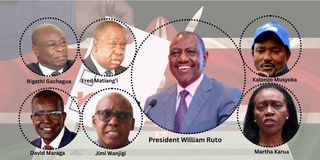
Kenya is once again edging toward an election, that familiar season when politics resembles both a family gathering and a football match — noisy, emotional, and occasionally short on logic. From the terraces, we shout advice at the players — “Messi, run!” — with the confidence of those who will never touch the ball. As the Kikuyu say, he who is wise has been advised. Whether the players listen is another matter.
Spectators are often wrong. But they do see patterns. And in this contest between government and opposition, both sides carry risks that are as old as politics itself — only the slogans have changed.
The opposition’s first hurdle is as prosaic as it is decisive: money. Politics may be a noble calling, but campaigns run on fuel, airtime and human stamina —none of which come free. As Gwen Guthrie sang in 1986 with disarming honesty, “no romance without finance.”
Even the most idealistic candidate must pay agents, print posters and keep vehicles moving. There is a clean part of this spending — logistics — and a murkier part that tempts leaders to treat public office as an investment to be recouped. That, as taxpayers discover, is where governance quietly turns into bookkeeping.
The government, by virtue of incumbency, enjoys an advantage here. Yet money is not omnipotent. Its influence depends on the character of communities. Some communities command their leaders; others are commanded by them. In the latter, persuading —or purchasing — the leader may suffice. In the former, each voter is a small republic, stubborn and sovereign. Attempting to “buy” such an electorate is like trying to bribe every member of a large family at Christmas dinner—expensive, chaotic, and likely to end with someone pocketing the money and still voting against you.
Kenya’s own history offers a quiet lesson. In parts of the country, colonial agents subdued communities by winning over a single leader. In others, particularly more decentralised societies, resistance endured as long as there were no chiefs to be neutralised.
Recent elections reinforce the point. In 2022, despite vast resources deployed across the political divide, several regions voted in ways that confounded financial expectations. Voters listened, nodded — and then made up their own minds in the secrecy of the ballot.
Strategy is the opposition’s second gamble. Much of its current effort appears devoted to consolidating traditional strongholds. For example,Kalonzo is always in Ukambani, whereas UDA is camping in central.
Opposition stance is understandable— " You dance a yard before you dance abroad " . Yet politics, like football, punishes excessive caution. A team that remains pinned in its own half invites pressure; a small misstep, a clumsy tackle, and suddenly there is a penalty to defend.
Venturing into the opponent’s territory is not merely about winning votes; it is about legitimacy and hedging against your votes being stolen in your opponent's stronghold. The 2013 and 2017 elections showed how regions once considered impenetrable can gradually open up.
Unity, however, remains the opposition’s most delicate test. Coalitions are like extended families: everyone agrees at the wedding; fewer agree when it is time to share the bill. Personal ambition, ideological differences and regional calculations all pull in different directions. A divided opposition does not merely lose votes; it loses clarity. And in politics, confusion is often fatal.
The government, for its part, faces a different set of risks. Incumbency brings resources but also scrutiny —and, occasionally, fatigue. Large ethnic voting blocs appear increasingly fluid. The mountain. Lower Eastern. Western. Kisii. If they fuse, without considering anything else,Nairobi is totally gone. Political strategists may speak of chipping away at opponents’ mountain bases through "fire si fire" but such arithmetic has to be seen at the ballot box. Votes are counted individually, not in strategy memos.
Urban voters present another challenge. Across the world, cities lean toward opposition, driven by higher expectations and sharper exposure to inequality. Nairobi has often reflected this pattern, as seen in its gubernatorial and presidential voting splits over the years.
Mombasa and Nakuru, growing rapidly and thinking quickly, may follow similar trajectories. Cities are unforgiving: they reward delivery, not declarations. A pothole in a village is an inconvenience; in a city, it becomes a trending topic by noon.
Then there is the youth — Kenya’s restless, digitally connected generation. The so-called Gen Z wave has been discussed with both excitement and scepticism. In some countries, youthful movements have shaken governments; in others, they have been absorbed by established parties when elections arrive. Kenya’s young voters are energetic, expressive and impatient — but also diverse.
The lesson from elsewhere is sobering. In Bangladesh, youth-led protests overthrew the establishment, yet traditional parties regained dominance at the ballot. Energy alone is not organisation. As the Bible reminds us in the parable of the wise and foolish builders, it is not enough to start with enthusiasm; one must build on rock, not sand. Without structure, momentum dissipates.
Both camps would do well to remember that voters are neither saints nor fools. They can accept a gift and still vote their conscience; they can cheer a leader and quietly change their mind in the privacy of the ballot. A Kenyan voter is a bit like a parent listening to two children argue — outwardly patient, inwardly decisive, and ultimately unimpressed by theatrics. “I hear you,” the parent says. “Now let me decide.”
In the end, elections are less about who shouts loudest from the terraces and more about who plays the smarter game on the field. Money helps, but does not guarantee victory. Strategy matters, but must adapt. Unity is powerful but fragile. And voters, like referees, have the final say—often with a whistle that surprises both teams.
The final lesson is simple, if inconvenient: in politics, as in life, shortcuts are tempting but rarely decisive. You can spend heavily, speak loudly and organise cleverly—and still lose. Or, as one might put it more bluntly, you can buy the microphone, but you cannot purchase the verdict.
For now, we watch, we analyse, and yes, we shout advice. But the players would do well to remember another old truth: the crowd does not win matches. Goals do.