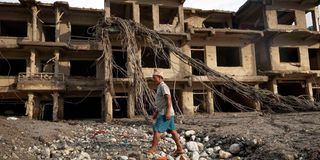
There are moments when the earth speaks in a language and with a level of vicious devastation impossible to forget. The flash floods that hit the Nepal–Tibet border in the Himalayas around the Langtang Himal region and struck the Gyirong border crossing flowing down the Trishuli River valley into Nepal were apocalyptic. At the time of this writing, more than 1,200 people are confirmed dead and nearly 5,000 remain missing.
The glacial collapse sent a wall of ice, water, and rock crashing down into the valleys of Nepal and Tibet. And in a seconds villages vanished, bridges disappeared and families were torn apart.
We have heard warnings about extreme climate events before: flooding, melting glaciers, droughts that will turn to famines, super El Niños. For decades these warnings have come and action is lukewarm at best.
Most of us have never seen disasters arrive like these glacial floods did. And here is the injustice that should keep us awake at night: Nepal, did almost everything right. This is a country that generates close to 80 per cent of its energy from renewables, and is responsible for 0.05 per cent of global emissions. It is a nation that has met its climate commitments with a seriousness few others can claim. It did not cause this crisis. It is simply standing where the crisis landed first.
Confronting climate change
This is what climate change actually looks like “kwa ground”. And the science leaves no room for doubt anymore because we can now trace, with precision, when a disaster is simply natural and when it is attributed to a warming world.
The truth is that the work of confronting climate change can feel invisible, easy to overlook in the noise of daily life filled with climate misinformation & disinformation. But Nepal has just shown us, in the most devastating terms possible, exactly why this work cannot wait. The question is no longer whether we understand the danger. It’s whether we are willing to move as fast as the climate effects are now moving against us.
If we are honest with ourselves this is exactly the moment that Nepal should be getting the support from the opportunities enshrined in the Paris Agreement. But climate finance is not likely to deliver. Today climate finance is too slow, too indirect, and too often out of reach for the countries that need it most. The Loss and Damage Fund, created at COP27, remains a fraction of what disasters like this one actually cost. And pledges are currently in the hundreds of millions against needs measured in the billions.
Adaptation finance, meant to help vulnerable nations build resilience before disaster strikes, consistently falls short of even the modest targets set under the Paris Agreement. And for a country like Nepal, accessing what funds do exist often means navigating years of bureaucratic approval processes, competing against wealthier nations with better-resourced negotiating teams, or taking on new debt just to rebuild what a crisis it didn’t create has destroyed.
This is the paradox at the heart of the international climate finance system: the countries doing the least to cause the crisis, and the most to meet their own commitments, are also the ones least equipped to draw down the resources meant to protect them. Nepal will rebuild homes, roads, and bridges in the coming months, but largely without the scale of international support the moment demands, and largely despite the system built to provide it.
I could not help but ask myself what a crisis of this scale would mean for us in Africa. How do we begin, today, to build the infrastructure that can cushion us against the worst predictions?
Pursuit of climate justice
Next week, from September 7 to 10, Nairobi will host the Pan-African Biennale under a theme that could not be more timely: “Shifting the Center: From Fragility to Resilience.” This gathering will invite a question adaptation too often skips past. What if we designed our cities deliberately around the realities of the places we actually live?
The stakes could not be higher. Africa’s cities have grown at 3.5 per cent annually for two decades, and by 2050 they will absorb 600 million more people, reaching 1.2 billion urban residents. We must build for that future awake to the realities of climate change. Nairobi already knows what one night of heavy rain can undo.
In Cape Town, informal settlements bake under heat that leafier suburbs never feel. But we have proof that another way is possible. Burkinabé architect Francis Kéré shows us buildings can be rooted in the wisdom of their place and still feel gloriously, unmistakably modern. Kigali’s Nyandungu Wetland Eco-Park shows us that reclaiming, not paving over, our waterways is itself a form of design.
Progress does not have to look the same everywhere but it has to work for the people who live there. That is the resilience worth building.
Ultimately, our continued and crucial pursuit of climate justice from the countries that pollute the most cannot be an excuse to wait. We must adapt our cities now, and refuse to let our people suffer a second injustice.
They will be punished first by a crisis they did not cause, then again by our failure to prepare for it. Nepal offers us a painful glimpse into a future none of us can afford. Averting it will demand a genuine, concerted multilateral effort, but the walls, roads, and wetlands we build in our own cities are ours to decide. That much is within our power. And that is where resilience begins.