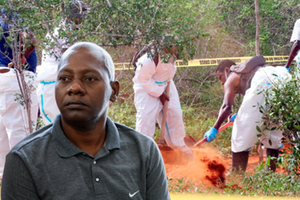
For three years, from late 2019, hundreds of people, including children, were drawn into Shakahola Forest, where what had been presented as a place of spiritual refuge became a scene of mass death.
At the centre of the operation was controversial preacher Paul Nthenge Mackenzie, whose teachings persuaded followers to abandon their homes, livelihoods and establish lives in pursuit of what he portrayed as a divine calling. But the preacher alone did not drive the movement into the forest.
photo 33
Photo credit: File | Nation Media Group
Mr Mackenzie, who was sentenced to 200 years in jail on Friday, November 8, as his co-accused received prison terms of between 140 and 160 years, relied on a network of trusted followers who helped mobilise believers, coordinate their relocation, and enforce the rules governing life in the settlement.
Testimony from survivors, former followers and investigators, alongside digital and other evidence presented in court, has helped reconstruct how the Shakahola tragedy unfolded. It revealed a carefully cultivated belief system, a network of mobilisation and an increasingly isolated community in which even ordinary family decisions became subject to religious instructions.
Live: 200 years for cult leader Mackenzie over Shakahola massacre
The recruitment and mobilisation began long before many of the followers arrived in the forest. Through thousands of WhatsApp messages, audio sermons and other digital material, Mackenzie steadily cultivated fear of an approaching end of the world, warning believers of what he described as satanic forces taking control of governments and other institutions.
The scale of this campaign emerged during court proceedings when Chief Inspector Joseph Kolum, a digital forensics officer with the Directorate of Criminal Investigations, detailed material recovered from Mackenzie's Nokia and Itel mobile phones.
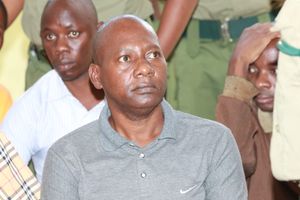
David Amanya Amwaya, one of the 29 accused Persons of Shakahola Massacre.
Photo credit: Kevin Odit | Nation
Using a Universal Forensic Extraction Device (UFED), investigators extracted more than 74,000 pages of WhatsApp conversations dating back to September 2020. The exchanges captured communications between Mackenzie and his followers before and during their relocation to the forest, including discussions about fasting, the end times and preparations for Christ's return.
Kolum told the court that messages recovered from Mackenzie’s phone, some original and others forwarded, revealed how the preacher maintained contact with followers, reinforced his teachings and coordinated the transition from his Good News International (GNI) church in Furunzi, Malindi, to the Shakahola forest settlement.
Evans Kolombe Sirya, one of the 29 accused persons convicted of murder charges alongside Pastor Paul Mackenzie.
Photo credit: Kevin Odit | Nation
After closing the church, which had operated for nearly a decade, Mackenzie presented the move as a divine instruction to abandon established places of worship and pursue salvation in the wilderness. He portrayed the forest as the only refuge from an evil world approaching its end, urging followers to relocate without delay.
“The data revealed recurring conversations about fasting, the Antichrist, the Beast, the coming New World Order and the number 666,” Kolum testified.
Mackenzie warned of satanic forces allegedly infiltrating powerful global institutions and repeatedly told followers: “The church is no longer in your homes; it is in the wilderness.”
Gilbert Kea Katana, one of the 29 suspects charged with murder alongside Pastor Paul Mackenzie.
Photo credit: Kevin Odit | Nation
His instructions extended beyond relocation. He urged parents to withdraw children from school and avoid seeking medical treatment for them, while discouraging women from plaiting their hair, wearing wigs and wearing ornaments.
The recovered messages also showed how he used biblical prophecies to portray modern institutions and technology as instruments of evil, including describing the Huduma Namba identification system as “the mark of the beast”.
Beyond the promise of spiritual salvation, followers were also attracted by the prospect of settling on land where they could practise agriculture and sustain themselves.
George Mwaura, who was involved in the land arrangements, told the court about the allocation of plots to followers who moved into Shakahola. The settlement was presented as an opportunity for believers to establish homes and cultivate the land, giving them a place to live as they awaited the return of Jesus Christ.
Enos Amanya described how jangwani, or the wilderness, was presented as a spiritual refuge for the chosen. Some followers bought land and initially farmed, but the settlement’s purpose gradually shifted from agriculture to preparing for what Mackenzie called their journey to meet Jesus.
Many made significant financial sacrifices, selling property and using savings to acquire land and settle in the forest.
Investigators recovered audio sermons, PDF documents and YouTube links that continued spreading Mackenzie’s apocalyptic teachings, including warnings about the Antichrist, 666 and the end of the world. He claimed God had authorised him to open the church and later instructed him to close it and surrender its registration details to the government, portraying the closure as a transition to the wilderness mission.
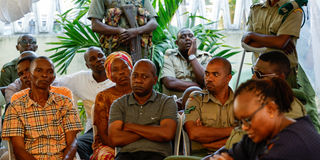
Peter Ramadhani Kahaso is one of the 29 suspects charged with murder alongside Pastor Paul Mackenzie. He is seen here following proceedings during the sentencing.
Photo credit: Kevin Odit | Nation
In Shakahola, followers lived under a tightly controlled hierarchy. Mackenzie divided the settlement into 12 biblically named villages, each led by an appointee. Trusted followers enforced fasting, controlled movement, apprehended escapees, obstructed rescue efforts and helped dispose of bodies.
Mackenzie's second-in-command, Smart Deri Mwakalama, was among the key figures. As the GNI secretary, he helped transport followers into Shakahola, relay instructions, apprehend escapees and supervise burials. The court also heard evidence of his involvement in assaulting a witness.
Stephen Sanga Muye, who headed security, assaulted witnesses, dug graves and reburied the children of Isaac Ngala, a General Service Unit officer who also died in the tragedy.
Evans Kolombe Sirya, a village elder, summoned meetings, participated in assaults and burials, and drafted a land agreement linked to the settlement.
Stephen Ngugi, one of the 29 suspects charged with murder alongside Pastor Paul Mackenzie.
Photo credit: Kevin Odit | Nation
Other security personnel were tasked with ensuring that followers did not leave or receive outside assistance.
Alex Munangwe Odari apprehended escapees, including a witness who later managed to flee the forest. He also guarded fasting areas using clubs and pangas. During rescue attempts, guards moved people undergoing fasting deeper into the forest, making it harder for rescuers to reach them.
Mwinzi Kavenge helped block attempts to reach those undergoing fasting and used violence against people trying to assist them. He attacked a witness with a panga during a rescue attempt.
Stephen Owinde Lwangu, one of the 29 suspects charged with murder alongside Pastor Paul Mackenzie.
Photo credit: Kevin Odit | Nation
Alfonze Chomba Eliud, meanwhile, posed as a Directorate of Criminal Investigations officer to discourage followers from escaping and also transported bodies to burial sites within the forest.
The court's findings further exposed the secrecy surrounding life in the settlement. Mackenzie's teachings discouraged contact with the outside world, while worship and other religious activities were restricted under his instructions. Security personnel were deployed to deal with intruders, whom Mackenzie feared could discover what was happening inside the forest and expose his activities.
Maurice Machacha, one of the 29 suspects charged with murder alongside Pastor Paul Mackenzie.
Photo credit: Kevin Odit | Nation
Even the handling of the dead was organised in a manner that reduced the chances of discovery. Witness accounts and the evidence considered by the court described bodies being buried at night or in the early hours of the morning. Graves were flattened and vegetation planted over them to conceal signs of burials, making them less conspicuous to anyone who might enter the settlement.
The secrecy was reinforced by restrictions on movement and communication, intimidation of those who questioned the teachings and the apprehension of people attempting to leave. Together, these measures created an environment in which deaths could occur, bodies could be buried, and those still alive could remain isolated from potential rescuers.
Other followers also played roles in sustaining the system. Lucas Owino Ogola, a pastor and close ally of Mackenzie, prepared shallow graves for children.
Mark Kiogora Kiara, one of the 29 suspects charged with murder alongside Pastor Paul Mackenzie.
Photo credit: Kevin Odit | Nation
Michael Mweri Baya, a videographer and interpreter of dreams, disseminated Mackenzie's teachings and dug graves. Peter Ramadhani served as a security guard, preventing followers from leaving.
The court also examined the involvement of parents who subjected their own children to the fasting regime. Amanya confessed to fasting and burying his six children.
His wife, Ann Anyoso, withheld food and water from their children, who died. Gilbert Kea Katana converted homesteads into fasting bays, locked his children inside and assaulted a son who attempted to escape.
Titus Munyao Musyoka, one of the 29 suspects charged with murder alongside Pastor Paul Mackenzie.
Photo credit: Kevin Odit | Nation
Titus Munyao Musyoka served as a guard, gravedigger and body transporter. The court heard that he watched as food was confiscated while his seven children died.
These accounts revealed how the system extended from Mackenzie's teachings to the settlement's leadership, security personnel and individual households. While the preacher provided the religious justification for the fasting, those around him helped enforce it, prevent escape, obstruct intervention and conceal the resulting deaths.