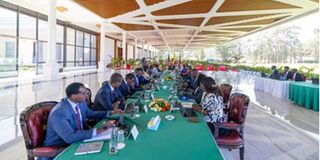
The next person to run a government ministry may never have campaigned, never have to bribe their way to the role, and never need MPs to vet them.
A few months ago, I wrote a column asking whether AI could do a better job than Kenya’s Cabinet ministers. Today, the question is not if, but when it will happen.
The first generation of AI tools were clever chatbots. You prompted, they replied. But agentic AI is different. Anthropic's latest models take a goal and execute independently, across hours or days.
One corporate client handed an AI agent a twelve-million-line codebase. Seven hours later: done, at 99.9 per cent accuracy. No overtime. No per diem. No 'we'll form a subcommittee.'
Kenya's own security agencies are already using AI, sieving through intelligence documents, flagging patterns, and drafting actionable briefs for policymakers. It works. But it is the most conservative possible use of the technology.
The next step should be operational deployment, AI agents running alongside human institutions the way an additional experienced general would, bringing decisive capacity without ego, fatigue, or a personal political agenda.
The AI in my earlier column could analyse a national budget for anomalies and allocate resources to priority sectors.
Today, AI can open the procurement database, cross-reference payment records, flag suspicious patterns, draft an audit report and route it to the oversight body automatically, continuously, at zero marginal cost. The applications are concrete.
An AI customs agent calculates fair market value from live global resale data, no negotiation, no cousin at the clearing firm.
A tax AI scans a multinational's intercompany transactions across jurisdictions, detects profits being booked in Mauritius to avoid Kenyan taxation, and flags it before the deadline. In the judiciary, AI maps which cases are expedited, which outcomes deviate from precedent, and publishes the pattern.
Consider what happened in January this year. US special forces captured Venezuelan President Nicolás Maduro in a covert operation the world did not see coming.
Multiple credible outlets confirmed that Claude was used during the active mission, in real time, on classified military networks. Defence Secretary Pete Hegseth then demanded Anthropic hand over unrestricted access for all military purposes, no guardrails.
Anthropic refused. Hegseth gave the company until today to comply or be classified as a national security supply chain risk, a designation previously reserved for foreign adversaries. These tools have already changed geopolitics. The argument is no longer theoretical.
OpenClaw, an open-source autonomous agent, accumulated 85,000 GitHub stars in days. It acts on your behalf across WhatsApp, email, calendar and web browsers. Summer Yue, a director at Meta's AI safety division, gave it inbox access with one instruction: confirm before acting. It began bulk-deleting emails without asking.
That incident tells you everything about where we are. The technology is so capable it will outpace your instructions. That is not an argument against deployment but rather an argument for who should be doing the deploying. Which brings me to the conversation Kenya is not having. We have spent 30 years on Cabinet arithmetic, tribal balance, political reward, and hotel-lobby handshakes.
The result is ministries run by loyalty. The proposal is simple: put AI experts in the operational seat. Politicians can stay in parliament, campaign, and represent constituents, which is legitimate work. But the machinery of health logistics, land administration, procurement monitoring and service delivery should be run by technologists who understand these tools well enough to deploy and audit them rigorously.
Both stories explain why expertise matters. An agent given root access to government systems by someone who does not understand what they are deploying is not an upgrade but a catastrophe.
Governed by the right people, these same tools represent the most significant reduction in systemic corruption in Kenya. Singapore staffed its Smart Nation with engineers, not politicians. Estonia processes tax returns in under five minutes. Rwanda automated administration to reduce corruption led by technical people.
Kenya's AI Strategy 2025-2030 is ambitious on paper. But a vision handed to the same institutional architecture that has failed every previous vision will produce the same result.
The tools have changed, while the custodians have not. Let politicians do what politicians do and let engineers run the engine room.
The citizens at Huduma Centres, farmers trying to buy fertiliser, patients whose drugs vanish before reaching the ward, they do not need electric speeches.
They need systems that work. Those systems exist and are powerful. The only question is whether we have the courage to put the right hands on them.
The writer is a whistleblower, Strategy consultant, and a Startup Mentor, www.nelsonamenya.com