There are two conversations happening about the war in Iran. One is conducted in the language of international law, treaty obligations, and UN resolutions. The other is conducted in the language of B-2 bombers, bunker-busters, and the Strait of Hormuz. Only one of those conversations is deciding what comes next.
The uncomfortable truth at the centre of global order, the real truth that conference rooms are architecturally designed to obscure, is that rules are precisely as powerful as the consequences attached to them. When the consequences disappear, the rule disappears with it. This is not a modern discovery. It is the oldest observable fact in the organisation of human societies, and no amount of institutional furniture has changed it.
Rome did not build peace through a treaty. Pax Romana was the geographic expression of an army that could reach you. When that army degraded, the peace degraded with it, not because the agreements lapsed, but because the enforcement capacity did. The British Empire's 19th-century order, which suppressed piracy, stabilised trade routes, and enforced contracts across hemispheres, rested not on the moral authority of the Crown but on a Royal Navy larger than the next two combined.
When Britain's relative capacity declined, so did its ability to set the rules. The Americans, who inherited that capacity after two world wars, inherited the rule-making with it. This is not a judgment on those arrangements. It is a description of their operating mechanism. What is less often acknowledged is that this logic does not stop at the border. It runs straight through it.
We speak of international law as though domestic law is fundamentally different, more binding, more reliable, safer. But the history of the 20th and 21st centuries is a long list of constitutions that meant nothing the moment a faction with superior firepower decided they did not.
Libya had a government. Myanmar had a constitution, elections, and a Nobel Peace Prize laureate at its head. Venezuela had one of Latin America's oldest democratic traditions. Rwanda had laws. None of it mattered when the capacity for organised violence shifted. Armed factions do not cite constitutional violations when they take the capital. They write the new constitution.
Even within functioning democracies, what we call the rule of law is, at its foundation, the monopoly on violence dressed in civilian clothes. The police officer enforcing a court order is not a symbol of legal philosophy. He is the physical consequence without which the order is simply a document.
Citizens obey not merely because laws exist, but because there is a credible, coercive apparatus behind them. Remove that apparatus — through collapse, corruption, or capture — and the most beautifully drafted constitution becomes a historical curiosity. Weber understood this. Machiavelli understood it before him. Most statesmen understand it privately, even as they speak differently in public.
This is the mechanism that political theory underplays and practitioners of power never forget: legitimacy is not conferred by documents. It is conferred by the credible ability to defend the arrangement the document describes. When that ability is successfully challenged, whether by a rebel faction in Kinshasa or a superpower in the Persian Gulf, the legitimacy dissolves with it.
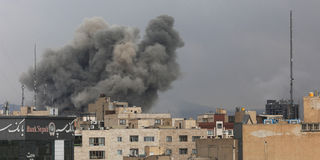
Against this backdrop, the debate over whether the US-Israel strikes on Iran are "legal" is, at best, a secondary conversation. Iran has launched hundreds of missiles and drones in response. It has moved to close the Strait of Hormuz, through which roughly a fifth of global oil transits daily. Six American soldiers are dead. Over a thousand Iranians.
The Senate voted down a war resolution; the bombing continued anyway. These are not the dynamics of a system in which agreements constrain behaviour. They are the dynamics of a system in which behaviour determines what agreements, retroactively, are understood to mean.
Somewhere in all of this, earnest people are citing the JCPOA, the Non-Proliferation Treaty, and the laws of armed conflict. These are not at all frivolous citations, but they are offered in the manner of someone waving a lease agreement at a person who has already changed the locks. The document is real. The situation is also real. They are operating in different registers entirely.
What the Iran conflict illustrates — as Korea, Vietnam, Iraq, and Libya illustrated before it — is that the post-war rules-based order is not a cage that contains great powers. It is a managed vocabulary for describing what great powers have already done. It shapes narratives, holds alliances together, and gives history its official version. But strip away the vocabulary, and the structure is unchanged: capacity determines conduct. The strong act. Then the framework adjusts.
Consider what the post-war order's founding document actually did. The UN Charter's veto mechanism, presented as a safeguard for global consensus, was designed explicitly to ensure that the most powerful states could never be held accountable by it. The architects of that order were not naive. They knew that a rule the powerful would not submit to was a rule in name only. So they built the exception into the architecture and called it governance. That kind of honesty has largely gone out of fashion.
The world does not lack rules. It never has. It lacks consistent consequences. A rule without a consequence is not a rule. It is a preference, formally stated, perhaps unanimously endorsed, perhaps inscribed in marble, but a preference nonetheless. Laws are as consequential as the consequences that follow them, and in international affairs, those consequences have always been calibrated to the relative power of the parties involved.
Iran is learning this again, as it has before. The question is not whether agreements matter. They do, the way traffic laws matter: well observed when enforcement is visible, negotiable in its absence. The real question, in every era, is the same one: who has the capacity to make compliance costly?
That is the rule beneath all the rules. It is not written in any charter. It has no revision history. It has never had a serious rival.