There are seasons when a country’s institutions behave like furniture. Present in the room. Useful when you’re looking for somewhere to rest your elbows, yet quiet when the house is on fire.
And then there are seasons when a few institutions remember what they were built for: to be inconvenient. To be loud. To be precise. To be the annoying friend who grabs your wrist before you step into traffic, and doesn’t care that you’re offended.
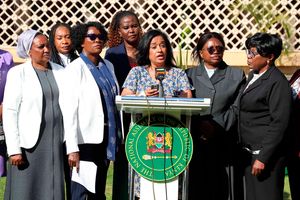
For the last two years, under Faith Odhiambo, the Law Society of Kenya has been one of the few national bodies that consistently acted like the Constitution is not a decorative document. Not a piece of poetry for civic education posters, but a binding contract between the governed and the governors — enforceable, litigable, and worth taking heat for.
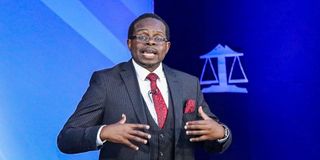
So when Senior Counsel Charles Kanjama was elected as the 52nd President of LSK and tasked to steward the Society for the 2026–2028 term, this wasn’t just a professional milestone for the Bar. It was a national moment.
Because like it or not, in the Kenya we are becoming, LSK may repeatedly find itself as the last clean line on the map as the State steadily tests how far it can push into the Constitution before the Constitution becomes merely “a reference point.” A suggestion.
This is how constitutional erosion happens in real life. With a thousand “small” moves. A shortcut here. A workaround there. A public participation theatre. A directive that becomes policy. A policy that becomes practice. A practice that becomes “normal.” And then, one day, you wake up and realise you’ve been living under a different Constitution — without ever voting for it.
That is why the Odhiambo era mattered so much. It established a precedent that LSK can be more than a welfare union for advocates. It can be a civic institution.
A constitutional pressure valve. A disciplined irritant to impunity. History will record what it chose to speak against, where it litigated, and where it refused to be bribed by silence. It was not a perfect reign, by no means. But it stood up when it mattered. It stepped forward against a State that had chosen to release hell on its youth.
The burden is heavier than a collar and a title. Because a presidency at LSK is equally measured by how well you keep the membership happy, as it is by what you do when the State expects you to behave like furniture.
Kanjama’s campaign language was telling: Rule of Law, Integrity, Practice and Welfare, and Engagement—“RIPE,” he called it. Nice acronym. And simple enough. But this reign needs one more thing. It needs spine — consistently, predictably. Here is the real test: can LSK stay constitution-first even when it is inconvenient to the Bar itself?
Because the State not only attacks the Constitution by breaking it. Sometimes it attacks by exhausting its defenders — dragging them into endless distractions, splitting coalitions, weaponising procedure, and betting that fatigue will do what intimidation couldn’t.
So if Kanjama’s LSK is to matter, it will need to master three things.
First, speed. Constitutional violations are often time-sensitive. The State wins by moving fast — implementing first, litigating later, and then insisting the damage is now “a fait accompli.” LSK must be built for rapid response: legal, media, and coalition, within hours, not dragging over weeks.
Second, clarity. Pick the fights that define the era. Not every scandal deserves equal oxygen. But certain moves, especially those that set precedent, must be confronted aggressively, because they become templates. The State learns from what it gets away with.
Third, institutional courage. This one is simple: the Bar must be willing to be unpopular. In a polarised country, defending the Constitution will sometimes look like “opposition.” Fine. Let it. The Constitution is not a government accessory; it is the cage around government power.
And let’s be honest: the temptation will be to soften. To “engage stakeholders.” To “balance interests.” To become diplomatic at the very moment the country needs blunt.
But Kanjama is not walking into a blank slate. The Society he inherits has already been shaped by a president who refused to be domesticated. Faith stood unshaken through a sustained attack on constitutionalism; she left behind an LSK that Kenyans now watch and count when listing the defenders they can rely on.
A gift, because when LSK speaks now, it can carry national legitimacy. A trap, because the moment it retreats into internal politics, the country will feel abandoned. And abandonment in constitutional seasons is expensive. It gets paid for in court delays, impunity, brutality, and silence.
So, Kanjama, over to you. Your election was decisive. Your mandate is clear.
But your legacy will not be decided in the comfort of meetings. It will be decided in these uncomfortable, inconvenient moments.
In the years ahead, there will be attempts, subtle and aggressive, to redefine Kenya’s constitutional boundaries in favour of raw power. LSK will be invited to cooperate. To “understand the political realities.” To stop being “activist.” To focus on “the practice space.”
But never forget this: when the Constitution is under sustained attack, the practice space for everyone shrinks. For lawyers. For citizens. For journalists. For doctors who speak out. For young people who protest. For ordinary Kenyans who simply want a State that stays inside its lane.