Kenya wants its neighbours to lay out the red carpet for our banks, our goods and our entrepreneurs, yet seems ready to pull up its own when a Burundian arrives carrying a thermos of kahawa and a bucket of kangumu.
We understand the value of an open regional market when a Kenyan business finds customers in Kampala or Juba, but become suspicious of the same principle when a neighbour finds customers in Nairobi.
At the beginning of this month, in front of small traders gathered at State House, President William Ruto made that contradiction explicit, calling for foreign hawkers to close their businesses while distinguishing them from the investors Kenya wanted to attract.
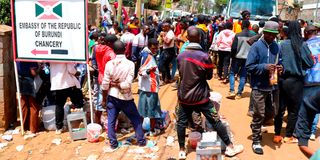
By the following Monday, hundreds of Burundians were queueing for travel documents at their embassy, some reporting threats from neighbours.
The Trade Ministry said Ruto’s directive applied to foreigners operating without work permits. However, that qualification offered little comfort to people already afraid to remain in their neighbourhoods.
Before celebrating this as a significant defence of Kenyan livelihoods, let’s consider how many of those livelihoods depend on the regional openness we are so willing to withdraw from others.
Kenya sold roughly Sh351 billion of goods into the East African Community (EAC) in 2025 and ran a trade surplus of about Sh248 billion, while the regional subsidiaries of Kenyan banks contributed $611.6 million to group earnings.
Our neighbours are customers, borrowers and business partners whose spending sustains Kenyan enterprises, and whose governments could make life considerably harder for those enterprises if they adopted the same political logic.
To cite some examples, KCB alone runs 10 branches in South Sudan: in Juba, Nimule, Rumbek, Aweil and Torit, among other areas. Isn’t it incoherent that we celebrate a Kenyan institution finding customers along the Juba road yet treat a South Sudanese or a Burundian looking for customers in Nairobi as an economic intruder?
The same ambition is taking Kenyan businesses into Ethiopia, outside the EAC altogether, where Safaricom passed 15 million subscribers this month, five years after winning its licence. Kenyan companies need buyers beyond the purchasing power of Kenya alone, and their future depends on other countries accepting that a business with foreign shareholders can still enrich the place it operates in.
Looking at regional integration in East Africa at large, the EAC counts over 300 million people. Integration lets a Kenyan manufacturer plan for a bigger market, spread fixed costs across a larger volume and justify investment that our domestic demand alone would never support. Consumers are also producers, workers and entrepreneurs, and their ability to trade with one another is what turns a large population into a prosperous market.
Aliko Dangote, Africa’s richest man, breaks ground at Lamu on September 30 on a refinery costed at $20 billion, and the arithmetic behind it is entirely regional. South Sudan is expected to supply around 350,000 barrels of crude a day, Uganda 250,000 and Turkana 120,000. Kenya has been offered a 10 per cent equity stake with 30 per cent reserved for the region, and Ethiopia and Rwanda have requested to come in. We cannot plan industries of that shape while encouraging citizens to treat neighbouring populations as unwelcome competitors.
These regional relations are based on our different but interconnected needs. Ethiopia’s need for the sea gives Lamu a further purpose. Kenya has launched construction of the Naivasha to Kisumu to Malaba line and Uganda is targeting financial close on Malaba to Kampala in November, and freight from a larger hinterland gives our railway a better commercial case.
None of this makes the anxiety of a Kenyan trader imaginary. Someone losing customers to a Burundian barber is suffering a real loss, and regional export earnings will not pay his rent. A World Bank study of South Africa between 1996 and 2011 estimated that each immigrant worker generated about two jobs for locals. While this study was based on South Africa, it helps illustrate why migrants must be counted as buyers, founders and employers rather than only as rivals.
Similarly, working outside formal employment does not mean contributing nothing to public services. Kenya Revenue Authority collected Sh2.844 trillion in the year to June, of which PAYE supplied Sh598.8 billion, customs brought a record Sh988.8 billion and domestic VAT Sh355.3 billion. This shows that roughly half of what the State spends arrives through taxes charged at a till or a border and paid by consumers. Kenya should enforce its immigration rules, make lawful registration easy and hold employers accountable whenever they use vulnerable workers to undercut wages.
The government later gave foreign operators 90 days to regularise their situation and warned against harassment, which mattered, and which left the contradiction where it was. Kenya wants the opportunities of a regional economy while indulging a populist agenda that makes regional belonging conditional on wealth. The Kenyan hawker deserves affordable premises, reliable power, credit and a realistic chance of growing into the kind of enterprise that sells across a border and offering him a Burundian to blame is a poor substitute for that.