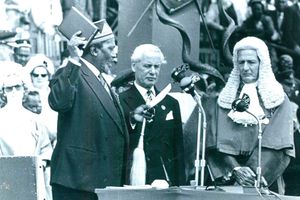
A short video circulated in Kenya this week and set off an argument that has travelled far and wide. In it, a celebrated Kenyan correspondent for a foreign network – a man who did more than almost anyone to amplify the state’s violence against its young people and carry it to the world – stands among the President and the political elite in Kilgoris, laughing loudly, posing for photographs, entirely at ease.
The occasion was the koito of Charlene Ruto and the Tanzanian entrepreneur Isaya Yunge on August 8. The explanation offered afterwards was reasonable enough, that the groom has been his friend for years and a man may attend a brother’s wedding.
For most of the republic’s life, the agenda was set in a small number of rooms by the government, by the firms that bought the advertising and by the newsrooms that decided every evening what the country would discuss over breakfast.
That arrangement has been dismantled by something wider than social media, which is only its loudest quarter, an assembly of bloggers, podcasters, small independent outlets and online organisers, none of whom holds office or draws a broadcasting licence, and all of whom now shape what the country talks about and what its government must answer.
William Dutton of the Oxford Internet Institute named that constituency the fifth estate in 2009, arguing that networked individuals had begun to perform, without anybody’s permission, watchdog functions professional journalism once monopolised.
Afrobarometer’s January dispatch found 77 per cent of Kenyans insisting the media should constantly investigate and report on government mistakes and corruption, with social media now a regular news source for 57 per cent of the country and 71 per cent of the young.
When the Communications Authority ordered every station to stop live coverage of the protests on June 25 last year and officials walked into Limuru to switch off NTV, Citizen and KTN, the country watched anyway, on phones held by young people.
The bodies, the abductions and the names were carried by accounts holding no press card and no lawyer, and the newsrooms that returned to air next morning were reporting a story the crowd had already established.
The reaction to a wedding video has been dismissed too quickly. Nothing about attending a friend’s koito is corrupt and the occasion was personal, of the kind everyone is entitled to, which is exactly what makes it instructive, because a few professions never separate the private act from its public reading.
English law settled the principle a century ago when Lord Hewart held that justice must not only be done but must manifestly and undoubtedly be seen to be done, which is why a judge withdraws from a case in which no bias exists, the appearance of it being injury enough. A correspondent’s authority rests on the same fragile arrangement, lent rather than owned, and this week the lender was reading pictures and doing sums.
The estate handing down these verdicts answers to nobody, which leaves the harder question of who writes its rules. Communities judging their own is the oldest arrangement on this continent, resting on ubuntu, the idea that a person is made a person by other people and answerable to them.
The elders under the tree were held in check by custom, memory and by the certainty of meeting the accused again at the market. The fifth estate is a council of elders several million strong, sitting daily and it holds itself in check by argument alone, since no verdict it reaches goes unopposed for long.
This week produced as many Kenyans asking why influencers are tried while politicians go free as it did accusers. Argument is a real restraint, though it works slowly and tends to arrive after the damage.
The week may turn out to have been about something larger than one man’s Saturday. This republic has always run on personalities, reputations built in a handful of rooms and guarded by everybody holding a key and the arrangement worked because the public could be told what to think of a man rather than shown.
That monopoly is gone. When accountability is spread across millions who keep their own records and owe nobody a favour, the untouchable figure becomes far harder to manufacture, and the question worth carrying into 2027 is whether the age of the personality cult is ending – or not!