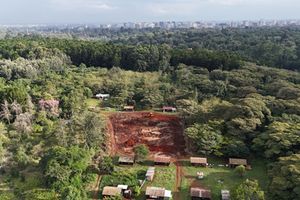
This year the rains came to Nairobi again. Flash flooding caused by heavy rainfall killed at least 66 people, inundated roads across the city, swept away vehicles, and cut power to entire neighbourhoods. Approximately 3,500 households were affected in Nairobi alone, with thousands of residents displaced overnight.
It has become a familiar story. Just two years earlier, the long rains of 2024 had killed 294 people across Kenya and displaced approximately 55,000 households, with Nairobi County bearing the heaviest toll.
The sad reality is that these are a predictable, recurring consequence of a number of solvable failures: the absence of decent, resilient housing for the people who need it most.
When a city grows faster than its housing, it is not the flood that kills. It is the gap between what was built and what was needed.
In Africa, the need for housing is an immediate and pressing concern. Africa's population is currently at 1.5 billion and it is estimated to reach 2.5 billion by 2050.
So often we speak about infrastructure expansion that will be able to serve all these people, but rarely do we speak meaningfully about housing for all people. Our cities in particular are the ones who will feel the strain of this growth as two out of three Africans will live in urban areas by 2050.
This means that Africa’s urban population will double from 700 million to 1.4 billion people becoming the second largest urban population after Asia (3.5 billion). Should there not be adequate housing, the results will certainly be catastrophic.
Already countries in Africa are facing housing backlogs. For instance, Nigeria claims a backlog of 17 million units; in Kenya, the housing backlog is estimated at about two million units; Angola’s backlog is also estimated at just under two million units. We must find the right solutions and also interrogate the task we set ourselves when we say we want housing for all.
In April, about two weeks from now, Nairobi will host the Africa Urban Forum. It will be hosted under the theme: “Adequate Housing for All: Advancing Socio-economic and Environmental Transformation towards the realization of Agenda 2063”.
The forum places housing at the centre of the urban transformation agenda, recognising it as both a social imperative and a strategic economic driver.
Here in Kenya, the idea of housing has taken a political undertone. However, when we look closer at what is really at stake, we find that housing is not merely about how many ribbons can be cut to open a building or how many speeches can be made, but it is about real lives on the ground.
It is about dignity, safety, affordability, and access to essential services. Housing should mean that families can live without a fear of eviction and their children can play in safe conditions and the thriving of communities.
Across the continent, millions of people already live in rapidly growing cities where housing supply has not kept up with demand. The deficit stands at 53 million housing units that are needed today, and this is growing by double-digits every year.
The result has been the steady expansion of informal settlements, and while these communities can be vibrant, they are often exposed to grave risks. Often these informal settlements are carried over from an urban planning that was made by colonial governments which kept cities racially segregated, and by advancing the same after independence, it means people become more and more separated along class lines.
Flooding is one main risk that informal settlements have faced severely in the past month in East African countries. Other risks also come into the fore such as overcrowding, inadequate sanitation and insecure land tenures. These communities remind us that housing requires planning and sustained investment.
The truth is that adequate housing is not four walls, clean air, green space, and living nature. Build without that, and you have not housed people, you have simply contained them.
For example, heat is a growing crisis in housing which lacks greenery. In fact, in the world's biggest capitals, the number of extremely hot days has risen 25 percent since the 1990s. Yet even as heat rises, it does not rise equally.
A Heat Watch campaign in 2024 in Cape Town found that neighbourhoods with densely packed buildings and no trees face temperatures up to 15°C higher than some other areas of the city. Extreme temperatures upend people’s lives, their jobs, and cities’ economies.
There are innovations which can set us on a path of adequate housing that takes into account proper urban planning and the environment. Tools such as WRI’s Cool Cities Lab gives cities what they need to figure out where heat issues are the worst and which solutions can best address them.
It helps cities understand the benefits of cooling and make the case for taking action. For example in densely populated housing areas, a new urban park or increasing street trees and restoring wetlands could work well in easing the lives of residents.
As Nairobi prepares to host the Africa Urban Forum, it is an opportunity to act. Housing must be understood not as something to be addressed in isolation but as something that intersects with climate resilience, economic growth and social inclusion. This will be our path to building cities which are inclusive, sustainable and humane.
Ms Mathai is MD for Africa & Global Partnerships at the World Resources Institute and Chair of the Wangari Maathai Foundation.