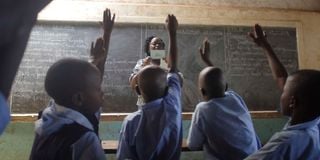
On this International Mother Language Day, as we reflect on the theme “Youth Voices on Multilingual Education,” my heart returns to a school in Nakuru County that is reshaping the future of African education: Freedom International Schools - Africa (FISA). I first walked through its gates in 2018, when it was Children in Freedom School. There were only 20 students then. Today there are over 250, and growing. Fast.
What struck me was not so much the humble size then, but it was the spirit. Every classroom door bore the name of an African hero or heroine: Kwame Nkrumah, Wangari Maathai, Thomas Sankara and on and on. Before a child even sat down to learn, they were reminded: You come from greatness.
And then came the languages. Every child was learning and speaking at least two Kenyan mother tongues. Luo, Kisii, Luhya, Kikuyu, Kamba, Kalenjin, Borana, Meru. In addition, all students learn Swahili and English and have the option to add French, Kenyan Sign Language, and Mandarin.
When I was introduced to the Luo teacher, the Kikuyu teacher, and the Swahili teacher, my heart swelled because I had not seen anything as intentional, deliberate and revolutionary as this in our schools. The Founders of FISA Dr. Utheri Kanayo and Engr. Oku Kanayo-Egbeni made the bold decision to return to Kenya with a conviction that access to education was not enough.
Dr Utheri had completed her PhD in Education at Cambridge University, and as a researcher in the Faculty of Education, she had seen brilliant Kenyan students shrink under an inferiority complex of seeing themselves as less than. Unable to articulate their dreams, not because they lacked intelligence, but because systems had quietly eroded their sense of worth. So they asked a radical question: What if education could affirm identity? What if global excellence did not require the erasure of Africanness?
They built a school on the pillars of affirmation of African identity, global excellence through the International Baccalaureate, and wholeness with dignity. Engr. Oku, drawing from his background as a Computer Engineer with Hewlett Packard, ensured coding and digital fluency were embedded from day 1. This is a school that is both Afrocentric and global. There was something deeply personal in witnessing this.
I remember my own mother, Wangari Maathai, frustrated that she had to reduce her use of Kikuyu at home because the system privileged English. “We wanted you to excel,” she would say every time I asked her “why?”. English became the language of opportunity. Swahili later became examinable. Kikuyu had no chance in an ecosystem like this, and therefore, it was never validated.
We must therefore celebrate the intention of Competency Based Curriculum (CBC) for the opportunity it offers to children to start learning African languages from Grade 4. This is vital. The future of our languages lies with our young people, and it is important that the digital tools of today are employed in enabling them to learn and understand the languages. Dr David Njengere of KNEC calls on us to treat African languages as any global language and for the youth to speak it, write it and be proud of it.
My mother would have loved and celebrated FISA and all it stands for. On this International Mother Language Day, I offer a profound tribute to Dr Utheri and Eng. Oku. Their vision is exactly what this day is about: adding languages to a curriculum and raising confident young Africans who can walk into any global arena without surrendering their roots.
Africa hosts up to 3,000 languages, yet despite this richness, many African languages remain historically suppressed in education and communication. We know very well that the suppression of African languages has its roots in colonialism.
What colonialism did at the time was to make Africans believe that their languages were inferior to the colonisers languages, that they did not include science, philosophies and other complex codes of making sense of the world. Ngũgĩ wa Thiong’o in his book Decolonising the Mind writes, “The domination of a people’s language by the language of the colonising nations was crucial to the domination of the mental universe of the colonised.”
Sadly, this hierarchy of prestige carried on into the post-colonial world. It has left some African languages completely out of the formal structure (until recently), leaving them only to be passed down orally and in deep danger of dying out completely. Imagine the depth of understanding we would lose if our languages were to disappear. Take Nairobi’s Maa name, “Enkare-Nyirobi”, meaning “a place of cool waters.”. In its name is an intimate knowledge of the land’s hydrology and patterns. The name remembers wetlands, springs, and the cooling presence of water long before modern maps did. It encodes observation, relationship, and belonging.
This wisdom is not confined to Kenyan communities. Among the Igbo people of Nigeria, the Iroko tree is deeply revered. Its name carries sacred meaning and commands respect. It is not simply wood for use; it is presence, history, continuity.
Language shapes how we relate to the land and African languages carry generations of ecological knowledge, soils, winds, droughts, plants, water sources. Losing these languages risks losing this wisdom. Africa-centred education, like FISA, empowers youth in their own languages. When their voices are nurtured, they rise. And when they rise, Africa rises with them.
Ms Mathai is the MD for Africa & Global Partnerships at the World Resources Institute and Chair of the Wangari Maathai Foundation.