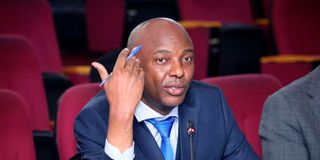
Governor Irungu Kang'ata’s articles are usually just above mine in the newspaper. I see his name, then mine right below it, and I always laugh a little because what exactly am I supposed to say after that?
How do you share space with someone who is out here treating governance like a full-time job in a country where leadership is mostly vibes, speeches, and strategic photo-ops?
If you don’t know him, Kang’ata is the governor of Murang'a County, and the man is exhausting his own people with work. Every other day, there’s something new. Another hospital opened, another school supported, another system rolled out. At this point, people joke that he finished his manifesto early and decided to start freelancing.
Murang’a right now feels like that one group project where one person actually does all the work, and now everyone else looks bad by association.
Once Kenyans see what is happening there, the illusion everywhere else starts falling apart very quickly. The excuses sound weak. The delays start looking intentional. Those big speeches from the other 46 governors begin to sound like what they have always been, noise dressed up as leadership.
Start with healthcare. In most counties, a hospital project is a building that will be launched multiple times, budgeted for repeatedly, and still lacks beds, equipment, or staff. It becomes a monument to procurement instead of service. In Murang’a, hospitals are built and equipped. Patients walk into facilities that function.
Education follows the same pattern. Across many counties, support for schools exists mainly in press releases and staged visits. In Murang’a, that support shows up in ways parents and students can feel through resources, systems, and continuity. There is an effort to make things work and to keep them working.
Then there is the part that unsettles the political class. Kang’ata has not turned himself into the brand.
Kenyan politicians are deeply attached to their own faces. You will find them everywhere on water tanks, market stalls, school buses, and even uniforms. Every project becomes a reminder of who to thank. Public funds build the project, and then more public funds brand it with the image of the leader.
Murang’a feels different. There are no giant portraits staring down at residents as they access services.
That difference shifts the focus back to service instead of personality, and once that shift happens, everything else becomes harder to ignore.
Across the other 46 counties, the same cycle keeps repeating. Budgets are passed, funds are allocated, and somewhere along the line, everything starts thinning out. Audit reports keep flagging the same issues.
Hospitals sit half-built or fully built but empty. Equipment is procured at exaggerated costs and left unused. Patients are told to bring their own basic supplies into facilities that are fully funded. Health workers strike over unpaid salaries while county officials move around in fleets purchased under the banner of service delivery. Roads exist beautifully on paper. On the ground, they break apart with the first rains or never appear at all.
There is also the performance side of governance, which many counties have perfected. Groundbreakings come with full media coverage. Launches come with speeches, banners, and applause. Social media pages remain active and polished.
On the ground, the gaps show. Markets built at high cost sit empty because no one thought about how they would function. Youth programs are announced but never reach the youth. Bursary funds meant for vulnerable students become political tools or arrive too late to matter. Garbage piles up in towns.
Then come the trips. Benchmarking visits abroad that produce little beyond allowances and photo opportunities. Delegations flying out to study systems that never get implemented back home.
Kangata’s performance removes the comfort that underperformance has relied on for years. When everything is broken everywhere, failure feels normal, and expectations drop. But when one county starts delivering consistently, comparison becomes unavoidable.
Murang’a changes the conversation. It shows that the resources have always been there. Every county receives funding. The systems exist. The framework exists. What has been missing in many places is priority.
When leadership is focused on extraction, projects turn into procurement opportunities, budgets reward networks, and service delivery fades. When leadership is focused on delivery, systems respond.
That shift is visible in Murang’a, and it is raising uncomfortable questions across the country. Why are some counties still struggling to equip basic health facilities?
The rest of the country has the resources. What remains is the choice to use them well or continue pretending that this is the best Kenya can do.