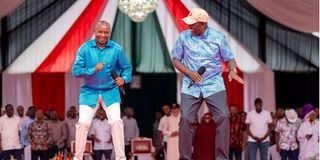
President William Ruto and his deputy Prof Kithure Kindiki dance on the podium during the disbursement of Nyota business start-Up capital to 5,880 young entrepreneurs at Jomo Kenyatta Showground in Mombasa on February 6, 2026.
In 2007, as Japan Airlines haemorrhaged money under the weight of a debt approaching Sh1.16 trillion, its chief executive Haruka Nishimatsu cut his own salary by 60 per cent, taking home just 11.7 million a year, a figure lower than what his own pilots earned.
He gave up his executive dining room, bought his suits at a discount store, rode public transport to the office, and joined his employees in the cafeteria queue. No bodyguards. No reserved parking. No perks. And when his workers noticed, morale shifted and this led to one of the most dramatic corporate turnarounds in modern history.
Now consider Kenya: an ordinary Member of Parliament earns a gross monthly salary of Sh739,600. Once car maintenance allowances, mileage claims, and sitting allowances are added, the total can reach Sh1.5 million a month, making Kenyan legislators the second-highest-paid lawmakers in the world relative to their economy, according to a joint study by the UK’s Independent Parliamentary Standards Authority and the International Monetary Fund. The same study found that Kenyan MPs earn 76 times the country’s GDP per capita.
President William Ruto preaches “living within our means” while his State House budget has reportedly ballooned from Sh 8.58 billion to a projected Sh17 billion in the current financial year.
Deputy President Kithure Kindiki’s office received an additional Sh420 million in the supplementary budget. Foreign travel for state visits has already exceeded its annual parliamentary allocation of Sh1.8 billion by Sh400 million, with the total potentially reaching Sh5.3 billion by June.
Meanwhile, six new government state departments were quietly created mid-year, while the administration publicly celebrated scrapping 47 state corporations in the name of austerity.
William Ruto’s office alone spent an average of Sh2 million per day on printing during the last financial year, according to the Controller of Budget.
Lee Kuan Yew understood something that Kenya’s leaders have refused to grasp. When he assumed the prime ministership of newly independent Singapore in 1959, a city-state with no natural resources and a per capita income of barely $500, he made personal integrity and sacrifice the first pillar of his governance.
A World Economic Forum reflection on his legacy put it plainly: people follow leaders into the unknown only when there is a foundation of trust, and that trust is born out of personal incorruptibility and moral authority.
Yew did not merely legislate against corruption but lived against it. Within a year of taking office, his government passed the Prevention of Corruption Act and held ministers to an iron standard of accountability. Singapore, an aid recipient from Australia and New Zealand less than fifty years ago, today earns twice the per capita income of both countries.
Three thousand kilometres from Singapore’s waterfront, Paul Kagame rebuilt Rwanda from the rubble of the 1994 genocide through a similar conviction: that governance without sacrifice is governance without legitimacy.
Rwanda’s annual GDP growth averaged seven per cent between 2000 and 2020. Poverty rates fell from 77 per cent in 2001 to 38 per cent by 2020. Kagame has explicitly cited Singapore as his model, describing his ambition to make Rwanda the Singapore of Africa.
The results are visible in Kigali’s clean streets, its plastic bag ban that Rwandan citizens actually observe, and a civic culture built on the credibility of its leadership rather than the mere authority of its offices.
You cannot summon a collective national consciousness from a population being squeezed from every side while watching its leaders expand their budgets.
The ask of the Kenyan government of citizens—to pay more taxes, endure higher costs of living, work harder, and invest in a shared future—requires a social contract. Social contracts are built on trust. And trust, as both Singapore and Rwanda demonstrate, must be earned visibly, not asserted from a State Lodge.
Nishimatsu’s own words are worth repeating: “We in management should work for the front-line people. It is the front-line people who are working for the customers.”
Applied to governance, the translation is blunt: those in power work for the citizenry, not the other way around. A government that builds new state lodges while public hospitals run out of drugs is not a government that citizens will willingly sacrifice for.
A parliament whose members earn 76 times the average Kenyan’s annual income will not inspire a taxi driver in Gikomba or a hawker in Kisumu to believe the system is worth preserving.
County governors who travel in convoys and host lavish functions at taxpayer expense will not convince a nurse on a Sh30,000 salary to deliver public service with pride.
The path to a first-world Kenya does not run through budget lines, development masterplans, or PPPs alone. It runs through the collective will of 55 million people who have decided this country is worth building together.
That decision will not be made in a vacuum. It will be made, or withheld, by what citizens observe in their leaders every single day. Change the example at the top, and the culture below shifts. Maintain the example, and no amount of taxation will close the distance between what Kenya is and what it ought to be.
Follow our WhatsApp channel for breaking news updates and more stories like this.
The writer is a whistleblower, Strategy consultant, and a Startup Mentor, www.nelsonamenya.com