Paul Oduor had barely pulled down the iron door of his garage in Grogon on Kirinyaga Road when the water came for him.
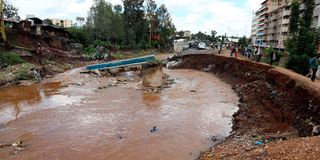
By morning on March 7, rescue workers were pulling bodies from the same street. By the time Kenya stopped counting, at least 45 people were dead, 26 of them in Nairobi alone.
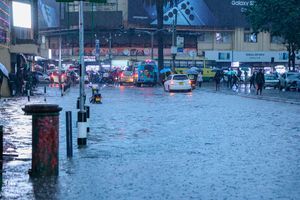
Cars lay submerged on Uhuru Highway. Rivers consumed roads in Mathare, Kibera, South B and C, Roysambu and Westlands. Flights were diverted to Mombasa. A substation flooded and the lights went out across the Industrial Area.
For nearly 48 hours after the floods struck, as 26 Nairobians drowned or were electrocuted in his county, Sakaja stayed off-camera.
He finally emerged on Citizen TV’s Sunday Live on the night of March 8. What followed was a performance rather than direction.
He cited inconsistent figures on overhauling drainage. Challenged on his absence, he offered this: “I am not a firefighter.” When asked if he would resign, he said: “I am not resigning, I’m working.”
He accused other leaders of politicising the floods but spent the rest of the interview doing exactly that.
The Kenya Meteorological Department had issued its heavy rainfall warning on March 3, four days before the deaths.
When I lived in an apartment block on Raphta Road in Westlands around 2017, the building sat directly against what should have been riparian land. The developer had fenced off the riverbank, the narrow channel that separates Riverside Drive from Raphta Road, leaving the river itself a constricted, unmanicured gutter. Our parking, which in any lawfully planned city would have been a buffer zone, sat on that riparian land.
On the other side of the river, a swimming pool belonging to another development occupied the same protected ground. When the heavy rains came, both sides flooded without ceremony. The car park drowned. The pool merged with the river. Worse, because the channel had been squeezed so thin and left unmaintained, the stormwater had nowhere to spread. It accelerated downstream at terrifying speed, tearing into walls and structures further along its path. Some of those walls collapsed.
Rotterdam sits mostly below sea level, one of the most flood exposed cities in the world. Its Climate Change Adaptation Strategy redesigned the urban landscape around three functions: absorb, protect and recover.
Green roofs, permeable pavements and underground cisterns were built into new developments as standard. The flagship Benthemplein water square sits at the heart of the city. For most of the year it functions as a skatepark and public square. When the rains arrive in force, its three sunken basins become attenuation tanks, capturing large volumes of stormwater.
In July 2011, a cloudburst dropped up to 200 millimetres of rain on Copenhagen in two hours, causing about €1.6 billion in damage, the most expensive natural disaster in Europe that year. The city responded with the 2012 Copenhagen Cloudburst Management Plan: 300 surface projects across eight catchment areas over 20 years, combining drainage tunnels with nature based solutions at street level.
Nairobi does not need to look far for where to start. The Aga Khan Walk sunken car park in the CBD flooded to halfway up parked vehicles last week. That geometry, an open, below grade public space at the heart of the city, is precisely what Rotterdam’s engineers designed Benthemplein to be: usable public space on dry days, engineered flood storage when the rains arrive, funded through the drainage budget. The Globe Cinema Roundabout, Africa’s largest at 250 metres in diameter, sits directly above the Nairobi River, adjacent to the 12 hectare Michuki Memorial Park along the riverbank, a ready made blue green drainage spine for the northern CBD, currently serving as a matatu holding ground notorious for muggings.
Then there is Uhuru Park’s artificial lake, a feature of the city since 1969, which could be deepened into a genuine CBD flood buffer. Rotterdam’s Museumpark underground cistern holds 10,000 cubic metres of stormwater beneath an active car park. Nairobi can do the same.
The money spent on repeated emergency response is not an alternative to investment but one with no return.
Ruto controls the national budget and the Kenya Defence Forces, both deployed this month not to build but to search for bodies. Sakaja knows, or maybe not, where the drainage needs to go. He told three different television audiences, with three different price tags, that he knows exactly what the problem is. What he has not done, in three flood seasons since he won the seat, is fix it. Identifying a problem on a Sunday night television programme, two days after your city has buried its dead, is not leadership. It is just conmanship, and Nairobians have had enough of the con games.
The writer is a whistleblower, strategy consultant and a startup mentor, www.nelsonamenya.com