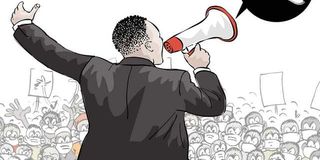
The politician who can most effectively identify who has wronged the anxious worker may win the ballot.

You can often tell what kind of leader a man will be by the pronouns that dominate his speech. Grammar does not determine how a leader governs, but it can reveal where he places agency, blame and responsibility before policy is written. In public life, decisions fall into three patterns. One says, “I will decide, and I will carry the burden.” Another says, “They caused this, and they must be stopped.” A third says, “We have this problem, and we must solve it together.”
The first seeks obedience. The second seeks an enemy. The third seeks participation.
The “I” leader places himself at the centre of every solution. His language is filled with promises that he will build, save and fix what others could not. His strength becomes inseparable from the state.
Nebuchadnezzar provides the ancient warning. Standing over Babylon, he attributed the city’s greatness to his own power. The story that follows is one of humiliation: the ruler who imagined himself the source of greatness discovers that power without humility can become weakness. The examples matter less than the pattern: concentrated power weakens institutional correction.
Then there is “They.”
The “They” leader governs by naming an adversary. His vocabulary is populated by people who have stolen from us, betrayed us or plotted against us. The enemy may be foreigners, elites, dynasties, bureaucrats, protesters or an unnamed conspiracy. The target changes. The mechanism does not.
Fear mobilises faster than hope.
The attraction is obvious. A citizen struggling with unemployment does not need a 20-page explanation of structural transformation. He wants to know who is responsible. “They” provides an answer immediately.
But an enemy can explain a problem without solving it. That is the fundamental weakness of “They.” It can win power. It cannot, by itself, run a country.
Famine approaches
Then there is “We.”
The “We” leader is less theatrical because he distributes responsibility. “We will build.” “We will measure.” “We will reform.”
The biblical Joseph is the clearest illustration. When famine approaches Egypt, he does not search for an enemy. He counts, stores and plans. Grain is accumulated during plenty so society can survive scarcity. The important word is not even “we”, but the institutional meaning behind it. Joseph creates a system that can outlast the moment.
That is what developmental leadership can do. Lee Kuan Yew’s Singapore, Deng Xiaoping’s China and Park Chung-hee’s South Korea achieved extraordinary economic transformation through state capacity, institution-building and long-term planning. Their success came not from using the right pronouns, but from building systems capable of delivering results.
But “We” is not a magic word. A dictator can say “we” and still mean “I.”
The real test is what the pronoun reveals. Does “we” mean citizens participating in institutions, or merely citizens being asked to obey? Kenya’s own experience offers examples. Mwai Kibaki’s presidency moved from turbulence towards recovery, with growth rising sharply and free primary education bringing more than a million children back to school. Makueni under Kivutha Kibwana demonstrated how county government could improve revenue collection and expand access to healthcare. The underlying idea was important: government is not simply something done to citizens.
That is the difference between rhetorical “We” and institutional “We”. The first is a speech. The second is a governing method.
And that brings us to 2027.
This may not necessarily be a builder’s election. Builders emerge when populations are exhausted by conflict and begin valuing competence over confrontation. Kenya experienced something like this in 2002 after 24 years of Moi.
Kenya in 2026 is not exhausted. It is anxious.
That anxiety has three sources: the payslip, the street and the response. Housing deductions, health insurance and pension changes arrive every month. The state touches income before the citizen does. The Gen Z protests of 2024 showed that a decentralised youth movement could force the government to retreat on a Finance Bill within days. That was a psychological shock.
Build 10 dams
Then came reports of violence and the alleged use of organised groups against protesters, creating another layer of anxiety. Citizens now fear both unrest and force in response to unrest.
An electorate that fears its payslip and its street does not necessarily ask who will build 10 dams. It asks who will protect it and who will punish those responsible.
That is why “They” has an advantage going into 2027. For the government, “they” can mean foreign-funded anarchists. For the opposition, “they” can mean the administration accused of squeezing household incomes and using force. Each side can construct its own enemy.
But after the election, the enemy does not disappear.
The unemployed youth is still unemployed. The payslip still arrives. The hospital still needs medicine. The grain still has to be stored.
The politician who can most effectively identify who has wronged the anxious worker may win the ballot. But the politician who cannot move from “They” to “We” after winning will discover the limits of anger.
Campaigning asks who is responsible.
Governing asks: what do we do now?
The real test of Kenya’s next president will not be whether he can say “I” with confidence or “They” with fury. It will be whether, after the votes are counted, he can make “We” mean something.
Not “we” as a slogan.
“We” as a budget.
“We” as a functioning hospital.
“We” as a school that teaches.
That is the difference between winning an election and building a country.
Follow our WhatsApp channel for breaking news updates and more stories like this.
Dr Francis Kang’ata is the Governor of Murang’a County. Email: [email protected]