Because of the adage that fortune favours the bold, President William Ruto has pitched turning Kenya into a First World country in the next 30 years as his life’s mission.
There are many examples Kenya is encouraged to emulate, including Singapore, Malaysia, South Korea and Japan—and it seems that citizens will be passengers on that train.
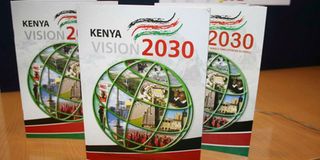
Some 25 years ago, the country was dragged kicking and screaming into ownership of the ambition in Vision 2030, which seeks to make Kenya a globally competitive and prosperous nation.
That Kenya, a mere five years away, is supposed to be a newly industrialising, middle-income country providing a high quality of life to all its citizens.
If Vision 2030 is the mid-point in the journey to First World status, a review of progress would reveal how realistic the dream destination is. Five out of the 44 flagships under Vision 2030 have been completed, two—the Lamu coal power project and Galana Kulalu irrigation scheme—have stalled or been cancelled, while 37 are reportedly ongoing.
Vision 2030 progress reports and the 2024–25 Scorecard avoid a single percentage score, but sifting through the polite lexicography of “ongoing” and “substantially implemented”, the emergent pattern is that the easy things have moved; the hard ones have not.
With five years left on the clock, Vision 2030 has entered that awkward phase in every Kenyan development plan where the speeches become louder because the results are harder to explain.
The country has undeniably changed—yes, there are new roads, substations, digital platforms, and an alphabet soup of new agencies. But physical visibility is not the same as economic transformation.
Kenya has done well where the state needed to marshal equipment, contractors and ribbon-cutting ceremonies. It has expanded energy and constructed roads; and ICT is now the bloodstream of public service.
These are Vision 2030’s low-hanging fruit. If development was measured purely in kilometres of road or terabytes of data, Vision 2030 would be a runaway success.
However, ribbon-cutting projects rarely deliver the structural change Kenya has postponed. Industrialisation will not happen by televised state address. Social transformation does not emerge from slogans.
Vision 2030’s hypothesis is that if the country has gleaming infrastructure, its people will be rich and happy. The big promises around universal health coverage, equitable education and decent jobs remain further ahead.
Yes, the Social Health Authority has launched. ICT has marched into classrooms. Public services have stepped further into the digital age. But the country is still transforming landscapes, not lives.
Vision 2030’s real ambition—the one that warmed hearts in 2007—was to turn Kenya into a newly industrialising economy with factories humming; farms irrigated; and value added before export. Manufacturing was supposed to be powering jobs, not declining in its contribution to GDP.
Employment—the clearest test of economic health—continues to elude millions. It is in these transformative sectors that require discipline, long-term financing and political resolve that Kenya’s performance looks threadbare.
Few things delight the Kenyan politician like a megaproject: the flyover, the port, the expressway, the technocity. These are the glitter of development—shiny, quick to commission, easy to photograph—but they also deliver rewards in the form of kickbacks.
Becoming a First World country does not turn into reality because of wishful thinking. The examples of transformation often cited are not miracles willed into existence by lofty speeches. They have emerged from a brutal honesty, ruthless discipline and a bureaucracy that abandons mediocrity as its defining value. Kenya continues to negotiate with mediocrity every day.
The skyscrapers and stable currency in the nations Kenya seeks to copy have been built by habits that are sorely lacking: competent government, strict execution, predictability, meritocracy and intolerance for corruption. In the unglamorous trenches, corruption is waiting, the rule of law is on pause, and coherent planning is a luxury.
These pathologies are what drive Kenya to push manufacturing one day and chase digital nomads the next; rediscover agriculture one week and launch a new special economic zone the week after so that it is abandoned the following month. From the political stumps, promises are being made to reverse critical policies. Such an environment does not just confuse investors; it exhausts them.
Kenya does, indeed, have the human talent, material resources and ideas to become a First World country. What it lacks is the one ingredient successful states insist on: more commitment to progress than to politics. The last mile of this dream demands political honesty, fiscal discipline and a willingness to confront the sectors the country continues to tiptoe around.
The next five years offer Kenya a chance to finish the Vision 2030 house rather than keep planting flowers around the veranda. What would be worse is to abandon it and replace with a grander vision to leapfrog into First World status without doing the work.
The writer is a board member of KHRC and writes in his individual capacity. @kwamchetsi; [email protected] .