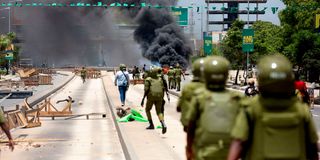
Tanzanian riot police disperse demonstrators during violent protests that marred the election following the disqualification of the two leading opposition candidates in Dar es Salaam, Tanzania, October 29, 2025.

A curfew, threatened public protests and a pervasive climate of fear are overshadowing this year’s commemoration of Independence Day in Tanzania on December 9.
Tanzania has cancelled three previous Independence Day celebrations — twice under President John Magufuli and once under Samia Suluhu Hassan ostensibly to redirect funds to infrastructure — but this year’s non-event is a humiliating acknowledgment of the inability to face the public and confront rising dissent.
Officials holding the instruments of state seem consumed with serving up repression, oblivious to their loss of legitimacy in the face of rising continental and global condemnation. Their retreat from the public sphere is a cautionary signal to the world — Tanzania’s descent into authoritarianism demands continued attention.
Under the cover of severe media restrictions, internet shutdowns and official demands for major tech companies to clamp down on voices perceived as being critical of the regime, Dodoma has in recent weeks continued to deploy violence, mass arrests, enforced disappearances and killings as its choice tools of governance.
All indications are that the state is setting the stage for another round of violence that will be hidden under the cover of darkness.
Workers face reprisals
So far, gunshot survivors are reportedly being moved from hospitals into mortuaries to hasten their departure from this life while health workers face reprisals for attending to the injured. Bodies have been removed from mortuaries that are being erased, and mass burials conducted in secrecy while families are denied the rites of closure for loved ones they have lost.
Religious institutions offering sanctuary and assistance to the injured have been targeted with violence.
Ironically, four heads of state from the East African Community were in Washington last week at the signing of a peace deal between Rwanda and the Democratic Republic of Congo, but maintained a studious silence on Tanzania. The silence of the powerful notwithstanding, Tanzania’s younger generation, frustrated with the direction of the country, has been talking back through memes, mimicry and social media posts. And for their trouble, the state has charged hundreds of students, drivers, mechanics, entrepreneurs, social media personalities and minors with incitement, treason and terrorism.
Lawyers defending detainees are being arrested, families searching for missing loved ones are threatened or detained, and civil society organisations providing legal or humanitarian support are being labelled as criminal.
Fuel restrictions further expose the state’s insecurity. Authorities capped fuel sales to tuk-tuks and boda boda riders at just two litres per vehicle, ostensibly to limit mobility ahead of planned protests. Such policy only betrays a deeper crisis of confidence in a government whose oxygen is coercion rather than consent.
Public opinion increasingly reflects distrust, anger and rejection among citizens dissatisfied with repression, lack of democratic choice and personal economic hardship. Independent assessments, such as the Bertelsmann Transformation Index 2024 country report, highlight restrictive laws that have frustrated multiparty democracy and made political stability dependent on coercion.
Afrobarometer’s Round 10 survey of Tanzania last year showed that while many citizens appreciated official efforts to manage the economy, a significant portion of the population was still grappling with unpredictable incomes, inadequate access to water, healthcare and essential services. The data from that survey suggested that a majority of the population believed that the country was headed in the right direction, even though public health emerged as the top concern, particularly in rural areas, highlighting a stark divide. The economic optimism that coexisted uneasily with everyday hardship is, however, fast dissipating.
The official response to this evident crisis of public confidence has been to attack digital spaces through internet shutdowns, social media throttling, takedown of testimonies, and pressure on social media platforms in an attempt to silence critics and erase any record of crimes.
Break resistance
The weaponisation of the law and digital platforms is designed to break resistance — but it is instead strengthening Tanzanians’ demand for justice, and waking the world to the horrors happening before its very eyes.
The administration’s desperation shows in how often it has changed tune on who to blame for its troubles. From attempts to deflect blame to foreign bogey’s to exploiting religious divides, there is a belief among Tanzania’s elite that it can continue to rely on repression, targeted restrictions, and political expediency to maintain stability.
Within Tanzania, a segment of youth has begun identifying as ‘Chrislims’, a playful yet powerful synthesis of Christian and Muslim identities, to demonstrate interfaith solidarity. Similar initiatives reflect a conscious effort to transcend sectarian divides, even as the state attempts to weaponise identity for political gain.
Across the region, youth in Uganda and Kenya are watching closely, and so too must their governments. Tanzania’s missteps are a cautionary tale and a potential rehearsal for what could befall their own countries during upcoming elections.
The crisis Tanzania faces is unlikely to be tamped down by authoritarianism and another massacre, and its friends must help those in power to come to that realisation.
The writer is a board member of the Kenya Human Rights Commission. @kwamchetsi; [email protected]