Picture a swamp island at the tip of a peninsula, malarial, tin-roofed, ringed by slums that flooded every monsoon season, with no natural resources beyond a deep-water harbour and a population its own colonial masters considered unfit to govern itself. That was Singapore in 1959.
Out of that swamp, a Cambridge-trained lawyer named Lee Kuan Yew built a nation that would outrank the empire that had colonised it. His first act in office was a wardrobe choice. His newly sworn-in ministers walked into their council chamber that June dressed head to toe in white shirts and slacks alike, a costume chosen deliberately to declare, before a single policy had been written, that purity and honesty in public life were conditions of employment rather than aspirations.
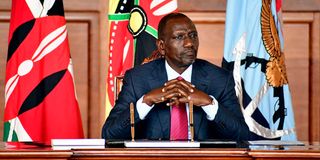
Sixty-six years later, President William Ruto stands before Kenyans and reaches for that same Singapore, the same miracle of will and discipline, as the horizon towards which he claims to be steering the country.
However, in a tweet aimed at critics questioning the government’s tolerance of graft, David Ndii, who is the chief government economist, said: “Let me restate. We will leave Kenya as corrupt as we found it. On this Sunday, I suggest you contemplate your own life and leave the other sinners to contemplate theirs.”
The remark was consistent with something Ndii had told Citizen TV years earlier, explaining why the Kenya Kwanza campaign kept its distance from graft as an issue: “We said we are not running on an anti-corruption ticket, we are running on a bottom-up economic platform.”
Ruto’s repeated invocation of Singapore thus raises an uncomfortable question, since the man running his economic policy has publicly abandoned the very premise Lee Kuan Yew treated as foundational.
Lee treated a clean government as the precondition for growth. Writing of the region Singapore emerged from, he described the ordinary texture of corruption in Southeast Asia in the 1950s and 60s — travellers delayed at airports until bribes changed hands, traffic police extorting cash for alleged speeding, hospital admission after an accident requiring payment before treatment began.
It could pass for a diary entry from Nairobi, where clearing customs still carries an unspoken tariff, where a traffic stop can still turn into a roadside toll the uniform was never meant to collect, and where priority in a public hospital after an accident still depends on what a family can produce in cash.
Kenya gained independence within a year of Singapore’s self-government, inheriting comparable colonial administrations and comparable temptations. One nation decided, at the level of its founding leadership, that the temptations would be fought. The other decided, at the level of its current leadership, that they would be managed and, where convenient, ignored. That decision, repeated across six decades, is the entire distance between a first-world economy and a third-world one.
Lee’s Corrupt Practices Investigation Bureau, inherited from the British in 1952, was redirected to concentrate on big takers in the higher echelons rather than small fry alone. The 1960 amendments gave investigators power to examine the bank accounts of suspects and their families, made proof of living beyond one’s means admissible as corroborating evidence of a bribe, and widened the definition of a gratuity. High-profile ministers were caught roughly one per decade between the 1960s and the 1980s, proof that Singapore’s political class was never less venal than anyone else’s, only more exposed to consequence.
Inclined towards corruption
Kenya’s Ethics and Anti-Corruption Commission finds the evidence and builds the file, then watches it die between investigation and courtroom, a pattern visible across the twenty-five high-profile cases rights groups say have been withdrawn in the past three years, 18 of them between 2023 and 2025 alone.
Lee also insisted that a clean government began with candidates who did not need vast sums to get elected, since money spent buying power is money later extracted to repay itself. Kenya’s election costs run into the billions of shillings, and politicians who borrow their way into office arrive already indebted to whoever financed them, leaving the public purse as the obvious place to settle accounts.
None of this means Kenyans are more inclined towards corruption than Singaporeans were in 1959. Human ingenuity in converting power into personal gain is universal. What separates Singapore from Kenya has always been the will of the men at the top, and whether they chose, at the founding moment, to make honesty cost something to violate.
Kenya faced that exact choice once already, in 1963, and its founding generation chose patronage over discipline, a choice every administration since has renewed rather than reversed. Ruto inherited that same fork in the road and, through his own chief economist, has chosen it again, in public, without the courtesy of pretending otherwise. A country cannot announce its journey from third world to first while re-enacting the precise failure that made it a third world in the first place. It amounts to deception, and Singapore’s name deserves to be left out of it.
The writer is a whistleblower, strategy consultant and startup mentor. www.nelsonamenya.com