This week, on April 1st, I paused to honour what would have been my mother’s 86th birthday and felt her presence most powerfully in the stories she left behind.
She had a gift for storytelling, and in many ways, that gift lives on in the remarkable work of talents like the Too Early For Birds (TEFB) crew: a group of extraordinary talents dedicated to staging Kenyan biographical productions that breathe life into our stories.
They remind us that the past, rather than being behind us, is the very lens through which we understand who we are today.
And this weekend, from April 10 to 12, 2026, TEFB takes the stage with a production on the life of Wangari Maathai drawn from the living memory of my mother’s own story. To see her life reflected in theatre, embraced by a new generation of storytellers and witnessed by new audiences, will be to understand that a life well-lived multiplies and continues to inspire.
Chinua Achebe, the great Nigerian author wisely told us that until the lions have their own historians, the history of the hunt will always glorify the hunter. Why is this important today? Because the proliferation of misinformation and disinformation is epic.
In the age of social media algorithms, artificial intelligence, and the 24-hour news cycle, “hunters” have never had more tools at their disposal. We are living through an epidemic of misinformation and disinformation so vast and so sophisticated that it has become one of the defining crises of our time. The goal is not merely to deceive.
It is to overwhelm and exhaust, and to make truth feel so elusive that people simply stop looking for it. Imagine for a minute what this means for this charged political electioneering season we are experiencing in Kenya and beyond? A moment when the hunters have never had more powerful, more precise, or more insidious tools at their disposal.
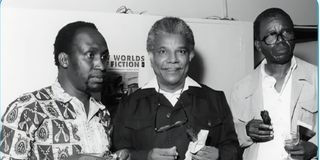
The late Nobel Peace laureate Prof Wangari Maathai.
Photo credit: File | Nation Media Group
By the time the truth catches up, the damage is done. When the only stories that are amplified are stories of destruction, when the algorithm rewards despair and penalises hope, when the voices of those quietly, courageously rebuilding the world are drowned out by noise, we are left with what the writer Chimamanda Ngozi Adichie called the danger of a single story. And when a single narrative dominates, it can create a sense of helplessness.
That’s why stories matter and must be told. If we never hear of the communities planting forests in the face of forest destruction and desertification, the activists rebuilding democracies, the ordinary people refusing to surrender their dignity and their environment to those who would exploit both, then we begin to believe that resistance is futile. That nothing can be done. That despair is the only rational response to the world as it is. That is precisely what those who benefit from injustice want us to believe. This is why storytelling is crucial. Stories shape not only how we see the world, but how we can imagine a better world, and our place in it.
For a long time, Africa had been subjected to reductive storytelling portrayed through the narrow, distorting lens of conflict, poverty, and fragility, as if these were the continent’s defining characteristics rather than chapters in a far richer, more complex story.
These narratives were harmful then, and they continue to be harmful today. Consider the so-called “African Premium” that punishing price African countries pay to borrow money on international capital markets simply because of perception.
When global investors and credit rating agencies view an entire continent through the lens of instability and risk, they demand higher interest rates to lend to African governments and businesses. This is not necessarily because the fundamentals warrant it, but because the story they have been told demands it. Narrative becomes policy.
Stereotype becomes economic reality. Research by Africa Practice and Africa No Filter lays bare the staggering scale of this injustice: Africa could be losing up to $4.2 billion in interest payments annually, not because of poor governance or weak economies alone, but because of the stubborn persistence of negative stereotypes that distort how the world values African opportunity. The cost of a bad story, it turns out, can be measured in billions.
These narratives limit policy and concentrate power in ways that ensure Africa is perpetually spoken about rather than spoken for. And perhaps most insidious of all is what happens when these stories travel inward. When harmful external narratives begin to shape how Africans see themselves.
When a young person grows up in a world that consistently tells them their continent is broken, their history is tragic, and their future is uncertain, the most dangerous outcome is not what the world believes. It is what they begin to believe.
In her memoir Unbowed, my mother wrote of the landscape she grew up in: the rivers, the fig trees, the hills of Nyeri draped in a green so vivid it felt like a living thing. That description shaped me because she talked about it all the time.
It deepened my love for Nyeri in ways I carry to this day. And so the question before us is this: which stories need to be told now? We must elevate the stories that ignite action and expand what we believe to be possible.
Ms Mathai is MD for Africa & Global Partnerships at the World Resources Institute and Chair of the Wangari Maathai Foundation.