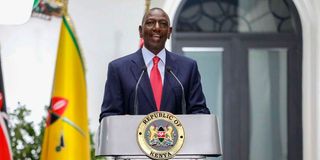
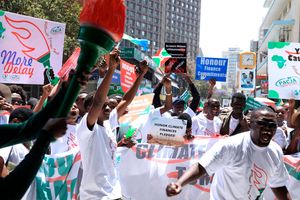
Unlike his predecessor Uhuru Kenyatta, whom critics merely urged to “Maliza uende” (finish your term and leave), President William Ruto faces a harsher political reality.
His prospects for re-election are polling at numbers equivalent to the temperature of a comatose patient. Yet, in stoic fashion, he has chosen to look beyond the next election and invited Kenyans to begin imagining a successor to Vision 2030: a national ambition to propel the country into a high-income industrialised nation status by 2060.
Every nation needs a horizon beyond the next budget, election and the administration that comes after. Countries that think in generations prosper. Those that think only in election cycles merely change governments. But how does a president persuade a nation to dream about the next 30 years when a majority of its citizens are unconvinced by his stewardship of the present?
National visions are not government documents; they are acts of public faith. They ask millions of citizens to suspend today’s frustrations and invest emotionally in a shared tomorrow. They require trust that today’s sacrifices will produce rewards tomorrow. A vision developed in the absence of trust risks becoming another government brochure rather than a national covenant.
Vision 2030 was launched in 2008 at the start of the term of the Grand Coalition government. It was a delicate consensus document that promised to transform Kenya into a newly industrialising, middle-income country offering a high quality of life to all its citizens. It was conceived as Kenya’s development compact—a blueprint that would outlive administrations, parties and personalities.
Five years before its destination, however, the scorecard tells a mixed story. Only five out of 44 flagship projects have been completed. Others have stalled, been cancelled or remain described reassuringly as ‘ongoing’ or ‘substantially implemented’. Vision 2030 appears destined to reach its endpoint as an unfinished project.
Responsibility for that outcome is not difficult to assign. Between them, Uhuru and Ruto have shaped Kenya's budgetary priorities for almost two-thirds of Vision 2030’s lifespan. Whatever the achievements in roads, electricity, ports and digital infrastructure, the deeper promise of structural transformation—industrialisation, quality employment, value addition and shared prosperity—remains unfinished.
Governments enter office on the basis of trust. They can nurture it or squander it. Every unfulfilled promise makes the next promise harder to believe. The danger, therefore, is not simply that Vision 2030 may remain incomplete but that its unfinished business will be the lens through which Kenyans will view Vision 2060.
The first victim of political distrust may well be the country's ability to think beyond the next election. Nothing is wrong with asking what Kenya should look like in 2060. If anything, the conversation is overdue. Nations that stop imagining their future soon begin basking in the glories of their past. But nations dream best when they trust the people asking them to dream. Before anyone debates Vision 2060, they will debate the Ruto presidency. Every proposal will be read through the prism of his presidency and every aspiration measured against his record. The debate will likely shift from the content of the vision to the fortunes of the man presenting it. That would be a serious disservice to national planning.
Long-term development strategies ought to be insulated from the fluctuations of presidential popularity. They should command confidence across political parties, generations and regions because they are understood to belong to the nation rather than the government of the day.
Kenya has not always protected that distinction. The country has quietly abandoned the vocabulary of national planning for the language of presidential branding. Vision 2030 was gradually eclipsed by the Big Four. The Big Four was in turn eclipsed by the Bottom-Up Economic Transformation Agenda.
Every administration invented a new vocabulary that persuaded the country that development belonged to the president rather than the nation. The result is that national planning became hostage to electoral politics. Every change of administration invites a new slogan, a new flagship programme, a new promise of transformation.
Vision 2060 deserves careful handling. If it is perceived as Ruto's political project, it will inherit his political baggage. A national vision is never launched in a political vacuum. It enters into the accumulated memory of broken promises where the future is difficult to disentangle from history. Before Kenya’s leadership asks its citizens to believe in Vision 2060, it must reckon honestly with what Vision 2030 has become.
The country certainly needs another conversation about its future. It could still be grappling with the unfinished business of Vision 2030 while simultaneously poisoning the atmosphere in which it ought to be dreaming about 2060. But perhaps the first question is not where Kenya should be in 2060; it is whether the country can create the trust necessary for that conversation to belong to all Kenyans rather than to one presidency.
The writer is a board member of the Kenya Human Rights Commission and writes in his individual capacity (@kwamchetsi; [email protected] ).