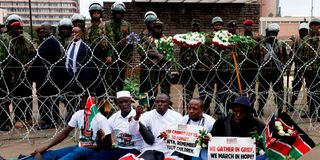
Police officers stand behind a razor wire with flowers placed on it, as protesters chant during demonstrations to mark the second anniversary of the 2024 anti-government protests, in Nairobi on June 25, 2026.
This is an angry piece on disappointment, not one of Philip Ochieng’s overlearned columns. I don’t know whether my Sociology classmates at Egerton – Choti, Kasire, Mkala, Ndambuki, Munene, Analo Makonjio, etc – remember Emile Durkheim and the term he coined for circumstances when a society’s rules stop making sense to the people living under them. Anomie.
It applies to moments when the moral scaffolding collapses and citizens no longer believe the game is winnable by honest effort. Today, millions of Kenyans wake up, work, pay, queue, obey and feel, correctly, that none of it is buying them a stake in the republic their fathers fought and some died for. Are we even Kenyans? Do we belong, or are we just but metaphorical monkeys, swinging on the trees of this “paradise” of affordable housing, “world class healthcare” and flyovers, taxed to death, suffering and dying poor?
The Public Service Commission’s audit of 253,318 national government jobs found the Kalenjin (17.3 per cent) and Kikuyu (20.5 per cent) communities overrepresented, the former by four percentage points, in a country of more than 40 tribes. Of the first 51 principal secretaries appointed in this administration, 13 were Kalenjin and 13 from Central Kenya, that’s half of all such jobs shared between two communities. Are people like you and me, who are not from the right tribe, only fit for the salt mine, gulag or the grave?
Youth joblessness
You are unemployed, so are your children and so will be their children after them. Because the privilege of making a living is not for everyone. The Federation of Kenya Employers puts unemployment among Kenyans aged 15 to 34, a third of the population, at a staggering 67 per cent. The Kenya National Bureau of Statistics’ 2025 survey found youth joblessness above 16 per cent even on its narrower definition, with over a million new job-seekers entering the market annually and more than 80 per cent absorbed only into the Jua Kali economy. Meanwhile, the tenders keep flowing to a handful of players; even the empowerment scheme for youth, women and the disabled is routinely hijacked through proxy registrations.
Taxation, our daily portion, is the sharpest edge of the alienation. We wake up in a cold sweat every day to a barrage of texts and emails from the Kenya Revenue Authority, telling us in graphic detail the nasty things it is going to do to us: block our PINs, freeze our accounts, seize our income. The tax collector, in chasing its Sh2.63 trillion target through “aggressive” audits and enforcement, forgets that we are not the “makwerekwere” in South Africa.
And what does that money buy? Rural and Urban Private Hospitals Association members say they are owed roughly Sh30 billion in unpaid claims, a crisis that has seen 66 per cent of nurses and 56 per cent of clinical officers sacked and many facilities scaled down. Where does the money collected go?
In Kiambu, a five-month doctors’ strike with 164 newborn deaths and 14 maternal deaths – figures Health Cabinet Secretary Aden Duale tabled in Parliament, though the county government disputes them as “inflated”. Health is allocated less than 4 per cent of the national budget while 67 per cent of revenue is set aside for the more urgent business of servicing debt; debt which people have gone to court to dispute.
Fighting graft
Parliament, meanwhile, admits it is for sale. Chief Whip Silvanus Osoro confessed that opposition MPs were paid and flown abroad to be absent for the 2023 Finance Bill vote; a UDA legislator separately claimed Sh2 million was the going rate per supporting vote. A senator recently described impeachment battles as “soko huru” (open market) after one governor allegedly spent over Sh300 million buying his own survival.
Corruption is not incidental to this picture; it is the picture. Transparency International’s 2025 Corruption Perceptions Index dropped Kenya nine places to 130th out of 180 countries, scoring 30 out of 100 – below the sub-Saharan African average. Afrobarometer finds seven in 10 Kenyans say government is doing a poor job fighting graft, and trust in the presidency and Parliament has been sliding for a decade. When the Ethics and Anti-Corruption Commission does raid a home, staggering amounts of cash are seized: Sh65.3 million from a Nairobi planning officer, Sh615 million in assets by a county cleaning services boss, hundreds of millions traced to a governor’s office tender.
In this our land and nation, dissent meets force, not dialogue. The Missing Voices Coalition recorded 104 police killings in 2024 and 125 in 2025. Amnesty International has documented 128 deaths, 83 enforced disappearances and 3,000 arbitrary arrests since June 2024, and Human Rights Watch counts 41 protest-linked Kenyans still missing. Courts are simply ignored: the Inspector-General of Police was found guilty of contempt for defying orders to account for abducted men and the Law Society of Kenya filed a fresh contempt application against government just last month.
Amnesty also documented a network of roughly 20 paid bloggers, earning up to Sh50,000 a day, manufacturing pro-government trends and abusing critics online, vicious frontline soldiers of the propaganda-disinformation industrial complex.
We wade in disillusionment in this land of anomie. If you have found hope, please point us to the way.
Mr Mathiu is a communications consultant and farmer. [email protected]
Follow our WhatsApp channel for breaking news updates and more stories like this.