President Netumbo Nandi-Ndaitwah of Namibia is one hell of a woman. She is undoubtedly the greatest and truest leader in service on the African continent today.
She sees the current needs and the future prosperity – and independence – of her country with a fierce clarity. For example, she is clear that land of Namibia belongs to her people, not to settlers, and those who massacred Namibians in colonial times must pay reparations, otherwise an apology without restitution is just noise. In her view, sovereignty is not a gift dispensed at G7 tables but a condition that precedes every other negotiation. It is a refreshing, unapologetic approach which many leaders claim to subscribe to at night but whose actions during the day are anything but.
African nations have to work their way through a dense mass of entrenched interests, the threat of violence, sabotage and assassination, untold greed, racial prejudice and historical entanglements to chart a path through this global morass to a good future for their people. From what I see, especially in online interactions, I think the foreign powers and their people generally think we are simple minded (“borderline retarded” is the common insult). A prosperous and independent Africa is, of course, not good for business and it is something that they actively work against.
Africans have taken four broad approaches to deal with this complex and existential reality. There are many of us who are genuinely simple-minded, we believe all foreign people are very nice Father Christmas types with our best interests at heart and we trust them completely. The second cohort sees reality for what it is and have the courage to get in the cold sea of deceit with the sharks, eat the crumbs, learn the tricks of the game and wait for a chance to eat something big. And then there are those like Namibia and the ring of rebellion in West Africa who call the world what it is and defy it. The fourth category is the worst of all and consists in a minority of ruthless Mobutus. They get in the water with one intention, to look out for number one, they prey on their own kind and, in the unlikely event a chance presents itself, on the other sharks too.
Macron’s “civilisational” nonsense
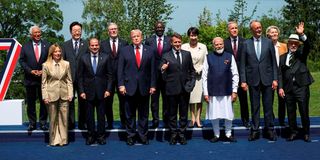
The picture of President William Ruto, in a very nice suit, seated among the leaders of the world’s seven most powerful economies in France is still on all our minds. From social media, it appears that he arrived in a luxurious private jet, a Gulfstream, and was airlifted to the town where the meeting was taking place in a military chopper. The sight of our president mixing it up with the big crocodiles was indeed a moment of national pride. A lot of folks responded to it with hearty self-congratulation; they feel that we have arrived. We are invited, welcomed, swimming the global waters with the big fish. But you must ask yourself: welcomed as what, exactly?
The man doing the invitation – Emmanuel Macron of France – told the world at the G20 in Hamburg in 2017, with the calm confidence of a man reading a weather forecast, that Africa’s problems are “civilisational”. That we are held back not by history, not by architecture, not by the elegant machinery of extraction that Europe spent four centuries perfecting on our bodies and our land, but by something essentially wrong with us.
Macron’s “civilisational” nonsense is the oldest of colonial lies, that Africa is poor and desperate because of what Africans are, not because of what was done to Africa. Of all colonial powers, France was among the worst. Not only did it colonise parts of Africa, it engineered Africa’s dependency and then patented the maintenance contract. The CFA franc – that immoral instrument of monetary servitude – still holds 14 African nations in a financial chokehold, their reserves warehoused in the French Treasury, their monetary policy set in Paris.
Leaders of extraordinary discipline
The path of managed engagement – attend the summits, collect the pledges, service the debts, diversify the partnerships (China, Gulf states, the new multipolar players), and gradually, incrementally, molecularly shift the terms – requires that we are honest about what we are doing. We are managing dependency, not ending it. And it requires leaders of extraordinary discipline and backbone, who can sit at Macron’s table without becoming Macron’s projects. Such leaders are few and far between.
The other path is the Namibian path – a full-throated assertion, first and without precondition, of total sovereignty. The insistence that reparations, monetary reform and genuine economic independence are not radical demands but the minimum conditions for a conversation between equals.
This path carries real costs. Markets punish it, former colonial powers freeze it out. It demands sacrifice from populations already exhausted by sacrifice. But it is the only path whose destination is freedom.