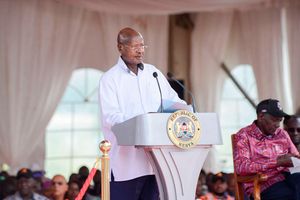
Somali referee Omar Abdulkadir Artan, who was expected to officiate at matches during the 2026 FIFA World Cup but was denied entry to US, addresses fans at the Mogadishu stadium, in Mogadishu, Somalia, June 10, 2026.
Walk around Nairobi today, stop at a café, or wander through a hotel lobby, and you are likely to hear Somali-Canadian musician K'naan's "Wavin' Flag". The familiar soaring melody has made a surprising comeback 16 years after it served as the soundtrack to Africa's World Cup in South Africa in 2010.
"Wavin' Flag's" popularity extended beyond the World Cup by two or three years, and by the 2014 tournament in Brazil, it had long fallen off the top charts. Its resurgence, nevertheless, could be explained by football nostalgia, given that the World Cup is currently on in Canada, Mexico, and the US, one might argue. Well and good, but then why didn't it rebound in 2018 during the World Cup in Russia, or in 2022 during the World Cup in Qatar? This suggests that beneath the celebratory surface lies a deeper cultural undercurrent.

In the streets of Nairobi, especially among the Kenyan capital's growing and vibrant Somali community, the song might have transformed from a standard anthem of hope into a protest and a defiant homage to one who never got to step on a World Cup pitch in the US: Omar Abdulkadir Artan.
Artan, a 34-year-old native of Mogadishu, the Somali capital, had achieved the impossible. Navigating roadside bombs and other perils just to reach training sessions in a war-torn capital, he rose to become the Confederation of African Football's (CAF) Men's Referee of the Year in 2025.
In April, he was handpicked by football's world governing body Fifa to officiate at the 2026 World Cup, and he was set to become the first Somali in history to do so. They hadn't reckoned with US President Donald Trump's government, a man who delights in showing off his contempt for Somalia, and other Africans, for that matter.
Despite holding a valid visa, Artan was denied entry at Miami International Airport on June 6 while travelling for World Cup duty. He was held for 11 hours of additional questioning.
Weaponising song by Somali refugee
He flew back to Mogadishu and was met by thousands at the airport. His dream ended not because he lacked merit, but because of the politics of his passport. In Nairobi, many people didn't just get upset; they turned to K'naan's lines and poetry.
One reason "Wavin' Flag" fits this moment so perfectly is that one needs to look beyond its catchy hook and examine its guts, as it were. K'naan wrote the song about growing up amidst the ruins of conflict in Mogadishu, waiting for a freedom that always seemed just out of reach.
Nairobi and the Somali community are executing a clever bit of cultural irony. Canada, Mexico, and the US are currently hosting a tournament meant to symbolise global unity, yet America chose to erect exclusionary borders against one of Africa's top sports officials.
In response, a corner of Africa is weaponising a song by a Somali refugee, K'naan, to cross western borders, achieve global stardom, and create the definitive anthem for Fifa’s premier event. When K'naan sings, "When I get older, I will be stronger / They'll call me freedom, just like a waving flag," it is no longer just a pop song. It has turned into a musical middle finger to the idea of Fortress America.
Washington can bar a Somali from entering a physical stadium, but it cannot bar Somali brilliance from the tournament's cultural landscape.
That is because, if the story of the 2026 World Cup for Somalis began with a border-control crackdown, its vindication is being written on the playing field by Taha Ali, a dazzling 27-year-old winger tearing up the flank for Sweden.
Classic football fairy tales
While Artan was barred from entry, Ali arrived in North America with a Swedish passport and a bold statement to make. He was born in Stockholm to parents who escaped the chaos in Somalia.
His journey to the top of the tournament feels like one of those classic football fairy tales. Just six years ago, he wasn't even playing proper 11-a-side football. He was shaking up the local Swedish futsal leagues instead. That small-sided, indoor background is exactly what makes him easily the most exciting player in the Swedish squad. Futsal demands near-impossible improvisation, lightning-fast decision-making, and close-quarters ball control.
Arab commentators, some of the most colourful and dramatic there are, and sports analysts have taken to calling him the "Neymar of Somalia".
For some of the crowds watching in Nairobi and across the global diaspora, Ali's presence in the iconic yellow and blue of Sweden is bittersweet but deeply triumphant.
Somalis will forever remember the 2026 World Cup for the injustice dealt to Omar Artan. But through the sweet comeback of K'naan's music, Ali's brilliant football, Ali on the fields of America, the message is that they remain unbowed. Borders may stop an individual, but they can never contain the culture. The flag keeps waving.
Some might well be thanking Trump for the "gifts". Certainly, without him, Artan wouldn't have returned to a frenetic welcoming crowd of thousands waving the flag and a meeting with the president if he had been allowed to blow the whistle.
The author is a journalist, writer and curator of the Wall of Great Africans. X@cobbo3