Coffee sold through the weekly Nairobi Coffee Exchange (NCE) fetched a record Sh38.74 billion in 2025 as prices hit an all-time high, fuelled by global shortages and soaring demand for Kenya’s premium beans.
Analysis of the Kenya National Bureau of Statistics (KNBS) data shows that 41,561,910 million kilogrammes were traded at the auction in 2025, at a record price of Sh932.19 per kilo.
This was an improvement from 2024, where some 44,871,490kg of coffee was sold at an average price of Sh658.81 per kilo and fetched a total of Sh29.56 billion.
The gains in price and earnings followed a global slump in supply after production disruptions in key markets linked to climate change challenges, which lifted prices across international markets.
The bulk of Kenya’s coffee, which is much sought-after by roasters and blenders, is sold through the Nairobi Coffee Exchange (NCE), even though farmers have a window to sell it directly to buyers abroad.
Kenya’s coffee calendar runs on two distinct harvests. The main crop, which produces the bulk of the premium beans, is picked between October and December before heading to the NCE for auction from January to April.
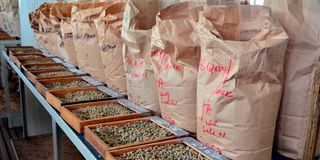
Coffee beans on display for auction at the Nairobi Coffee Exchange (NCE) at the Kenya Planters Cooperative Union (KPCU) along Haile Selassie Avenue.
Photo credit: File | Nation Media Group
Mid-year, farmers turn to the fly crop, a smaller but still significant harvest gathered between June and August and traded at the exchange from August to October.
Together, the dual seasons keep Kenyan coffee flowing to international buyers almost year-round, sustaining the country’s reputation for high-quality Arabica.
The KNBS data shows that the total quantity of coffee sold under auction at the NCE in the 2023/24 season rose by 27.5 per cent to 41,617tonnes, up from 32,652 tonnes sold in 2022/23 due to changes in regulations during the period under review.
However, the quantity of coffee sold under direct sales decreased by 29.6 per cent from 9,350 tonnes in 2022/23 to 6,583 tonnes in 2023/24.
“The total quantity of coffee sold under both auction and direct sales was 48,200 tonnes valued at $ 229.55 million (Sh29.61 billion) in the period under review, a 14.8 per cent rise from 42,001 tonnes valued at $176.43 million (Sh22.76 billion) in 2022/23,” the regulator said.
Belgium was the main export market for Kenya’s coffee in the 2023/24 crop season, toppling the US and tipping investors on the opportunities in the European country, which is currently registering a steady growth in consumption of the beverage, driven by an expanding specialty products.
Belgium bought 8,275.79 tonnes of Kenyan coffee worth Sh7.42 billion in the 2023-24.
This performance saw Belgium pip the US, which imported 7,917.13 tonnes of coffee from Kenya worth Sh6.68billion in 2023/24 and equivalent of 16.09percent of Nairobi’s exports of the commodity for the season.
A picture showing Kenyan coffee.
The US was the top buyer of Kenyan coffee in the 2022/23 season, where it bagged 11,228tonnes worth Sh7.93billion to account for a 23.41percent share of the East African nation’s total exports of the beverage.