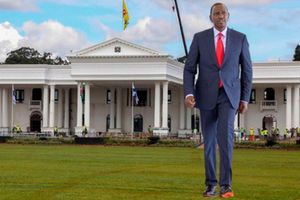
President William Ruto’s Kenya Kwanza administration has borrowed at least Sh3 trillion in the last three years it has been in power, in what compounds the country’s debt stock.
A Central Bank of Kenya (CBK) document presented to the Public Debt and Privatisation Committee of the National Assembly indicates that in the financial year 2021/22, when President Ruto took power, the country’s debt stock stood at Sh8.7 trillion.
The document by CBK Governor Kamau Thugge indicates that as at June 30, 2025, the public debt had escalated to Sh11.81 trillion, a growth of 17 percent, with a higher reliance on domestic financing, highlighting rising debt service pressure on the country’s fiscal sustainability.
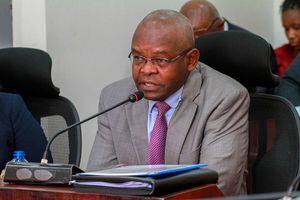
Central Bank of Kenya Governor Kamau Thugge at his office in Nairobi on June 21, 2024.
Photo credit: Wilfred Nyangaresi | Nation Media Group
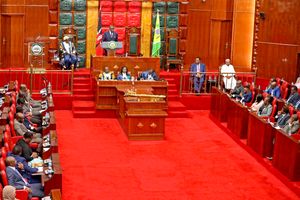
“Recent borrowing targets have been quite ambitious as the domestic market continues to support growing budgetary financing requirements,” the CBK document presented to the committee chaired by Balambala MP Abdi Shurie, reads.
However, the CBK document does not show the projects that were financed by the Sh3 trillion borrowed within the first three years of the Kenya Kwanza administration.
The country’s debt stock includes Sh6.33 trillion in domestic loans and Sh5.5 trillion in foreign financing.
President Ruto was sworn into office on September 13, 2022, following the August 9, 2022 General Election on the promise of instituting fiscal consolidation reforms to ensure debt sustainability against an economy that had been blighted by drought, floods and the Covid-19 pandemic.
President William Ruto displays the sword after receiving the instruments of power from his predecessor Uhuru Kenyatta during his swearing-in ceremony at Moi International Sports Center, Kasarani on September 13, 2022.
Photo credit: File | Nation Media Group
In the financial year 2020/21, the country’s debt was Sh7.7 trillion before increasing by Sh1.1 trillion in the 2021/22 financial year.
In the 2020/21 fiscal period, the foreign debt accounted for a greater percentage, which stood at Sh3.999 trillion against the domestic borrowing’s Sh3.7 trillion.
The fiscal consolidation efforts that President Ruto undertook to put in place would have been critical in reducing the government’s appetite for debt accumulation and lowering the ratio of debt to GDP that currently stands at 69 percent, according to the CBK data.
In October 2023, parliament effected amendments to the Public Finance Management (PFM) Act, replacing the Sh10 trillion public debt numerical ceiling with a GDP ratio of 55 percent in Net Present Value (NPV) terms.
The increase in interest payments on domestic debt reflects Kenya’s growing reliance on domestic borrowing, which has crowded out Small and Medium-sized Enterprises (SMEs) from cheap credit.
For instance, in the 2020/21 financial year, the government paid Sh388.8 billion in domestic interest, which increased to Sh456.8 billion in the 2021/22 fiscal period, Sh533.1 billion in 2022/23 financial year, Sh622.5 billion in the 2023/24 period before hitting Sh776.3 billion in the 2024/25 financial year.
Although Dr Thugge says that the public debt remains sustainable to the economy, he admits that it faces “a high risk of debt distress.”
This means that the country may not be able to honour its payment obligations in the future amid missed revenue targets, partly caused by the government’s unpopular policies.
This as domestic interest payments increased by 24.7 percent to stand at Sh776.3 billion in the 2024/25 fiscal period from Sh622.5 billion recorded in the financial year 2023/24.
This was largely due to higher interest obligations on Treasury bonds and reflected the composition of the domestic debt.
The CBK document further shows that the domestic interest payments accounted for increasingly greater shares of ordinary revenue and expenditure, highlighting the rising debt service pressures on fiscal sustainability.
Despite fears of crowding out SMEs from cheap credit, Dr Thugge reveals that the government will continue to implement reforms to strengthen domestic debt market resilience amid “mild uptick in short-term obligations”.
Among the measures the government has implemented to mitigate risks in the domestic debt portfolio include the broadening of the investor base to enhance market resilience and reduce concentration risks.
The others are diversifying the product offering to cater for different market segments and improving access and efficiency in the government securities market.