President William Ruto’s Sh5 trillion plan to elevate Kenya to “first world” status will partly hinge on the success of the government’s push to convert some State corporations into commercial enterprises.
During his State of the Nation Address on Thursday, President Ruto said the government will establish the National Infrastructure Fund, “whose architecture will be underpinned” by reforms in the Government-Owned Enterprises (GOEs) Bill, 2025, which he signed into law on Friday.
The reforms include privatising some GOEs while ensuring the State retains not less than 50 per cent shareholding. The intention is to allow private sector participation and capital injection to turn them into profitable entities.
Although the government has not disclosed how much it expects to raise from these privatisations, proceeds will be channelled into the new infrastructure fund to finance capital-intensive projects as the country pushes towards first world status.
“A government-owned enterprise shall operate as a commercial entity and shall operate for profit, be self-financing, self-sustaining and be accountable to the public through the National Treasury,” the law states, adding that GOEs may also perform public functions.
Privatisation of the Kenya Pipeline Company (KPC), expected to raise Sh100 billion, is already under way after National Assembly approval of the policy paper.
Also signed into law during the ceremony at State House, Nairobi, on November 21, 2025, were the County Governments Additional Allocations Bill, 2025, the Capital Markets (Amendment) Bill, 2025, and the Provisional Collection of Taxes and Duties (Repeal) Bill, 2025.
Best governance practices
The GOE Act establishes a rigorous framework for setting up GOEs, with enhanced corporate governance and performance management to secure their long-term commercial sustainability. A GOE is defined as a self-financing, self-sustaining company engaged in commercial activities, wholly or majority-owned by the State, and assigned financial and operational powers to conduct business.
The law repeals several existing statutes governing commercial State bodies - including the Agricultural Finance Corporation Act, the Kenya Airports Authority Act and the Kenya Literature Bureau Act - and makes consequential amendments to the Tourism Act.
By enabling the government to assign specific, funded public service obligations to GOEs, the law allows the State to leverage private-sector-style efficiencies in public service delivery “where necessary”. In addition to generating their own revenue, GOEs will draw funding from the National Treasury for assigned public functions.
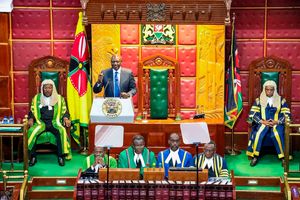
President William Ruto delivers the State of the Nation address at Parliament Buildings, Nairobi, on November 20, 2025.
Photo credit: Lucy Wanjiru | Nation Media Group
The law applies to existing and future GOEs, all of which will be public limited companies established under the Companies Act. It lists 65 existing companies and 18 statutory entities currently undertaking commercial activities, including AFC, KAA and the Postal Corporation of Kenya. It excludes statutory bodies without commercial mandates.
“The Government-Owned Enterprises Act is a landmark reform introducing best governance practices in the management of State corporations,” President Ruto said in a dispatch from State House.
GOEs will now be required to operate for profit and remain self-sustaining, ending reliance on exchequer support that has long fuelled inefficiency, duplication and debt.
Among the entities to be converted into companies are the Kenya Broadcasting Corporation (KBC), National Cereals and Produce Board (NCPB), KAA, Kenya Ports Authority (KPA), Kenya Railways Corporation (KRC), the Agricultural Development Corporation (ADC), the Kenya Literature Bureau (KLB), National Housing Corporation (NHC), Kenya Meat Commission (KMC) and the National Mining Corporation (NMC).
Any proposal to establish a GOE must include a detailed feasibility study demonstrating commercial viability and requires Cabinet approval. Each GOE will have a nine-member board, including six independent directors selected through a transparent, competitive process by an independent panel. The board will elect its chair from among the independent directors.
Boards must competitively recruit a qualified CEO to handle day-to-day operations and will be supported by a Certified Public Secretary to ensure adherence to corporate governance standards.
Re-energise capital markets
Each GOE must adopt an annual business plan aligned with its strategic plan. This plan will form the basis of annual performance contracts between the Treasury Cabinet Secretary and the GOE, informing performance targets and strengthening commercial discipline. The Treasury will also establish a performance incentive system for GOE boards, with boards doing the same for CEOs and staff.
The Act permits the government to assign funded non-commercial public service obligations to GOEs, subject to Cabinet approval and merit-based evaluation.
To safeguard public assets, staff and resources during the transition to the new regime, the law includes savings and transitional provisions. The Auditor-General must audit, publish and publicise a report on each GOE before any transfer of assets, liabilities, contracts or staff.
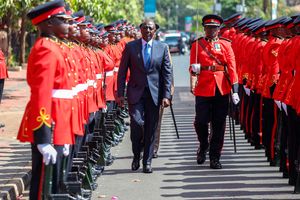
President William Ruto inspects a guard of honour mounted by the Kenya Defence Forces along Parliament Road, Nairobi ahead of the Sate of the Nation address on November 20, 2025.
Photo credit: Dennis Onsongo | Nation Media Group
The County Governments Additional Allocations Act provides Sh70.6 billion in extra funding to the 47 counties in the 2025/26 financial year, including Sh9.98 billion for settling salary arrears for doctors and Community Health Promoters (CHPs) and completing County Aggregation and Industrial Parks (CAIPs).
The Capital Markets (Amendment) Act modernises the licensing framework for capital markets intermediaries to revitalise the sector and enhance efficiency. It removes shareholding limits to attract investment and delegates the setting of category-specific limits to the Cabinet Secretary.
In June, Treasury CS John Mbadi said the government was reviewing the regulatory framework to re-energise capital markets activity and improve the ease of doing business.
The Provisional Collection of Taxes and Duties (Repeal) Act removes an outdated law inconsistent with the Constitution, which requires taxes to be imposed through legislation. The repealed 1959 law had allowed provisional tax collection before parliamentary approval, a power the courts ruled unconstitutional.