Cement consumption crossed the one-million-tonne monthly threshold for the first time in July, pointing to a sharpening construction recovery as State-backed affordable housing projects expand.
Consumption hit 1.008 million tonnes in July, up 13.5 per cent from 888,003 tonnes a year earlier, according to Kenya National Bureau of Statistics data, pointing to stronger demand for manufacturers and investors.
Cement production also topped one million tonnes in July 2026, rising to 1.029 million tonnes from 906,979 tonnes in July 2025 as manufacturers responded to the stronger market.
The July result capped a sustained recovery, with cement consumption rising in each of the first seven months of 2026 compared with the corresponding months last year.
Consumption reached 6.46 million tonnes between January and July, an increase of 14.3 per cent from 5.66 million tonnes during the same period in 2025.
Production rose by a similar 14 per cent to 6.57 million tonnes from 5.76 million tonnes, leaving manufacturers with an output surplus of about 104,000 tonnes over domestic consumption in the seven months.
The figures point to a cement market recovering from the subdued construction conditions of recent years, although the data does not show how much of the increase is directly linked to President William Ruto’s affordable housing programme.
The recovery coincides with increased housing and road construction, with Housing and Urban Development Principal Secretary Charles Hinga saying the State programme remains on course.
“We are now close to crossing 300,000 housing units under construction,” Mr Hinga said in August.
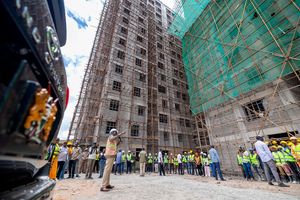
The Mukuru Affordable Housing project in Nairobi on August 28, 2026.
Photo credit: Bonface Bogita | Nation Media Group
The size of the housing pipeline could provide cement manufacturers with a sizeable source of demand as projects move from foundations into structural and finishing stages.
Demand, however, extends beyond State-backed housing projects, with Nairobi building-plan data showing an increase in private residential and commercial construction.
The value of Nairobi building plans rose 29 per cent to Sh101 billion between January and May 2026, from Sh78.3 billion in the same period last year.
Residential plans accounted for Sh73.2 billion, up about 20 per cent from Sh61 billion, while non-residential plans rose almost 60 per cent to Sh27.8 billion from Sh17.3 billion.
The sharp rise in non-residential projects is significant for cement producers because it suggests the construction recovery is broader than the affordable housing pipeline.
The cement market is also substantially larger than it was two years ago. Consumption between January and July 2026 stood at 6.46 million tonnes, compared with 4.62 million tonnes in the corresponding period of 2024.
That represents growth of nearly 40 per cent over two years, creating room for higher plant utilisation and stronger sales if the construction pipeline continues translating into actual projects.
The data shows manufacturers are raising output as demand strengthens, making volume growth and market share increasingly important considerations and supporting revenue growth across the industry if the trend holds.
The industry’s next challenge will be establishing whether the current acceleration marks a durable construction cycle or a temporary surge driven by a concentrated pipeline of projects.
The affordable housing programme could provide a visible source of demand, with the State targeting 45,000 new homeowners by the end of this year.
This could have multiplier effects across the construction value chain, as increased building activity raises demand for steel, aggregates, transport, building materials and related services.
Nairobi building-plan data provides another indication that the recovery could have a private-sector component, particularly if higher building approvals translate into actual construction starts.