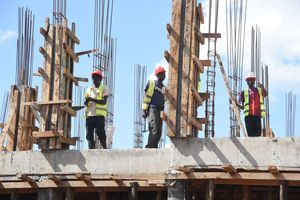
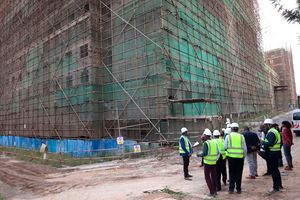
Many prospective homeowners in Kenya begin construction expecting a clear path to completion, only to find it slowed by extended timelines, rising costs and repeated delays that can stretch projects into months or even years.
In Naivasha, a factory-based housing system is being positioned as an alternative to this traditional process, with key stages of construction undertaken in a controlled production environment, where housing units are assembled before being transported for on-site installation.
Inside the facility, steel frames, wall panels and pre-cut components move through a sequenced process of cutting, assembly and fitting, gradually forming complete housing units.
The indoor setting minimises exposure to weather and on-site disruptions, supporting a more predictable production cycle than conventional building methods typically allow.
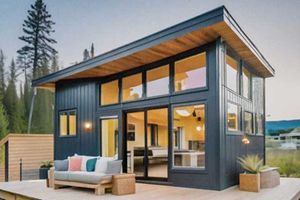
A completed POD. Fully fitted units, including kitchens and bathrooms, as well as insulated wall systems, can be delivered and installed within five to ten weeks.
Photo credit: Pool
SpinksInvest, founded in 2017 by Ben Spinks and operational since 2020, is behind The POD, a range of prefabricated homes designed to shorten construction timelines, reduce wastage of materials and improve build consistency compared with traditional stone-and-mortar construction.
Ben says he identified gaps in Kenya’s housing market, particularly in the delivery of affordable homes for middle-income buyers.
“Traditional construction in Kenya frequently faces delays due to reliance on wet trades such as cement and plaster, as well as supply chain disruptions and unpredictable site conditions, including weather and labour availability,” he says.
The firm manufactures its units in a controlled environment before transporting them for installation, where they are assembled with what Ben describes as “Lego-like” precision.
He says that fully fitted units — including kitchens, bathrooms and insulated wall systems — can be delivered and installed within five to 10 weeks, a significantly shorter timeframe than many conventional construction projects.
“The process also offers more predictable timelines and uniform finishes, compared to conventional builds that are often affected by changing site conditions, supply delays and variations in workmanship,” he adds.
SpinksInvest was founded by Ben Spinks and has been operational since 2020.
Photo credit: Pool
The company has also introduced the POD Pool, a prefabricated swimming pool made from repurposed shipping containers, which can be installed within two to three weeks.
Spinks Invest targets its POD range at middle- and upper-middle-income buyers within Kenya’s property market, where demand for faster and more predictable construction options has been rising.
The units are positioned for clients seeking modern, efficient homes that combine speed of delivery with contemporary design features, including refined finishes and outdoor living spaces.
According to data from the Kenya National Bureau of Statistics and industry reports, Kenya continues to record an annual housing deficit of about 200,000 to 250,000 units, with the cumulative shortfall now exceeding two million units. The gap points to sustained demand pressures, particularly in urban centres where population growth has outpaced new housing supply.
The shortage is most pronounced among middle-income households in urban and peri-urban areas, where construction timelines are often extended by financing challenges, fluctuating material costs and delays associated with conventional building methods.
“Our modular units are designed for homeowners, property developers and hospitality operators who are looking for faster and more predictable deployment of housing or accommodation units compared to conventional construction timelines,” he explains.
Pricing starts from Sh790,000 for the POD Office, Sh2.59 million for the compact POD Zero en-suite unit, and rises to about Sh3.87 million for larger studio and one-bedroom models, inclusive of VAT but excluding transport and on-site logistics.
A completed POD. Fully fitted units, including kitchens and bathrooms, as well as insulated wall systems, can be delivered and installed within five to ten weeks.
Photo credit: Pool
To date, the company has installed more than 120 units across the country and, depending on workload, engages up to 80 casual employees at a time, with plans to scale up output as demand for modular housing grows.
While preference for conventional stone-and-mortar housing remains widespread across the construction sector, he says demand for its factory-built units is increasing among buyers.
Spinks Invest recently completed a temporary platform structure for the World Rally Championship (WRC) Safari Rally in Naivasha, delivering the project within the set timeframe and budget. The project involved the construction of a temporary viewing stand during the event, which draws large crowds and places considerable pressure on local infrastructure, transport systems and accommodation capacity.
“Such assignments require rapid mobilisation of materials and labour within strict timeframes, particularly in high-traffic events of this scale,” he notes.
The system is designed to reduce on-site material waste and water use compared with conventional stone-and-mortar construction, where prolonged building cycles often lead to higher resource consumption. The units are manufactured using durable, weather-resistant materials and are fitted with solar-ready infrastructure and water-efficient systems, indicating a growing emphasis on more resource-conscious building methods.
A key feature of the system is portability. Unlike permanent structures, POD units can be dismantled and relocated, offering flexibility within both the housing and commercial property markets.
“This aspect may appeal to civil servants on frequent transfers, as well as professionals and families relocating between urban centres, where mobility and asset retention are increasingly important considerations,” he explains.
Kenya is a market hungry for homes, the factory floor might finally beat the construction site.
Photo credit: Pool
The approach is positioned within the framework of national development priorities under the Bottom-Up Economic Transformation Agenda (BETA) and Vision 2030, both of which emphasise accelerated delivery of affordable and sustainable housing.
Despite the efficiencies associated with this form of construction — including shorter build times, improved cost predictability and reduced environmental impact — conventional stone-and-mortar housing remains widely preferred across much of the market.
“Wider uptake will depend on a combination of factors, including increased public awareness, clearer planning approvals and supportive policy frameworks,” he says, noting entrenched perceptions around durability, status and permanence, which continue to shape buyer preferences in the housing market.
He acknowledges that part of the challenge lies in perception and regulatory familiarity.
At the same time, the sector faces practical constraints such as access to financing for large-scale adoption of alternative building technologies, limited regulatory familiarity with prefabricated systems, and the need to align new construction methods with existing urban planning and zoning requirements.
Ben says modular construction could play a larger role in addressing Kenya’s housing deficit if policy support and standardisation improve.
“In the long term, the opportunity is significant, particularly in markets where speed, cost certainty and flexibility are becoming more important,” he says.
The units are already being used for office space by remote workers, as well as for short-term rental accommodation in tourism areas, where demand for flexible and quickly installable structures has grown.
They are also being adopted in investment properties targeting the broader short-term rental market, where speed of setup and ease of management are often prioritised.
“All POD units are engineered to meet or exceed Kenyan building standards and are fitted with thermal insulation compared to conventional masonry construction,” he says, adding that the focus is on reducing the time it takes to bring buildings into use.