The government has introduced at least seven guidelines aimed at increasing the earnings of smallholder tea farmers from Sh50.18 per kilogramme of green leaf to at least Sh100 by 2027.
All farmers across the country are projected to benefit from the improved earnings, irrespective of where they grow their tea. The initiative addresses concerns raised by leaders from Kisii, Nyamira and East Rift Valley, who protested against what they termed unfair tea bonuses.
In November last year, the leaders petitioned Speaker Moses Wetang’ula over the unfair bonuses earned by farmers. They complained that the price differential of tea by region in Kenya needed to be investigated. This led to an inquiry by the National Assembly Agriculture Committee, which identified cartels and anti-competitive practices within the tea industry as factors suppressing prices and leading to low farmer earnings.
In a report to the National Assembly, the Cabinet Secretary for Agriculture, Mutahi Kagwe, pointed out that most of the guidelines are expected to be fully operational by June this year.
The guidelines were developed by a multi-agency committee comprising the Ministry of Agriculture and Livestock Development, the Tea Board of Kenya (TBK), the Tea Research Foundation (TRF), tea factories and traders.
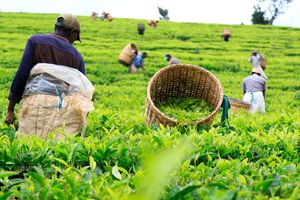
Women at a farm in Kapsabet, Nandi County, carry sacks with tea leaves to a collection centre.
Photo credit: File | Nation
These guidelines prescribe the minimum quality standard for green leaves to be processed by all tea factories. Once implemented, they will bridge the quality and price differentials between the western and eastern regions.
Mr Kagwe informed the House that the government is also establishing a laboratory in Mombasa to analyse and validate the quality and safety of teas. The CS informed the lawmakers that the civil works for the laboratory are complete, and that the process of equipping the lab is ongoing. This is expected to be completed by June this year, in order to facilitate the laboratory's operationalisation.
“We request the National Assembly to support the allocation of funds that are necessary to fully operationalise the laboratory,” CS Kagwe told MPs.
The facility is expected to address tea quality and safety through analytical testing of teas based on three sets of parameters, namely: the physical quality parameter, microbiological parameters, heavy metal contaminants and pesticide residues, and emerging contaminants. The laboratory will also help in the scientific verification of teas offered for sale at the auction, based on the quality by ascertaining the levels of nitrogen, polyphenols and ash content, which have scientifically been proven to correlate with sensory attributes.
In addition, through the laboratory, the Tea Board of Kenya will carry out sensory evaluation of teas to complement scientific testing of tea, which will then be used in the determination of price.
tea
Photo credit: File | Nation
On its third guideline, the government will do strategic tea quality improvement programmes aimed at assisting tea factories in the West to improve and meet market requirements.
The programme has been running for two years and it is expected that by the end of five years, most tea factories producing plainer to medium quality teas will have transitioned to above average or premium quality teas.
“Those teas are, in turn, expected to fetch better prices as has been the case with the performance of some tea factories in the West tea block,” Mr Kagwe told MPs.
Blind tasting, tea rankings
Agriculture Cabinet Secretary Mutahi Kagwe.
Photo credit: Boniface Mwangi | Nation Media Group
He said the programme entails conducting blind tasting of teas from all licenced tea factories for evaluation and ranking. The government will then select the 15 lowest ranked tea factories for inclusion in the quality improvement programme.
Further, the government will undertake on-site capacity building training with tea makers for black Crush, Tear, Curl (CTC) and orthodox teas.
In order to address inefficiencies at various tea factories, the government is providing a Sh3.7 billion loan from the Kenya Development Corporation, at a concessionary rate of 5 percent, to all small-holder tea factories that wish to modernise their equipment and machinery.
It's also expected that the factories will use this facility to expand their production of orthodox teas which fetch higher prices in niche markets.