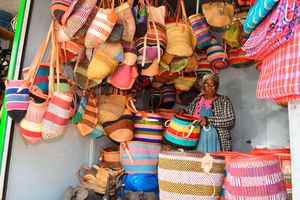
Gloria Kisilu grew up watching her grandmother, a skilled basket weaver, rally her fellow women to weave together. Despite their hard work and dedication, many struggled to get ahead financially, earning only meagre incomes for their craftsmanship.
Inspired by this, she set out to refine her grandmother’s idea. She founded The Shaba Studio Ltd, a manufacturing and distribution platform for sisal accessories that empowers women artisans.
Through the platform, the women she works with gain fair wages, healthcare, and market access for their products.
Ms Kisilu ensures the women earn a sustainable income while preserving the environment, turning a simple family craft into a powerful engine of social impact.
“Sisal helps prevent soil erosion, supports beekeeping, aids carbon sequestration, and thrives even in drought conditions. We encourage farmers to plant more around their farms, and we buy from them,” she explains.
This versatile crop is biodegradable, can be used as firewood or building material, and grows without disrupting local ecosystems, making it a natural solution that benefits both communities and nature.
The company has developed a unique ecosystem that combines a manufacturing and distribution platform focusing on efficient production, effective distribution and streamlined inventory management.
“Leveraging technology, we connect rural artisans with the global market, ensuring fair trade, recognition, and equitable pay for their incredible skills,” she adds.
The business was started with a capital of Sh25,000, raised from her personal savings, and initially on-boarded 30 artisans.
It has since grown to employ more than 350 women artisans who weave and produce over 50 products in its portfolio.
These products are sold both locally and internationally through retail and wholesale channels, with prices ranging between Sh4,500 and Sh25,000
She attributes the company’s innovation to its circular business model. The products are made from 100 per cent organic sisal, grown without pesticides or chemicals, and sourced from smallholder farmers within local communities.
The sisal accessories, including bags and other products, are completed and assembled at the workshop before being distributed to retailers.
Photo credit: Pool
“We design our products in-house and share the designs with artisans through the Shaba Community App. Farmers then plant and harvest sisal, which is spun into thread and hand-woven by skilled artisans without the use of synthetic or chemical dyes, while creating livelihoods at the grassroots,” she says.
Through the app, artisans can manage orders and track payments, while Shaba’s digital production and inventory system enables real-time tracking and quality control from raw material to finished product.
The woven pieces are completed and assembled into signature bags at the workshop before being distributed to retailers, who can stock through a dedicated web and app platform.
This integrated approach connects local craftsmanship with customers while ensuring transparency, efficiency, and sustainability across the value chain.
“Our inserts are interchangeable, meaning they can be used across different seasons. There is a lot that can be done in the fashion sector, from moving away from fast fashion to embracing practices that support ethical production,” she says.
Ms Kisilu advises consumers to choose eco-friendly products, noting that such choices protect the environment and support the communities behind their production.
However, building a sustainability-driven business has not come without challenges.
Ms Kisilu says one of the biggest hurdles has been changing consumer perceptions, particularly in markets where handmade products are often undervalued compared to mass-produced alternatives.
“People want sustainability, but they are also price-sensitive. Educating customers on why ethical products cost more, because they pay fair wages and use environmentally friendly materials, is an ongoing process,” she notes.
Access to capital has also been a persistent challenge. While the business has grown steadily, scaling up production while maintaining quality and ethical standards requires significant investment.
She notes that many women-led enterprises struggle to access affordable financing, limiting their ability to expand operations or invest in new technologies.
Logistics and infrastructure pose additional obstacles, especially when working with artisans in remote rural areas. Poor road networks, unreliable transport and high shipping costs often affect delivery timelines, particularly for international orders.
To address this, the company has invested in decentralised collection points and digital inventory systems that allow better coordination between production hubs and distribution centres.
Many of the women artisans join the enterprise with basic weaving skills passed down through generations, but she says consistent quality and design innovation require continuous training.
The sisal accessories, including bags and other products, are completed and assembled at the workshop before being distributed to retailers.
Photo credit: Pool
“We invest heavily in upskilling our artisans, not just in weaving techniques but also in quality control, product finishing and understanding market trends,” she explains.
They also provide financial literacy training, enabling the women to better manage their income and savings.
She says building trust within communities has been crucial. In areas where artisans have previously been exploited by middlemen, establishing fair and transparent payment systems took time.
The company now pays artisans promptly and directly, helping to stabilise household incomes and improve living standards.
The impact, she notes, goes beyond income. Many of the women can educate their children, access healthcare, and contribute meaningfully to household decision-making.
For some, weaving has also become a pathway to leadership within their communities.
Ms Kisilu explains that while artisan production is hands-on and organised within small producer groups, the sector includes a large pool of skilled craftspeople across Kenya, East Africa, and the wider continent, creating opportunities for scaling.
“We have structured our operations to effectively coordinate this talent, ensuring consistent quality while expanding capacity. The brand serves both domestic and international markets, with strong growth potential in ethical fashion, “she says.
However, artisan-based models face constraints, including limited production volumes, difficulty competing on price, dependence on niche global markets, and the ongoing challenge of balancing growth with sustainability and fair wages.
Despite these factors, demand for sustainable fashion continues to grow, especially in Europe and North America, where consumers are increasingly aware of the environmental and social footprint of their purchases.
“This has opened up new opportunities for African-made brands, but competition remains stiff in the crowded global market,” she says.
To remain competitive, she continues to invest in design innovation, collaborating with designers to create contemporary products that appeal to modern consumers while preserving traditional techniques.
Digital marketing and e-commerce have also played a key role in expanding the brand’s reach beyond physical retail spaces.
She plans to expand the artisan network, deepen engagement with smallholder farmers, explore new sustainable materials that complement sisal, and strengthen the brand’s local retail presence to tap into the growing domestic market for ethically produced goods.
Ms Kisilu believes the future of fashion lies in responsible production and conscious consumption, where businesses are accountable for both their profits and their impact.
“For us, success is about growth that ensures the women we work with grow with us, the environment is protected, and our culture is preserved,” she concludes.