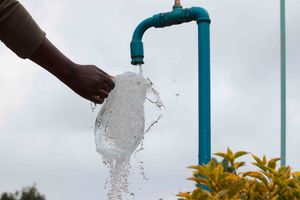
For many Kenyan homes, turning on a tap does not always guarantee access to safe drinking water. Across urban estates and rural homes, most households depend on water from a mix of municipal supply, boreholes, water vendors and bottled water. In some regions, families grapple with high fluoride levels that have been linked to dental and skeletal fluorosis. In others, borehole water contains excessive salinity that leaves an unpleasant taste and sometimes damages household appliances.
It is this gap between water access and water safety that led to iClear. The Kenya-based water purification company has positioned itself for household and institutional water treatment solutions.
“Across Kenya, concerns about water quality are still common. Families are dealing with issues such as salinity, fluoride, unpleasant taste, staining or uncertainty about what is actually coming out of the tap,” says Yanxiong Zhong, the company’s CEO.
Iclear Office Water Purifier setup pictured at the company’s offices in Nairobi on May 28, 2026.
Photo credit: Wilfred Nyangaresi | Nation Media Group
He admits that what stood out for him was the amount of money, time and effort consumers were already spending trying to solve water-quality problems. “People were boiling water, buying bottled water or relying on dispenser deliveries. However, many still lacked confidence in the water they consumed every day,” he says.
The observation exposed a business opportunity. Consumers were paying for temporary solutions yet few companies were offering long-term household water-treatment systems that are designed for local water challenges. Globally, the water purification industry has evolved into a multi-billion-dollar market. In countries such as Singapore, Israel and the United States, these advanced household filtration systems have become common fixtures in homes. That growing awareness is backed by consumer interest around health, sustainability and water quality. Similarly, the trends are beginning to emerge in the African markets as urbanisation accelerates. The company’s journey began four years ago through its Hong Kong parent company.
Kenya was selected as the first direct operating market because of the scale of water-quality challenges and its potential as a launchpad for expansion across Africa. “We saw a need for improved drinking-water solutions and a strong long-term growth opportunity. We believed Kenya could become the foundation for building a scalable water-solutions business across Africa,” Mr Zhong says.
According to the company, more than 12,000 homes, offices, schools, healthcare facilities and community projects have benefitted from its purification systems through a combination of commercial deployments and social-impact programmes. With its current operations in Nairobi and Nakuru, the company is making plans to enter Mombasa as they look to expand beyond Kenya’s borders. However, like any other business, their journey has had its own share of obstacles. “One of the biggest challenges was awareness. Many consumers knew they had water-quality concerns, but they did not always know what was causing them, whether those concerns posed long-term risks or what solutions were available,” Mr Zhong says.
Trust also proved difficult to build. “Water is something people consume every day, so customers need confidence not only in the technology but also in the people and service behind it,” he says. “Building that trust required consistent education, reliable after-sales support and a long-term commitment to customer relationships.”
Unlike many businesses of this kind that have been founded by engineers or water-treatment specialists, Mr Zhong says iClear’s origins were rooted in entrepreneurship and problem solving. “Through continuous learning, research, customer engagement and practical field experience, the company developed strong expertise in water purification technologies and local water-quality challenges.
Iclear Desktop Countertop water purifier setup pictured at the company’s offices in Nairobi on May 28, 2026.
Photo credit: Wilfred Nyangaresi | Nation Media Group
At the heart of the business model is Reverse Osmosis (RO), a technology that has been used around the world to remove contaminants from drinking water. “RO technology can effectively remove dissolved salts, excess fluoride, heavy metals, bacteria, viruses and other contaminants that ordinary filtration systems may not fully address.”
To understand how the technology works, imagine water being forced through an extremely fine membrane that acts like a microscopic sieve. Although clean water molecules pass through, contaminants such as salts, fluoride, heavy metals and other impurities are blocked and removed. The process begins before the water reaches a drinking glass. According to Joseph Maina, iClear marketing lead, water entering the system first passes through a pre-filter known as the P/C filter. “The first filter captures muddy water and removes large sediments and particles,” he says.
This initial stage is important because it prevents larger debris from reaching and damaging the more sophisticated filtration components downstream. After the sediment filter, water moves into the RO membrane, which is the core of the purification system. “The RO filter removes pathogens, bacteria, chlorine, salts and fluoride,” Mr Maina says.
This stage tackles contaminants that are usually invisible but can affect your health, taste and the overall water quality. The water then passes through a third stage known as the CTO filter. “The CTO filter improves the taste of the water. You do not feel the saltiness or any chlorine taste,” he says. Once purification is complete, the water flows into a storage tank where it remains ready for use. “The machine fills the storage tank automatically.
When you open the dedicated tap, the water comes from the storage tank. Once the tank is full, the system switches itself off automatically,” Mr Maina explains. The company currently offers several product categories that targets different customer segments. Its Standard purifier that costs Sh25,000, is designed for households of three to five people.
The system can produce approximately 400 litres of purified water per day and has an estimated purification lifespan of around 4,000 litres before major servicing requirements, which depends on the usage patterns and source-water quality. The Premier purifier, costs Sh49,000 and targets larger households of between six and 10 people. It also produces about 400 litres per day but offers a longer purification lifespan of approximately 7,200 litres.
For consumers seeking convenience, there is a desktop purifier costing Sh40,000 that can be positioned on a kitchen countertop. The unit incorporates the same three-stage filtration process and provides multiple temperature settings with rapid purification capabilities. The company has also developed a larger office purification system designed to serve workplaces with more than 30 employees. The system costs Sh120,000, although leasing options are available at about Sh90,000 per year.
Although many consumers focus on the upfront cost of a purifier, Mr Maina says that maintenance is also important for longterm performance. He explains that the Standard system, the sediment filter, is typically replaced every six months, while the RO and CTO filters generally last around 12 months. The Premier system is designed for heavier usage, with replacement intervals that varies between six and 18 months depending on the filter and water conditions.
The desktop unit also requires an annual replacement of all three filters. The company argues that one of the biggest misconceptions among consumers is that all water filters perform the same function. Mr Maina says their systems are designed to remove a range of contaminants, including salts, fluoride, bacteria, sediments, unpleasant odours, bad taste and some heavy metals. “We use reverse osmosis to remove salts, fluoride and very small impurities, making the water safer and cleaner to drink, especially for borehole water.”
Additionally, the growing demand for such technologies also reflects a shift in consumer behaviour. “People are becoming more conscious about the food they eat, the air they breathe and increasingly the water they drink. Water quality is becoming part of a larger conversation about health, wellness and quality of life,” says Mr Zhong.