Every day, waste leaves homes, offices and markets through formal or informal collection systems, slipping out of view as it is transported to disposal sites.
On the fringes of expanding cities, it re-emerges in mounting volumes in illegal dumpsites, exposing the strain on urban waste infrastructure and the limits of existing disposal capacity. As African cities expand, waste management systems are coming under increasing pressure. Plastic bottles frequently block drainage systems, food waste accumulates in markets, and municipal authorities contend with rising volumes of refuse linked to population growth and shifting consumption patterns.
The situation has exposed gaps in waste management systems across parts of the continent, where collection and disposal remain the dominant method of handling waste, while value recovery from discarded materials remains limited in many areas.
Parivartan Sharma, co-founder of Ecoloop Solutions Africa, says the company operates in the waste management sector and deploys solutions and technologies that enable waste to be processed on-site where it is generated.
“The idea emerged from the observation that while waste volumes were rising, practical solutions enabling institutions, businesses and communities to process waste at source remained limited,” he says.
He notes that a significant share of urban waste continues to be managed through collection and disposal systems, with limited recovery of organic and recyclable materials. Organic waste is commonly directed to landfills, where it generates methane emissions, while plastic bottles and aluminium cans are frequently discarded despite their recyclability.
These conditions have informed the firm’s framework built around technologies that support on-site waste processing and recovery of recyclable materials.
“Treating waste as a resource awaiting transformation rather than a disposal challenge could ease pressure on landfills while supporting wider efforts to improve resource efficiency,” he explains.
The company operates within the circular economy space, which has attracted growing attention from governments, businesses and consumers seeking alternatives to the traditional take-use-dispose system in the context of rising environmental concerns.
Ecoloop Solutions Africa focuses on decentralised systems that seamlessly integrate smart waste management into everyday life, enabling resource recovery from waste, closer to the point of generation, reducing emissions related to long-distance transport to disposal sites. The firm distributes reverse vending machines (RVMs), Aerobin composting systems and Organic Waste Composters (OWC) for larger-scale applications.
The reverse vending machines accept PET bottles ranging from 200ml to 2 litres and aluminium cans of up to 500ml, with a storage capacity of up to 1,500 bottles and 500 cans. Recyclable items are identified, compacted and recorded to support tracking of collection activity.
“The machines also incentivise users with eco-points redeemable via mobile money or loyalty programmes, and provide real-time data on recyclables collected,” Sharma says.
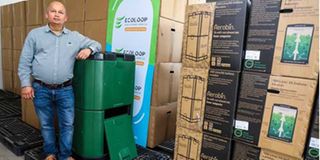
The Aerobin unit provides odour-free aerobic composting through an on-site, off-grid process that converts food scraps and other biodegradable materials into compost with minimal monitoring. It produces nutrient-rich liquid fertiliser from week 3 onwards and solid compost from 12 weeks onwards. Pricing ranges from about Sh40,600 for a 200-litre unit with a capacity of up to 250kg, rising to Sh103,240 for a 600-litre unit with a capacity of up to 750kg. The OWC processes between 125kg and 1,250kg of organic waste, including leftover food, daily for use in institutions, the hospitality industry, markets and food processing facilities, and features automated controls and achieves up to 80 per cent volume reduction.
Ecoloop Solutions Africa Ltd Co-founder and Managing Director Parivartan Sharma poses next to an Aerobin home composting unit at the company's warehouse in Nairobi's Industrial Area on June 27, 2026.
Photo credit: Bonface Bogita | Nation Media Group
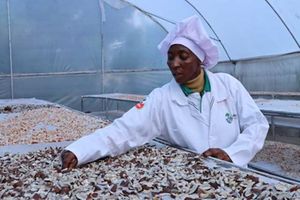
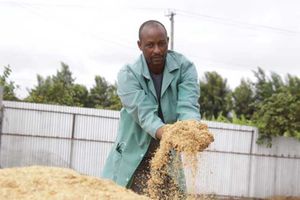
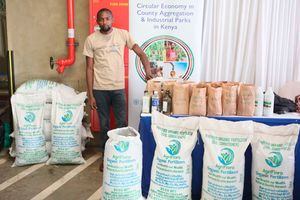
“Food waste, garden trimmings and other biodegradable materials are placed inside the OWC, where microbial activity breaks them down into compost in 24 hours for use as soil improvement,” he notes.
The technology addresses a challenge commonly identified in recycling systems, and although recyclable materials often have commercial value, collection networks in many markets remain fragmented.
Data generated by the systems, he adds, can help organisations track waste-generation patterns, participation levels and recycling volumes. The use of digital monitoring tools is becoming more common in environmental management, particularly as businesses and institutions place greater emphasis on monitoring and disclosing their environmental performance.
Despite diverting more than 150 tonnes of waste, serving hundreds of households and partnering with more than 50 institutions, Ecoloop Solutions Africa, like many firms in the waste management sector, faces challenges related to public awareness and adoption.
"Waste is often viewed primarily as a nuisance or disposal issue rather than a resource. Expanding adoption of circular economy practices requires awareness campaigns, training and practical demonstrations of value generated," says Parivartan.
He added that organisations introducing environmental technologies may encounter concerns relating to implementation costs, operational requirements and long-term returns. The company has therefore invested in stakeholder engagement and performance monitoring to demonstrate the performance of its systems.
Waste Infrastructure constraints continue to affect waste management across many African markets, with gaps in segregation, collection, and processing limiting the volume of materials diverted from disposal sites.
Parivartan says the company engages with public institutions, private sector actors and community-based organisations to strengthen collection systems and support material diversion initiatives. He attributes rising demand for environmental solutions to heightened public awareness, tighter regulatory frameworks and a growing emphasis on operational efficiency as organisations seek to target a growing environmentally conscious market and cut waste-related costs.
He noted that these pressures are increasingly shaping corporate and public-sector approaches to waste management. In recent years, African-led enterprises operating in climate resilience, resource efficiency and environmental sustainability have increased, as environmental constraints are increasingly being translated into commercial opportunities across sectors.
The global acceleration of the circular economy prioritises reuse, repurposing, recycling and regeneration of materials over linear production systems characterised by take-make-dispose approaches. These systems extend product lifecycles and retain material value for longer periods.
“Our technologies support composting and the processing of recyclable materials, contributing to efforts aimed at reducing the volume of discarded waste while improving resource utilisation,” he says.
Environmental experts identify organic waste management as a key component of climate mitigation efforts, with composting providing an avenue for carbon sequestration while producing soil-enhancing material for agricultural and landscaping applications.
The recovery and reprocessing of materials can reduce demand for virgin raw materials, lowering energy requirements associated with extraction, transportation and manufacturing. Governments, businesses and development organisations are giving increased attention to these issues as climate-related challenges intensify.
Environmental considerations are being integrated into policy frameworks and operational planning, supporting the adoption of technologies aimed at reducing waste and improving material utilisation, Parivartan notes. With expanding urban populations and rising consumption levels, waste generation is projected to multiply in less than a decade.
The company is scaling the deployment of decentralised waste-processing systems across urban and peri-urban centres and institutional clients.
Planned expansion includes distribution of composting and recycling technologies, deeper collaboration with public and private sector actors, and enhanced deployment of data-enabled waste tracking systems to monitor waste flows and recovery outcomes.
It is also pursuing entry into additional markets where demand for integrated waste solutions is accelerating in line with urban growth.
“My interest in the sector stems from identifying practical ways of extracting value from materials that would otherwise be discarded, a perspective that continues to guide the company’s operations,” he explains.
Learning from nature, “nothing is wasted, everything is recycled”, Parivartan points out that there is a need to wake up to the reality that nature will not continue providing unlimited resources indefinitely.
“Our future is in the classrooms and we need to introduce these practical solutions and technologies to the younger generation for a safer and well-balanced environment,’’ he concludes.