In Kiarukungu village in Kirinyaga County, agricultural waste and livestock by-products used to be considered rubbish. Not anymore.
Organic Kenya Limited, co-founded by Jacinta Njeri and David Karanja, is now transforming these materials into granulated fertiliser that enriches the soil and supports the livelihoods of many farmers across several counties.
Initially registered in 2014 as an organic food export company, the founders soon realised that many farmers were struggling to produce adequate yields due to poor soil health, often characterised by high acidity and imbalanced pH levels.
“We decided to use our expertise in organic agriculture to train and build the capacity of smallholder farmers, helping them improve their soils through the use of homemade biofertilisers and biopesticides,” says Karanja.
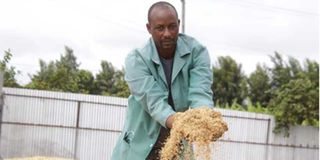
Amos Ndung’u mixes avocado waste used in the production of organic fertiliser at the Organic Fertiliser Factory in Mwea Gathigiriri, Kirinyaga County, on October 29, 2025.
Photo credit: Joseph Kanyi | Nation Media Group
The company became fully operational in 2019, coinciding with the onset of the COVID-19 pandemic.
This shift was driven by farmers’ requests for packaged fertilisers after observing significant improvements in their soil health through sustainable practices.
The demand also grew as imported fertilisers, particularly those from Russia, became increasingly expensive and difficult to access. Operating at a capacity of 6 tonnes per day, the business recycles approximately 1,488 tonnes of organic waste annually.
It was primarily financed through the founders’ personal savings. The initial capital was used to purchase land, construct production facilities, fabricate some of the production machinery, and obtain the necessary legal certifications. The model is built around converting plant materials and animal manure into a value-added product.
“In an effort to minimise waste and promote soil health through non-chemical agricultural inputs, we procure these raw materials from nearby farms and processing facilities,” explains Karanja.
Composting and mixing are carried out manually by eight employees during the off-peak season, and by up to 14 during peak periods. Some of these workers are young people from nearby communities who prepare and monitor the decomposition process, ensuring that the organic material breaks down properly before further processing. This approach, though labour-intensive, allows for close control of moisture and aeration, critical factors in the composting cycle.
Karanja explains that once the composting phase is complete, the material is passed through four electric granulating machines, which form the fertiliser into granules. These machines are also manually fed, maintaining a semi-atomated production flow.
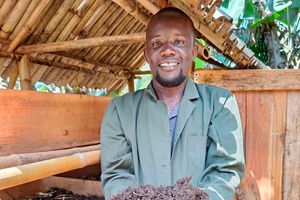
Amos Ndung’u explains the pyrolysis process — which is used to make biochar — at the Organic Fertiliser Factory in Mwea Gathigiriri, Kirinyaga County, on October 29, 2025.
Photo credit: Joseph Kanyi | Nation Media Group
While the company has mechanised part of its production process, the reliance on manual labour in earlier stages places practical limits on how fast it can scale output without additional investment in automation.
Despite this, the current capacity allows the enterprise to meet demand from a wide regional customer base. Farmers in need of sustainable soil fertility solutions have become the company's primary clients, though distribution remains a key area of development.
“Our products are certified by the Kenya Bureau of Standards. Our flagship product, a granulated fertiliser, retails at Sh2,000 for a 50-kilogram bag,” Karanja says.
They currently run four physical outlets in Kangari, Ndaragwa, Embu, Molo, and Kamwangi. These locations act as sales and distribution points for farmers in surrounding areas. The business also supplies its fertiliser to stockists in Kirinyaga, Murang’a, Nakuru, Narok, Nyeri and Eldoret.
This regional presence gives the company access to a range of agricultural zones, each defined by distinct soil conditions and crop varieties. Maintaining a consistent supply to these markets involves production management as well as coordination of logistics and inventory, especially given their focus on delivering granulated fertiliser, a form preferred by many farmers for its ease of handling and application.
Still, expanding their reach beyond its current footprint remains a priority.
“We view market growth as central to achieving economies of scale, but uptake of organic fertiliser remains uneven across regions due to factors such as cost, farmer awareness, and existing reliance on conventional chemical fertilisers,” he notes.
By processing nearly 1,500 tonnes of waste each year, the enterprise is helping to reduce local waste, particularly in agricultural regions where organic waste is abundant but often poorly managed. Sourcing plant material and animal manure from farmers, they reinvest in these farmers while also utilising materials that would otherwise contribute to unmanaged waste piles or be discarded through open burning.
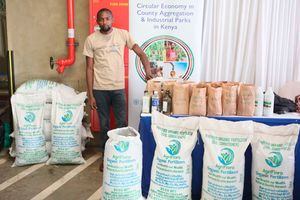
Organic fertiliser at the Organic Fertiliser Factory in Mwea Gathigiriri, Kirinyaga County, on October 29, 2025.
Photo credit: Joseph Kanyi | Nation Media Group
The environmental benefit of this model is not limited to waste diversion. Organic fertiliser offers long-term improvements to soil structure and fertility, unlike synthetic alternatives, which may degrade soil quality over time.
However, despite increasing support for sustainable agriculture, businesses in the organic inputs space often face structural limitations, including inconsistent policy support, limited incentives, and access to distribution networks dominated by legacy chemical fertiliser brands.
Organic Kenya Ltd is supported by the Kenya Climate Innovation Centre (KCIC), which provides incubation, technical advice, and access to networks for climate-focused SMEs.
“KCIC’s guidance on production processes, business model development, and market strategy has helped us refine operations and navigate early challenges such as raw material sourcing, quality control, and customer outreach,” he says.
Their technical assistance fund also enabled the acquisition of a business management system and international organic certification (EcoCert), milestones that would have taken much longer independently.
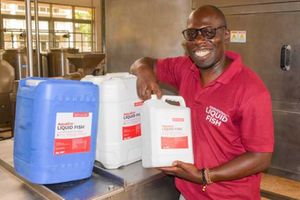
Organic fertiliser at the Organic Fertiliser Factory in Mwea Gathigiriri, Kirinyaga County, on October 29, 2025.
Photo credit: Joseph Kanyi | Nation Media Group
KCIC has further connected the company to relevant forums and policy dialogues, increasing visibility in a sector often underrepresented in agricultural discussions. This support is part of a wider effort by KCIC to strengthen climate-relevant value chains and de-risk small enterprises seeking to address environmental challenges through commercial solutions.
Constrained market environment
Despite its growth, the company operates within a constrained market environment. One of the key challenges remains farmer adoption. Many smallholders are familiar with synthetic fertilisers and may be hesitant to switch without evidence of comparable yield outcomes. Others are deterred by the cost or availability of organic products, which are not yet distributed as widely as their chemical counterparts.
They also face operational challenges tied to their semi-manual process. While granulation has been mechanised, scaling composting and mixing remain labour-intensive. Introducing mechanisation in these early stages would require capital investment, something that is not always readily available to SMEs without access to debt or equity financing. In addition, fluctuating availability of raw materials, particularly seasonally dependent waste like avocado or animal-based inputs, can create supply chain variability that needs to be managed to maintain consistent production levels.
“To remain competitive and increase production, we are looking to grow our market presence further across Kenyan counties. This includes identifying new distribution partners, deepening awareness among farmers, and investing in systems that would reduce production bottlenecks,” says Karanja, adding that they are considering partnerships with cooperatives and agribusinesses that can serve as anchor clients for more predictable demand.
“With increasing policy emphasis on soil health, climate resilience, and sustainable input use, we have an opportunity to contribute meaningfully to broader environmental goals, if we can scale effectively and navigate the challenges of an uneven market.”