The coastal belt is rich with coconut trees, an expansive green canopy that has long shaped both the landscape and the livelihoods of thousands of residents along Kenya’s shoreline.
For generations, these palms have served as economic anchors, sustaining households, feeding informal trade, and defining a coastal identity closely tied to the “tree of life.” Beneath this abundance lies an uneasy paradox: when supply rises faster than the systems needed to process, store and market it, value is steadily lost, nut by nut, season after season.
In Kilifi County, this imbalance is visible in piles of uncollected coconuts during peak harvests, in roadside stalls where prices fluctuate sharply, and in farms where mature nuts rot before they are sold—a sector defined less by scarcity than by inefficiency, where abundance coexists with avoidable loss.
As post-harvest losses persist and market structures remain weak, local stakeholders have begun experimenting with community-driven solutions aimed at reclaiming value from the coconut economy. Among them is the Garithe Mangrove Conservation and Nuts Value Addition initiative, which traces its origins to 2009 when it began as a small self-help group.
A bottle of coconut oil sold under the brand name ‘Lainisha’, which is produced by the Garithe Mangrove Conservation and Nuts Value Addition Initiative.
Photo credit: Pool
At the time, members were contending with a familiar set of constraints, including the absence of processing facilities, limited access to certification pathways and a market that offered minimal returns for raw coconuts.
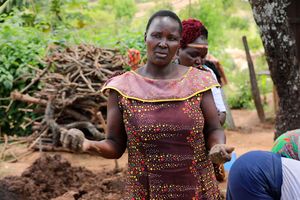
“Farmers were selling nuts at very low prices, sometimes as little as Sh2 to Sh5. Mature coconuts without water were often discarded because they were considered useless in the market,” recalls Getrude Uba Kombora, the group’s founder.
That waste, however, became the entry point for experimentation. With limited technical knowledge and no formal equipment, the group began processing coconut oil manually.
Production was small, labour-intensive and irregular, peaking at only about 20 litres a month. At this scale, it represented a departure from the sale of raw produce towards local value addition within the community.
The early years were marked by trial, error, and incremental learning. Processing techniques were refined informally, often guided by observation rather than formal training.
However, structural constraints persisted. Without certification or quality assurance systems, access to formal markets remained limited, keeping the initiative anchored in local sales.
Getrude says a change came in 2023, when the Kenya Climate Innovation Centre (KCIC), through its Agribiz Programme, began working with them. The support targeted foundational gaps that had previously constrained growth, rather than scaling production immediately. Training sessions covered coconut value addition, financial record-keeping, and product marketing.
Coconut oil has immense heath benefits when eaten, but is also wonderful for your hair and your child’s hair.
Photo credit: File | Nation
The group also received guidance on certification requirements from the Kenya Bureau of Standards as well as assistance in establishing market linkages beyond local buyers. The intervention also transformed the group's internal operations, replacing informal coordination with structured production schedules and quality-control systems.
This was followed by infrastructure support, including the construction of an operations facility and the installation of a cold press machine, which expanded production capacity and improved efficiency.
“Before, our incomes were low and inconsistent. With better access to markets, our sales have increased. The support has helped us build the capacity to sustain our operations and continue growing beyond the programme,” she says.
Changes in production volumes are among the most visible outcomes. From processing around 20 litres of coconut oil per month, the group now produces more than 600 litres a week. The expansion has also created employment opportunities for members of the local community who are engaged in different stages of production and processing.
At an individual level, members now process about 100 coconuts a day, earning up to Sh400 daily.
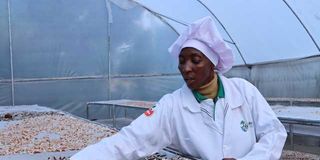
While modest, the income is more stable and predictable than earnings from the sale of raw coconuts. Beyond oil production, the group has introduced solar-drying technology through a dryer donated by Micro Enterprises Support Programme Trust (MESPT) and expanded its product line to include packaged coconut oil under the LAINISHA brand.
The solar-drying system has reduced reliance on weather-dependent drying methods, improving product consistency and reducing post-harvest losses.
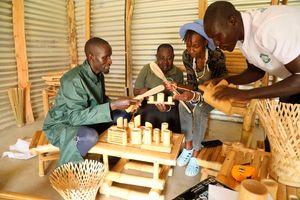
The group has also adopted a zero-waste model. Members began collecting coconut husks and shells—materials that are often burned or discarded by farmers. The shells are carbonised and processed into smokeless cooking briquettes, reducing reliance on mangrove firewood, while the husk fibre is being tested for use in products such as mats and ropes.
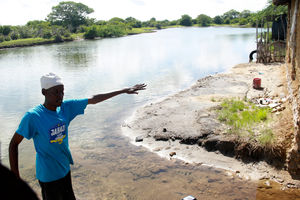
Ash generated during processing is used as organic fertiliser for local farms. The initiative has created additional revenue streams from coconut shells and husks, transforming waste into income for more than 30 women members. The organisation’s activities also extend beyond agribusiness. Alongside coconut value addition, it is involved in mangrove conservation in parts of northern Malindi and Watamu. Both activities take place within the coastal economy, where environmental conservation and livelihoods often overlap.
“Mangrove restoration efforts contribute to coastal protection, reduce erosion and support marine biodiversity—factors that indirectly benefit fishing communities and local ecosystems,” says Getrude, adding that for them, conservation is not a separate agenda but part of the same economic system that sustains coastal livelihoods.
Challenges remain in the coconut value chain, particularly around consistent raw material supply, fluctuating market prices, and competition from larger processors.
A glass of coconut milk.
Photo credit: File | Nation Media Group
Certification requirements, while now more accessible, still demand sustained compliance and investment. Processing capacity across the coast also remains uneven, with many farmers continuing to operate outside organised value chains.
“This is one of our biggest challenges,” says Getrude. “Even when there is demand, it is not always easy to guarantee supply or meet it consistently because many farmers are still not well integrated into structured systems.”
Kenya’s coconut sector is also shaped by wider market forces, including competition from imported processed coconut products and rising demand for coconut-based goods such as oil and cosmetics. While this demand has created new opportunities in urban markets, limited investment in processing infrastructure continues to constrain the ability of local producers to respond at scale.
“There is growing interest in coconut products, especially in towns, but local processors are still competing with imported goods that are often more standardised and easier to access,” says Getrude.
At the same time, structural gaps in the value chain persist, including the absence of aggregation centres and coordinated supply systems.
This has made it difficult for smallholder farmers to achieve scale efficiencies or move beyond informal trading networks.
Although the sector is beginning to attract younger entrepreneurs interested in processing and branding, access to finance and technical training remains a key barrier to expansion.
“While opportunities exist, many small producers are unable to fully take advantage of them without financing and proper systems.”
Looking ahead, the organisation is focusing on consolidating its gains by strengthening internal systems and stabilising supply flows to ensure more predictable production cycles.
Part of this effort involves formalising procurement relationships with coconut farmers to reduce seasonal fluctuations and improve planning for processing operations.
The group is also exploring opportunities to expand its packaged product line into new retail channels beyond the coastal region, including through partnerships with distributors targeting urban markets.
However, their biggest challenge now, Getrude points out, is capacity.
"With an upcycling machine, we could process 10 times more coconuts and coconut waste each day. This would create jobs for 50 additional women and help make Garithe a zero-waste village in Kilifi County."
She adds that the group also plans to strengthen members' skills in quality control, branding and enterprise management to support long-term sustainability beyond donor and programme support.
For Getrude, the emphasis is on building a model that can function independently, with systems strong enough to withstand market volatility while maintaining steady growth.