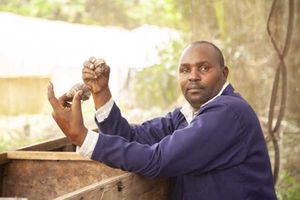
When Roussoss Demisse first encountered snails in 2017, he intended to kill them. To him, they were uninvited guests who had invaded his mushroom houses persistently and destructively.
As the person responsible for the operation, Demisse did what any practical heliciculturist would do: he searched online for solutions to the problem of how to get rid of snails on a mushroom farm.
A Google search yielded many ideas. Somewhere between pest control forums and agricultural guides, he stumbled upon something unexpected.
In Nigeria, Ghana and much of West Africa, people were not fighting these creatures. They were deliberately rearing them for food, cosmetics and profit.
“The original idea was actually how to kill them,” he says, still laughing at how quickly that had changed. “And then we realised—wait, these things are being farmed.”
This shift in focus, from exterminator to farmer, formed the basis of one of his agribusinesses, which began with just 70 snails.
Today, Demisse is the chief executive officer of Demi Farms, located in Olturoto, Kajiado County, home to around 5,000 Giant African Land snails and with two product lines in development, ranging from restaurant kitchens to cosmetics laboratories.
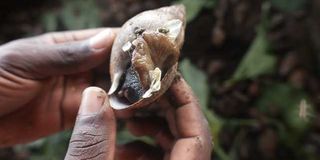
This variety of snail is also well recognised among the communities most likely to buy it and has proved to be well suited to Kenyan growing conditions.
Wycliffe Nato, a farm manager at Demi Farms in Olturoto Village, Kajiado County working on snails at the farm on April 10,2026
Photo credit: Evans Habil | Nation Media Group
A mature specimen weighs between 90 and 120 grams, meaning only 10 snails are needed to make a kilogram. Smaller breeds can require up to 20, which cuts sharply into margins.
Rosemary Odinga, who ran a farm called Shelltops in Rongai, and there was another farmer in Nakuru. Neither was easily accessible for advice.
“You couldn’t even find someone to consult with or visit,” he says. “So we just had to rely on online information. Most of it came from West Africa.”
The problem with the West African guides, useful as they were, is that they were written for West African conditions.
During the early months, a lot more of the snails died than he had expected because of the foreign techniques he had adopted to care for them.
“Explaining to a Kenyan in 2017 that you were farming snails for consumption required a great deal of patience and persuasion,” says Demisse.
A few were openly hostile to the idea. He recalls one farmer in the wider community whose operation was burnt down by locals who were convinced that the animals were spiritually dangerous.
“Snails are just like any other animal. They are livestock,” says Demisse.
Then there was the matter of licensing. Kenya requires snail farmers to obtain a permit from the Kenya Wildlife Service before they can trade, adding an extra layer of complexity to an already uncertain process.
Over the years, Demisse has learnt patience while dealing with the snails.
“The snail does not reward impatience. It is slow and quiet, operating entirely on its own schedule. In some ways, that is precisely what makes it manageable,” says Demisse.
A typical day at Demi Farms involves feeding the snails, mostly vegetables and shrubs grown on the farm’s own land, followed by the removal of any uneaten food before it rots and a careful scan of the pens for anything out of the ordinary.
Dead snails are removed immediately. Beyond that, there is not much to do except watch and wait.
Anything that can go wrong, he says, tends to be traced back to hygiene. Bacterial infections are the leading cause of death in snail farming and spread quickly in dirty conditions.
From the small animals, Demisse sells two things that are interdependent.
The first is snail meat, sold at Sh2,000 per kilogramme. Its customer base is small but loyal, consisting mainly of members of the Chinese community in Kenya, as well as West African expatriates, particularly Nigerians and Ghanaians, who grew up eating snails and actively seek them out.
He found his first customers through online marketing and quickly discovered that this clientele does not just buy once.
“When you get one customer, they don’t buy once and then leave,” he says. “They call you again. And then they have friends.”
Domestic Kenyan demand for snail meat remains low, largely confined to those who acquired a taste for it while living abroad. Demisse is, however, not discouraged. He believes that it is only a matter of time before the market opens up.
The second product is where things get genuinely interesting. Snail slime, the secretion that the animals produce naturally, has become a highly sought-after ingredient in the global cosmetics industry, believed to contain moisturising and skin-regenerating properties.
Snails at Demi Farms in Olturoto Village, Kajiado County
Photo credit: Evans Habil | Nation Media Group
At Demi Farms, they collect the slime, dry it and sell it to cosmetic manufacturers for Sh4,000 per kilogramme. The farm extracts roughly 1.5 kilogrammes of dried slime from 5,000 snails every week.
“The market is there; it’s growing,” says Demisse. ‘It’s not that big yet, but there is a lot of potential.”
For anyone who might be interested in this venture, Demisse breaks down the math.
A small-scale operation can be set up for between Sh30,000 and Sh50,000, around Sh10,000 for a basic pen, and the rest for parent stock.
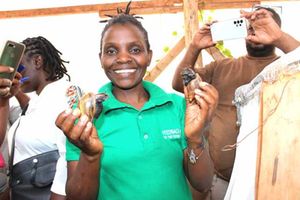
With around 20 snails per kilogramme of mixed-age breeding stock, this investment yields a workable founding colony of approximately 200 snails.
Medium-scale farms cost around Sh150,000, while larger operations cost around Sh200,000. Training, if need be, adds another Sh2,000 to Sh5,000.
Demi Farms currently runs its operation in a pen measuring 10 metres by 6 metres, with the plan to double its population to 10,000.
Most Kenyans, when they hear the word ‘snail’, picture a slug, the shell-less, slippery creature that appears on footpaths after rain.
“The two animals are entirely different. Snails always carry shells. Slugs do not, and certain species carry pathogens linked to diseases, including cholera. This confusion has cost the industry credibility that it should never have had to sacrifice,” he explains.