Caroline Muiru runs her bakery and hot kitchen, which are about 15 minutes apart. Every morning, chefs, cooks, cleaners, stewards and waiters report for duty, each with a clear assignment, whether that's preparing beef stew and burgers for an office lunch or setting up a buffet for a corporate event.
She calls this "organised chaos". This carefully coordinated routine has resulted in a thriving business with a loyal anchor client for the last three years and a recently expanded kitchen capable of serving up to 1,000 meals a day. Organic Basket, based in Karen, is a farm-to-plate catering and bakery business built on the belief that food should nourish as well as satisfy.
Caroline grows 80 per cent of the produce she uses through family and collective farming arrangements, sourcing the rest from trusted organic farmers. Nothing is preserved, so her food is cooked fresh every day, her cakes are baked to order and other baked goods have a shelf life of just five to seven days. "Food is alive," she says. "It heals. It's preventative medicine."
The business primarily serves corporate clients, a market that Caroline deliberately targeted after observing that many office caterers relied on repetitive, carbohydrate-heavy menus. She believes that employees who spend most of the day sitting at a desk need lighter, more balanced meals than the rich food typically served at weddings or social events.
"Weddings, for instance, are emotionally charged, one-off events, whereas corporate contracts typically last between one and three years and offer more predictable working relationships,” she says.
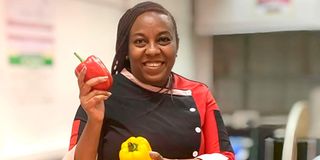
Caroline Muiru, a self-trained chef and founder of Organic Basket, at her bakery in Karen.
Photo credit: Pool
Her philosophy reflects a growing public health concern. According to the Ministry of Health's Cardio-Metabolic and Renal Health Programme, non-communicable diseases, including diabetes, hypertension, and heart disease, account for 62 per cent of hospital admissions and 43 per cent of deaths in Kenya. It is estimated that diabetes affects between 3.3 and 4.5 per cent of adults. Urbanisation, sedentary lifestyles and highly processed diets are among the major drivers of this condition.
As awareness grows, so does the demand for organic, chemical-free food, with more and more consumers seeking healthier alternatives.
For Caroline, healthy cooking is deeply personal. Her brother has cerebral palsy and autism and follows a specialised diet. Her father has diabetes, and she herself is intolerant to gluten and dairy, although she still enjoys pastries. These experiences have shaped the menu at Organic Basket, inspiring cakes and bread made with natural ingredients, less sugar and minimal icing, or, sometimes, none at all.
"I actually want you to experience the real thing," she says, explaining why she uses coconut milk instead of artificial flavouring.
The company incorporates free wellness talks into its corporate catering contracts and provides catering for weddings, funerals and birthdays. However, its long-term growth strategy focuses on schools, hospitals and factories that operate around the clock.
Caroline formally registered Organic Basket in 2016, having operated informally since 2013. Today, it employs five full-time staff, supported by casual workers as needed. The company has about three anchor clients, including an American firm that it has served for the past three years, and is pursuing more contracts following the expansion of its kitchen.
Last year, Organic Basket reached the final three in a catering tender for the American Embassy, competing against much larger hotels and catering firms.
Much of the company's growth has come through referrals rather than social media marketing. Sustainability is also central to its operations. For example, she turns farm waste into fertiliser and natural pest control, and kitchen leftovers are returned to the farm as compost or animal feed. She describes this as a complete food system.
Managing prices remains one of her biggest challenges. Corporate catering contracts often fix meal prices for a year, leaving the business exposed to the fluctuating cost of ingredients such as cooking oil and fruit.
To mitigate this risk, she bases contract prices on the highest recent market rates and adjusts menus according to seasonal produce, rather than compromising on quality.
“Our menu doesn’t include any soft drinks. Instead, we use fresh fruit juice prepared from seasonal produce. When inflation pushes costs beyond manageable levels, I just renegotiate with clients instead of quietly absorbing losses,” says Caroline.
Caroline's journey into entrepreneurship began long before Organic Basket. Raised in a farming family, she grew up surrounded by food production. Although she studied economics at university, she was always drawn to helping people and even considered pursuing a career in medicine or nursing at one point.
After becoming a committed Christian during her time at university, she worked with St John's Community Centre before joining Nairobi Chapel, where she spent about three years doing social work and community outreach. When the time came to move on, she resigned without having another job lined up, a decision that worried her family.
Without a steady income, she returned to what she had always enjoyed: cooking and baking for family and friends. She started by selling produce from her family's farm, and then took on small baking orders. Encouraged by a friend, she turned the grocery venture into a business. It grew quickly, but eventually collapsed.
What followed was nearly a decade of repeated cycles of growth and setbacks. Each time the business gained momentum, it outgrew its systems and stalled.
“I got frustrated and thought, “What am I doing wrong?"' she recalls. Her family struggled to understand why an economics graduate was baking cakes instead of pursuing a more conventional career.
A breakthrough came when she joined an entrepreneurship programme called PINapi around 2015. The six-month programme saw her business shortlisted among seven ventures competing for a Sh1 million grant, and included a further six months of one-on-one mentorship. Although the training programme enhanced her business skills, Caroline says that she only began to flourish when she realised that Organic Basket was not just about selling food; it was about improving people's health, one meal at a time.