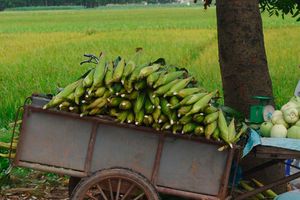
John Maina, a farmer from Laikipia West Sub-County, on his cassava farm. More farmers are increasingly bypassing banks and Saccos in favour of family and friends for credit.
Kenyan farmers are increasingly bypassing banks and Saccos in favour of family and friends for credit, signalling deepening stress in agricultural financing despite easing interest rates, new Central Bank of Kenya (CBK) survey shows.
Borrowing from family and friends jumped to 42 per cent of sampled farmers in January 2026 from 25 per cent in November 2025, overtaking formal lenders as the dominant source of farm credit even as overall borrowing rose.

The survey shows that overall borrowing rose to 48 percent of surveyed farmers in January from 37 percent in November, indicating growing demand for credit as farming activity picked up at the start of the year.
The structure of the borrowing has, however, tilted sharply toward informal and relationship-based sources, highlighting persistent barriers in formal agricultural lending despite policy efforts to stimulate bank credit.
After family and friends, buyers of farm produce, such as coffee factories and milk processors, were cited by 39 percent of farmers, underscoring the growing role of value-chain financing in agriculture.
These buyer-linked loans typically come as advances against future deliveries, effectively tying credit to output rather than fixed repayment schedules, a feature that formal lenders struggle to replicate.
More borrowers (farmers) favour informal sources despite bank financing policy stimulation.
Banks ranked third at 33 percent, up slightly from November, while Saccos recorded one of the sharpest drops, falling to 18 percent in January from 30 percent previously.
Digital lenders were cited by 26 percent of farmers, while the Agricultural Finance Corporation was mentioned by only 14 percent of respondents.
The CBK data shows that cooperative societies, the Hustler Fund, and other informal moneylenders remained unchanged at four percent through the two survey cycles.
“Trends in use of credit for various farming activities show that farmers typically borrow to purchase farm inputs, with the proportion having borrowed for this purpose increasing by 84 percent in January 2026 from 73 percent in November 2025,” wrote CBK in the survey that sampled 134 farmers.
“The proportion reporting using agricultural loans to meet labour costs also picked up to 75 percent in January 2026 from 47 percent in November 2025.”
The Hustler Fund had previously been a popular source of credit for farmers.
The Hustler Fund, a revolving fund that is officially known as the Financial Inclusion Fund, was launched in late 2022 as part of President William Ruto’s Bottom Up Economic Transformation Agenda (Beta), which seeks to uplift millions of ordinary Kenyans, including farmers, from poverty by giving them personal loans.
Follow our WhatsApp channel for breaking news updates and more stories like this.