Kenya’s public debt rose to Sh12.82 trillion in June 2026 after the government borrowed Sh416.2 billion from multilateral lenders and commercial creditors between January and April to finance development projects and support the budget, according to a National Treasury report tabled in Parliament.
The report, submitted to the National Assembly on July 29 under the Public Finance Management (PFM) Act, says the borrowing comprised six new loans and one International Sovereign Bond (ISB).
“The loans include six new loans and one International Sovereign Bond (ISB) contracted between the Government of Kenya and multilateral and commercial creditors,” the Treasury report states, adding that the bond had already been fully disbursed when the report was submitted.
The loans are denominated in US dollars, Japanese yen and Ukrainian hryvnia.
Section 31(3) of the PFM Act requires the Cabinet Secretary for the National Treasury to submit to Parliament, every four months, a report detailing external loans or loans denominated in foreign currency, including the amounts borrowed, lenders, repayment terms, interest charges, disbursements and intended use of the funds.
The largest facility was a Sh291.49 billion International Sovereign Bond, issued on February 26, 2026, between the Government of Kenya and Citibank Europe plc Germany Branch. According to the Treasury, the proceeds will finance liability management operations and provide budget support.
The government also secured two affordable housing loans signed on April 22, 2026. The first, worth Sh45.34 billion, was obtained from the International Development Association (IDA) to expand access to affordable housing finance, improve property registration and support environmental and energy access commitments.
A second Sh16.2 billion facility from the International Bank for Reconstruction and Development (IBRD) will finance similar objectives, including expanding housing finance for underserved households and improving land administration.
The Treasury further disclosed a Sh29.15 billion IDA loan for the second additional financing of the Primary Education Equity in Learning Programme. The project aims to reduce regional disparities in learning outcomes, improve retention of girls in junior school and strengthen systems for equitable education delivery.
A Sh20.33 billion NEXI Samurai loan facility, signed on March 31 and financed through Sumitomo Mitsui Banking Corporation, will provide general budget support, finance implementation of the National Automotive Policy and reduce energy losses.
Another Sh9.8 billion loan from the African Development Fund will support the second phase of the Higher Education, Science and Technology Project by improving equitable access to quality higher education and research to support economic growth and employment.
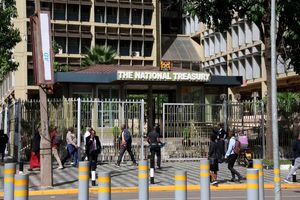
The National Treasury in Nairobi.
Photo credit: File I Nation Media Group
The Treasury also secured Sh3.9 billion in additional IDA financing for the Locally Led Climate Action Programme to strengthen national and county governments’ capacity to manage climate risks and implement community-led resilience initiatives.
The latest borrowing comes as concerns persist over Kenya’s debt sustainability amid subdued revenue collection and exposure to exchange rate fluctuations. According to the government’s borrowing plan for the 2026/27 financial year, debt servicing obligations are projected to reach Sh1.1 trillion.
Parliament amended the PFM Act in October 2023, replacing the previous Sh10 trillion public debt ceiling with a debt anchor of 55 per cent of gross domestic product in net present value terms. The Treasury projects the target will be achieved by 2029. Kenya’s debt level currently stands at about 62 per cent of GDP.