The Kenya Airports Authority (KAA) is recruiting a fixed base operator (FBO) to set up operations at the Jomo Kenyatta International Airport (JKIA), targeting to tap business from owners and operators of private jets.
An FBO is a private company authorised to operate at a public-use airport, providing aviation services for private, charter and business aircraft. The FBOs typically offer fueling, hangar space, ground handling, aircraft maintenance coordination, and passenger amenities separate from commercial airline terminals.
Disclosures by KAA showed that it targets an FBO facility for private, executive, charter, diplomatic, medevac and general aviation traffic.
“Kenya Airports Authority intends to procure a qualified investor, developer and operator to design, finance, construct, equip, operate, maintain and manage an integrated premium aviation and hospitality facility on approximately five acres of airport land,” KAA said.
Kenya currently ranks as the main private aviation hub for private jets in East Africa, backed by JKIA and Wilson Airport.
KAA revealed that the FBO would be required to develop a raft of facilities, including: an executive passenger lounge; a VIP arrival and departure reception; a crew lounge; crew briefing and flight planning rooms; operations control office; passenger and baggage facilitation area and immigration; customs, health and security facilitation areas.
The operator would also be required to develop crew accommodation, adequate luggage storage, airport shuttle or controlled access transfer arrangement, and boutique or luxury retail outlets for high-end fashionable clothing, among others.
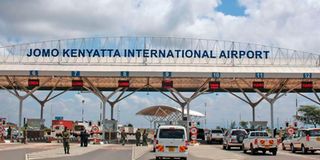
A section of Jomo Kenyatta International Airport's International departure in April 27, 2025.
Photo credit: Francis Nderitu | Nation Media Group
This comes as the government races to expand JKIA for Sh116 billion, partly funded through a Sh81 billion loan. The balance of Sh35 billion will be raised through a securitised bond and from the recently established infrastructure fund.
Kenya is aiming to nearly triple JKIA’s annual passenger handling capacity to 22 million, but had to pause the project last year after it cancelled a deal with India’s Adani group in 2024 following the indictment of its founder in the United States.
The project involves rehabilitating existing airport facilities, including runways and aprons, and building a new passenger terminal to boost annual passenger-handling capacity to 22 million, from 7.5 million.
China Road and Bridge Corporation in June bagged a deal for JKIA upgrade, which will entail building a new terminal and improving the airport’s existing infrastructure for Sh154.2 billion to increase its passenger handling capacity from the current 7.5 million to 22 million upon completion.
The government has contracted Africa’s Trade and Development Bank and Africa Finance Corporation to arrange financing for a $900 million (Sh116 billion) expansion of JKIA.
And as part of the upgrades, KAA is also set to introduce self-service passenger processing booths and automated luggage points at JKIA.
The airport manager plans to install a new Common User Passenger Processing System (CUPPS) and Common User Self-Service (CUSS) infrastructure that is aimed at improving efficiency and passenger flow across the airport.
The CUPPS and CUSS are technology platforms standardised by the International Air Transport Association that allow the agents of airlines to share facilities such as check-in desks, bag drop points, and boarding gates to cut costs and maximise airport capacity.
The CUSS enables multiple airlines to allow passengers to check in, print baggage tags, print boarding passes, and select seats.