The United States has announced the removal of tariffs on coffee imports from Ecuador, Argentina, Guatemala and El Salvador, in a development that immediately alters competitive dynamics in one of Kenya’s most important markets for the beverage.
Washington’s decision, unveiled as part of new trade arrangements with the four Latin American countries, gives their coffee producers duty-free access to the American market at a time when Kenyan shipments face a 10 percent levy under the reciprocal tariff regime introduced in August.
The tariff cuts mark a significant shift for Kenya as they reduce the landed cost of Latin American beans in the United States, potentially undercutting Kenyan coffees that recently posted strong growth and overtook textiles as the country’s leading export to America.
Before the cuts, Guatemala, El Salvador and Argentina shipped exports into the world’s largest economy at a 10 percent reciprocal tariff rate, while Ecuador ran the trade at a 15 percent rate.
Brazil is the biggest exporter of coffee to the US which recently imposed a 50 percent tariff on imports from the South American country. The current American administration has set and revised tariffs on trading partners at a rapid rate, putting various countries in better or worse positions.
The new development comes at a time when data from the Kenya National Bureau of Statistics (KNBS) shows that Kenya’s coffee exports to the United States rose 83.5 per cent in the first half of 2025 to Sh5.71 billion, up from Sh3.1 billion a year earlier.
Kenya also enters this altered competitive landscape at a moment when its textile shipments to the United States have weakened after the expiry of the African Growth and Opportunity Act (Agoa), amplifying the strategic importance of coffee in sustaining export earnings from the American market. Agoa previously provided sub-Saharan African countries with duty-free access to the US market for thousands of products.
Kenya has been positioning coffee as its primary export to the expansive Donald Trump-led market in the post-Agoa period, relying on rising specialty orders to cushion against declining textile receipts.
The tariff advantage now granted to Latin American suppliers is expected to compress margins for Kenyan exporters, particularly in the specialty segment, where price sensitivity has increased following slower retail demand growth in several US metropolitan areas.
Buyers in the United States use relatively small differentials to switch origins, meaning a duty-free competitor can immediately shift procurement patterns away from Kenyan beans, whose landed prices are already elevated by shipping and insurance costs.
Export data shows that more than half of Kenya’s direct coffee shipments to the United States are channelled through specialty buyers who use cup scores to justify premium pricing, but these premiums are set to narrow substantially when competitors achieve cost-free entry.
During the 12 months to September 2024, Belgium toppled the US as the main export market for Kenya’s coffee tipping investors on the opportunities in the European country which is currently registering a steady growth in consumption of the beverage driven by an expanding specialty products.
Data shows that Belgium bought 8,275.79 tonnes of Kenyan coffee worth Sh7.42 billion during the period, representing 16.82 percent of the total share of the exports of the commodity from the East African nation.
The US, on the other hand, imported 7,917.13 tonnes of coffee from Kenya worth Sh6.68 billion, an equivalent of 16.09 percent of Nairobi’s exports of the commodity for the season.
The tariff cut initiative aligns with the Trump administration’s broader effort to ease pressure on consumers by removing duties on goods the US does not produce, such as coffee and bananas, in response to rising inflation and voter frustration over high prices.
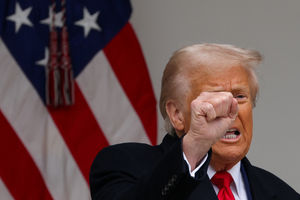
US President Donald Trump.
Photo credit: Evelyn Hockstein | Reuters
With Agoa’s duty-free access for many African apparel and farm exports now expired, Washington appears keen to strengthen ties with Latin American suppliers and shift sourcing patterns in a way that gives American importers cheaper and more reliable supplies.
The timing also reflects straightforward political pressure after recent Republican losses in state and local races were linked to household cost concerns, prompting the administration to use targeted tariff relief as a quick way to show action on everyday prices.
Earlier in May this year, the United States Department of Agriculture had projected a 13.3 percent growth in Kenya’s coffee production to 850,000 bags in the marketing period that started this October, up from 750,000 bags in the just-ended period.
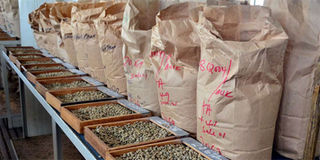
A sack of coffee beans.
Photo credit: File
The agency, through its foreign agriculture service division, said the expected rebound would be informed by higher coffee prices, the government’s ongoing coffee reforms programme, and the slowdown by farmers in converting their coffee plantations into real estate business.
“Following a year of high prices, farmers will be able to increase fertiliser application and improve disease and pest control. In addition, coffee plantations will be at the peak of the biennial production cycle that is characteristic of Arabica coffee,” the US agency wrote in a report dated May 15.
Since February 2023, the government has undertaken several reforms in the coffee sector, including placing NCE under the Capital Markets Authority (CMA) and the licensing of brokers to take over roles previously undertaken by marketing agents.
In September this year, the government concluded a two-month mapping exercise targeted at about 76,696 hectares of coffee farms across the country in a last-minute dash to comply with a European Union (EU) market rule that seeks to ban the sale of goods linked to deforestation starting January next year.
Kenya exports 95 percent of its coffee, with approximately 55 percent going to the EU, mainly Belgium, Germany, Sweden, and Finland.