The change of guard at the top management of the Kenya Tea Development Agency (KTDA) has sparked renewed interest among the 700,000 small-scale tea growers, who are demanding better pay for their green leaf supplies.
The move comes against the backdrop of a sharp drop in payments to farmers supplying their produce to 54 factories in the last financial year—down by Sh20.6 billion—a decline KTDA attributed to market forces and fluctuations in the shilling-to-dollar exchange rate.
KTDA Board Chairman Chege Kirundi announced the appointment of Engineer Francis Miano as the acting Group Chief Executive Officer (CEO), following the retirement of Wilson Muthaura.
“Engineer Miano brings extensive experience and deep institutional knowledge. The board is confident in his ability to provide steady leadership as the organisation transitions,” Mr Kirundi said. The changes took effect on January 16, 2026.
Mr Muthaura had succeeded former CEO Lerionka Tiampati in October 2021, in a prior boardroom change. The new leadership changes follow Mr Kirundi’s election as board chairman in January 2025, which saw Enos Njeru removed—a move reminiscent of past boardroom upheavals in 2023 when David Ichohi was ousted.
The changes also come amid a push for autonomy for 17 factories and the adoption of scientific tea testing to replace the traditional manual system at the Mombasa Tea Auction—measures stakeholders believe will address marketing inequalities between the Rift Valley’s East and West regions.
The drop in payments has left farmers’ purchasing power eroded, with KTDA directors coming under scrutiny for their handling of operations and marketing during the 2024/2025 fiscal year.
The agency paid Sh69 billion to growers in 2024/2025, down from Sh89.29 billion the previous year.
Farmers are struggling with financial obligations, including repayments to banks, SACCOs, and other lenders, which were attached to anticipated KTDA earnings.
“The money received as bonus and monthly payment was deducted by banks and SACCOs that had advanced us loans. We only saw the money reflected in our statements, not the actual cash,” said Patrick Langat, a tea grower from Konoin, Bomet County.
Mr Langat warned that the effects of the low payments would be felt for months, as deductions continued to cover outstanding loans.
“It is disheartening that the Ministry of Agriculture, through the Tea Board of Kenya, has abdicated its responsibility of regulating the industry and marketing Kenyan tea globally,” he added.
He also criticised the lack of market diversification and competitive intelligence, saying, “Some government actions, including calls for audits, appear to be mere distractions.”
Dr Michael Bongei, a strategic management expert, urged KTDA to adopt aggressive marketing strategies to penetrate major global markets such as the United States and China, which have high tea consumption.
“With traditional markets facing challenges, industry players must implement strategic marketing measures to access Asian and European markets,” Dr Bongei said.
He lauded government efforts to reopen the Iranian market and to expand processing units for speciality teas, including orthodox varieties that fetch higher prices abroad.
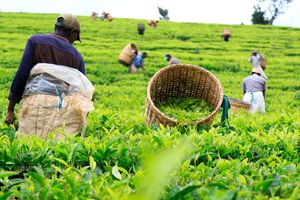
A farmer plucking tea.
Photo credit: File | Nation Media Group
Advocate Benhard Kipkoech Ng’etich noted that the tea sector suffers from the lack of a guiding policy, leaving small-scale growers with low pay from KTDA.
“While agriculture is Kenya’s economic backbone, sectors like tea, maize, coffee, beans, livestock, and avocados remain under-supported. Farmers face exploitation despite generating foreign exchange,” he said.
Beatrice Koech, a farmer in Belgut, Kericho County, highlighted additional deductions by KTDA for fertilisers supplied under government subsidy programs.
“That tea is a leading forex earner while growers remain in poverty is a paradox that cannot be ignored. High production costs and marketing issues must be addressed head-on,” Ms Koech said.
KTDA attributed the payout decline to market instability, carryover stock affecting Western Rift factories, and the strengthening of the Kenyan shilling against the US dollar, which rose from an average of Sh144 to Sh129.
“This year, the foreign exchange shift reduced export earnings by about Sh15 per dollar of tea revenue,” said Chairman Chege Kirundi.
Green leaf production also dropped by 12 percent, from 1.4 billion kilograms in 2024 to 1.24 billion kilograms in 2025—a decline of 160 million kilograms. The average selling price of made tea fell from Sh379 to Sh322 per kilogram, a decrease of Sh57 per kilogram.
KTDA sold 318 million kilograms of made tea in 2024/2025, up from 290 million kilograms the previous year. On average, three kilograms of green leaf produce one kilogram of made tea.
Historical KTDA payments to growers were: Sh52 billion in 2020, Sh44 billion in 2021, Sh63 billion in 2022, Sh68 billion in 2023, and Sh89.29 billion in 2024.
In 2024/2025, Murang’a County received the largest payout of Sh13.7 billion, while Trans Nzoia received the least, Sh251.5 million. Other counties received Meru: Sh9.09 billion, Kirinyaga Sh7.37 billion, Kericho Sh 6.81 billion, Kiambu Sh 6.69 billion, Bomet Sh 6.6 billion and Nyeri Sh5.38 billion.
Farmers in Embu got Sh4.27 billion, Nyamira Sh4.02 billion, Kisii Sh1.96 billion, Tharaka Nithi Sh1.29 billion, Nandi Sh993 million, Vihiga Sh448 million and Trans Nzoia Sh252 million.
In December 2025, members of the Parliamentary Agriculture Committee, chaired by Tigania West MP John Mutunga, were confronted by farmers at Motigo Tea Factory.
“Both the Legislative and Executive arms of government have failed tea growers, leaving them at the mercy of brokers who exploit them,” said Joseph Rono, reading a memorandum from farmers.
He added that Parliament had neglected its duty to restructure KTDA, creating conflicts of interest among industry players.