The afternoon of August 11 was characterised by excruciating heat from the scorching sun in Magadi Township, Kajiado West Sub-County. But unlike previous days, the usually busy town appeared deserted, with markedly reduced human and commercial activity.
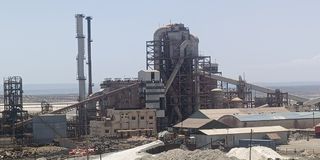
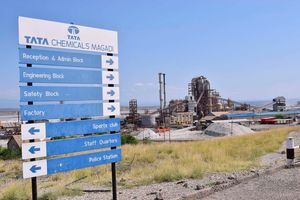
The imposing Tata Chemicals Magadi facility, which has for decades been at the centre of the town’s economy and essential services, stood silent after the suspension of its mining operations.
Tata Chemicals Magadi ,Kajiado County on August 11 2026. The factory has been closed for two weeks after Ministry of Mining suspended its mining operations on July 28, 2026.
Photo credit: Stanley Ngotho | Nation
Locals said an eerie silence had pervaded the town for at least a fortnight since the Ministry of Mining, Blue Economy and Maritime Affairs issued a notice directing the giant soda ash manufacturer to suspend its mining operations on July 28, 2026, pending a compliance review and submission of evidence demonstrating compliance with all statutory requirements. The company was also barred from exporting soda ash.
"The decision follows years of sustained engagement between the State Department for Mining and Tata Chemicals Magadi Limited regarding its statutory obligations under the Mining Act, Cap. 306, the Mining (Licence and Permit) Regulations 2017, the Mining (Royalty Collection and Management) Regulations 2024, and other relevant legal frameworks," Mining CS Ali Hassan Joho said.
On July 29, Tata Chief Executive Officer Swaminathan Nagarajan issued a statement announcing the company’s "safe shutdown” of its mining operations as the company engaged all the relevant stakeholders to find an amicable and speedy resolution to the matter.
However, on July 30, the company moved to the High Court in Nairobi seeking stay orders vide case No. HCJR/E280/2026 before Justice William Musyoka, who ruled against the company on August 7, 2026.
Tata Chemicals Company community livestock water point on August 11 2026.
Photo credit: Stanley Ngotho | Nation
This week, the High Court declined to lift the suspension of the company's operations.
The case is active, with judgment slated to be delivered on October 23, 2026, and a mention scheduled for October 6, 2026, according to court papers in possession of the Nation, dashing hopes of operations resuming before then.
The first two weeks of the company’s shutdown have left hundreds of residents from Shompole, Olkiramatian and Olkeri Oldonyonyokie group ranches fearing for the fate of projects that have become a lifeline, including corporate social responsibility (CSR) programmes covering water supply, healthcare and student bursaries.
Magadi is a striking, hot and arid region in Kajiado County, located about 120 kilometres southwest of Nairobi. It is centred on Lake Magadi, an alkaline soda lake famous for its thick crust of white and pink trona salt. Most locals are pastoralists.
Soda ash (sodium carbonate) is mined from underground or surface deposits of trona ore using dredging, underground conventional mining or solution mining.
Doris Miriam at one of the Tata Chemicals water point within Magadi township on August 11 2026.
Photo credit: Stanley Ngotho | Nation
The versatile alkaline chemical is used primarily in manufacturing glass, producing soaps and detergents, softening water, regulating pH in swimming pools and industrial processes, and fixing fibre-reactive dyes for crafts such as tie-dye.
A Nation spot check on Tuesday indicated that the town was slowly losing its aura, with the ripple effects of the closure of the towering factory, secured with a giant padlock, being felt across the town.
The facility comprises dozens of modern staff quarters, a mini shopping centre, a Level Four hospital, a private school, members’ club, churches and a police station.
The company also operates a commuter train to Kajiado town, at least 55 kilometres away, which has since been suspended, throwing locals into disarray.
Tata Chemicals Head of Community Affairs Wilson Tima told the Nation that humanitarian projects that have been a lifeline for locals might be suspended if the stalemate escalates.
He said it was the company’s policy and commitment to continue supporting several programmes that directly impact the lives of needy locals, but financial constraints had begun crippling operations and might see all the projects suspended.
"Over the years the company has offered bursaries and scholarships to hundreds of secondary and university students. Dozens of villages, domestic and livestock, depend on water from the company, not forgetting the healthcare at our Level Four hospital," said Mr Tima without revealing the amount involved.
Tata Chemicals Head of Community Affairs Wilson Tima speaking to Nation on August 11 2026.
Photo credit: Stanley Ngotho | Nation
"Magadi is an arid area with minimal income-generating avenues for locals. We might be forced to suspend all the services due to financial constraints that have begun to set in since the closure. The continuity of the projects is at stake for now."
Early in the year, the company rehabilitated the 1950s Sampu 78-kilometre water pipeline after it collapsed for 15 years, prompting local women to trek for at least 20 kilometres in search of the rare commodity.
At one of the water points within Magadi Township, a handful of women were fetching water, which they later used donkeys to ferry home, while men queued to water their animals and others took turns in communal bathrooms strategically set up for herders.
Ms Mary Maishon said that despite the standoff between the Ministry of Mining and Tata Chemicals, the two parties must ensure humanitarian assistance is not interrupted.
"There is no life in Magadi without water. Our rangelands can barely manage pastures for our animals. Cutting off the water is simply killing us," said Ms Maishon, holding back her tears.
A kilometre away, at Magadi Hospital, Ms Jane Nasieku sat on a wooden bench waiting to be attended to at a pre-natal clinic. She had ridden a motorcycle from Shompole Group Ranch, almost 30 kilometres away. It was her third pregnancy.
"I have witnessed some of my village mates dying while giving birth in the hands of Traditional Birth Attendants (TBAs). I gave birth to other children in this hospital," she said, smiling, insinuating that she was optimistic about giving birth to more children.
Tata Chemicals Company community livestock water point on August 11 2026.
Photo credit: Stanley Ngotho | Nation
Although Ms Nasieku was not aware of the impending facility closure, her remarks highlighted the core role the hospital played for locals.
A retired chief, Joel Sayinka, 72, urged the State to intervene to solve the stalemate amicably.
"We (locals) don't blame the Ministry of Mining for suspending the company's mining operations. Let the two parties acknowledge that the lives of hundreds of locals are at stake. They ought to ensure a seamless flow of humanitarian assistance. Availability of a medical facility has reduced infant and maternal mortality, especially from the interior parts of Magadi," said Mr Sayinka.
Magadi Hospital Medical Superintendent Dr Raymond Birya said the hospital has recorded at least 21 deliveries monthly. Despite most mothers being illiterate, they are said to be following their children’s vaccination calendar to the letter.
Tata Chemicals, formerly Magadi Soda, is among the country’s largest mining employers and the largest producer of soda ash in Africa. It is also one of Kenya’s largest single exporters, contributing approximately six per cent of Kenya’s exports and generating nearly USD100 million in foreign exchange earnings annually.
The company has previously been engaged in a protracted court battle with the County Government of Kajiado over land rates and mineral royalties running into billions. Governor Joseph Ole Lenku has also been pushing the company to relinquish part of the vast land in its possession. Last year, the Court of Appeal ruled that mineral royalties belong to the national government under the Constitution and Mining Act.