The government plans to spend Sh1.3 trillion of the country’s Sh4.79 trillion budget for the fiscal year 2026/27, on interest payments for maturing loans, crowding out development spending, according to the National Treasury estimates presented in the National Assembly on April 30, 2026.
The country’s planned expenditure in the next financial year is an increase compared to the Sh4.6 trillion budgeted for the current fiscal year, and exceeds the figure in the Budget Policy Statement (BPS), which the National Assembly approved in March this year, by 64 billion.
If approved by the National Assembly as printed, the national government will get Sh2.9 trillion, which includes the national executive Sh2.82 trillion, parliament Sh48.7 billion and judiciary Sh30.44 billion.
The national executive estimates include Sh1.98 trillion in recurrent expenditure and Sh840.61 billion in development spending.
The 47 county governments have been allocated Sh420 billion in an equitable share of revenue from the national government.
The allocation is against revenue projections of Sh3.63 trillion in ordinary revenue and Sh644 billion in Appropriation in Aid (AiA), leaving a fiscal deficit of Sh1.11 trillion to be financed in a borrowing mix of 995.7 billion in local borrowing and Sh145.6 billion in external borrowing.
The allocation towards debt repayment is under Consolidated Fund Services (CFS), which also includes Sh247.1 million towards pension and salaries for State officers.
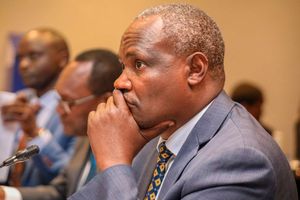
National Treasury Cabinet Secretary John Mbadi says that the estimates were prepared with the commitment of maintaining macroeconomic stability by keeping inflation within the target range, maintaining adequate foreign exchange reserves equivalent to at least five months of import cover, and increasing ordinary revenue collection.
Treasury Cabinet Secretary John Mbadi.
Photo credit: Bonface Bogita | Nation Media Group
“The government plans to reduce the fiscal deficit to 4.1 per cent of GDP while maintaining a balanced financing mix between domestic and external borrowing,” says CS Mbadi.
Details from the Office of the Controller of Budget show that the country’s public debt is at Sh12.29 trillion.
However, with the revenue shortfalls expected as has been the case in the previous financial years, it is projected that the government will raid the local and foreign market as usual through enhanced borrowing to finance its operations, reducing the set fiscal deficit to a moving target.
But the Treasury CS notes that continued efforts will be made to strengthen public financial management systems through fiscal consolidation.
This includes monitoring more public sector entities for compliance with the International Public Sector Accounting Standards (IPSAS), conducting value-for-money audits and integrating financial management systems like the Votebook Management System with IFMIS in sub-county treasuries.
At Sh781.3 billion, the education sector gets the lion’s share of the national executive budget.
This includes Teachers Service Commission (TSC) Sh422.7 billion, State Department for Higher Education Sh164.13 billion, Basic Education Sh135.34 billion, Technical Vocational Education and Training (TVET) Sh57.96 billion, with Science, Innovation and Research allocated a measly Sh1.2 billion.
Despite the overall increase in the education sector budget, some areas have been affected by cuts.
They include the secondary teachers' in-service budget, which has been reduced by 27.6 percent to Sh224.95 million, and the Free Primary Education (FPE) budget by 11.7 percent to Sh15.84 billion.
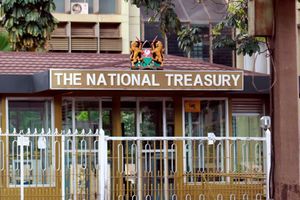
The National Treasury Building in Nairobi.
Photo credit: Pool
The others affected include primary teachers' training and in-service budget, which has been reduced by 4 percent to Sh771.53 million and secondary school special needs education budget slashed by 3 percent to Sh271.6 million.
The State Department for Roads has been allocated Sh234.7 billion, National Police Service (NPS) Sh147 billion, Housing and Urban Development Sh138.3 billion, health sector Sh175. 6 billion, which includes Medical Services Sh133 billion and Public Health and Professional Standards Sh42.6 billion.
The National Treasury will get Sh132.5 billion, with the State Department for Transport getting Sh63.9 billion in the next financial year.
The planned overall expenditure in the agriculture sector has nonetheless been reduced by about seven percent to Sh79.1 billion, with the food security budget increased to Sh31.1 billion, food safety as well as enhancement of the animal products development budget to Sh458.32 million.
With the high-stakes August 2027 general election about 15 months away, the Independent Electoral and Boundaries Commission (IEBC), the State agency constitutionally mandated to manage elections, referenda and demarcation of electoral boundaries, has been allocated Sh24.97 billion.
The commission’s allocation includes Sh12.8 billion for voter registration and electoral operations, Sh4.73 billion for electoral information and communication technology, with voter education and partnerships allocated Sh1.8 billion.