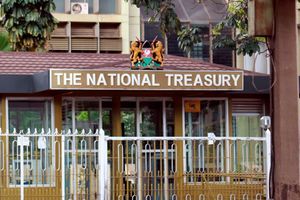
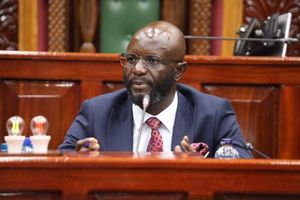
Safina Party leader Jimi Wanjigi has criticised the National Treasury’s recent revision of budget figures, dismissing suggestions they were clerical errors and raising fresh questions about Sh150.7 billion he alleges is held in a mystery account.
In a press briefing in Nairobi on Thursday, Mr Wanjigi dismissed the Treasury’s explanation that errors in the Kenya Gazette were accidental, arguing that the scale and nature of inconsistencies point to systemic failure or deliberate manipulation of public accounts.
Among the anomalies he cited was what he described as a “schoolboy error,” where the total recurrent exchequer figure in the initial notice exactly matched total revenue—Sh3.36 trillion—effectively implying the government spent nothing on development.
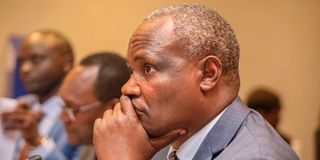
Safina Party Leader Jimi Wanjigi during an interview at his Kwacha House offices in Nairobi on October 8, 2025.
Photo credit: Evans Habil | Nation Media Group
He also questioned the disappearance of Vote R1015, the State Department for Performance and Delivery Management, which appeared in the original notice but was missing in the revised version.
“Does this department exist, or are we witnessing the manual erasure of questionable expenditures?” he posed.
“Attributing this to a clerical error strains credulity,” he said. “A national budget outturn is the sovereign equivalent of a bank statement. If billions appear and disappear overnight, that is not a typo—it is a red flag.”
The Treasury had earlier admitted mistakes in Gazette Notice No. 5726 published on April 17, 2026, and issued a corrected version—Notice No. 5803—days later.
But Mr Wanjigi argued that the revisions only exposed deeper problems, noting that 84 out of 88 recurrent expenditure line items were incorrect in the original publication.
The businessman-turned politician further highlighted drastic overnight fluctuations in allocations, including a reported Sh295 billion increase in exchequer issues to the Teachers Service Commission and a Sh123 billion jump in funding to the Ministry of Defence—figures he said cannot be explained by typographical errors.
“These are not rounding mistakes. They point to either a collapse of the Integrated Financial Management Information System or a hurried attempt to reconcile funds already spent without proper documentation,” he said.
At the centre of his claims is a Sh150.7 billion balance disclosed as being held in a “Sovereign Bond Proceeds Account,” which he argues is unconstitutional.
Citing Article 206 of the Constitution, Mr Wanjigi said all public revenues, including borrowed funds, must be deposited into the Consolidated Fund.
“By holding these funds off-book, the Treasury is bypassing the Controller of Budget, blinding the Auditor-General, and evading parliamentary scrutiny,” he said.
He questioned why the government would claim liquidity constraints while such a large sum remains idle in what he termed a “shadow account,” especially in the absence of any publicly declared Eurobond issuance in the period under review.
“This raises serious questions—whether this is a secret private placement or simply a plug figure to cover a hole in public finances,” he added.
Mr Wanjigi issued four demands to Treasury Cabinet Secretary John Mbadi, including disclosure of the bank holding the funds, publication of certified statements for the account, and a full accounting of interest earned.
He also called for the immediate freezing of the account by oversight bodies until it is regularised within the law.
When contacted by Nation, Mr Mbadi however, dismissed the demands by Mr Wanjigi as misplaced, urging him to first establish whether the funds in question were processed through the Consolidated Fund before raising alarm.
The CS said such a determination is fundamental, as it defines the legal and accountability framework governing the money, adding that public discourse should be anchored on accurate financial procedures rather than speculation.
“All Treasury accounts are established, operated and audited strictly in line with the Public Finance Management Act, and are subject to oversight by constitutionally mandated institutions, including the Auditor-General and Parliament,” Mr Mbadi said.
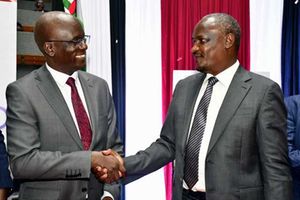
National Treasury Cabinet Secretary John Mbadi.
Photo credit: Billy Ogada | Nation Media Group
On the call to freeze the account, Mr Mbadi termed the proposal unnecessary, arguing that there is no evidence of wrongdoing to warrant such drastic action, insisting that the error on the Gazette notice originated from the government printer and not National Treasury.
“On Eurobond, I want to assure Kenyans that for the first time we shall be able to explain how each and every coin is spent and it will entirely be spent on development and not as recurrent,” Mr Mbadi added.
He reiterated that any concerns regarding public funds should however, be formally lodged with oversight bodies, which have the mandate to investigate and take appropriate action, instead of resorting to public pressure that could undermine confidence in the country’s financial management systems.
The controversy stems from official correspondence from the Treasury instructing the Government Printer to withdraw the initial Gazette due to “erroneous” figures, which Mr Mbadi insisted did not emanate from his office.
The admission triggered scrutiny from financial experts and opposition figures, who say the discrepancies go beyond routine accounting errors.
Documents reviewed show inconsistencies across multiple sectors, with some departments recording massive unexplained variances between the original and revised figures, while others appeared duplicated or misallocated.
Mr Wanjigi warned that such irregularities risk eroding confidence in Kenya’s public financial management system, particularly among international lenders and investors who rely on official data.
“Kenyans carry the burden of public debt. They deserve transparency, not approximations that leave billions unaccounted for,” he said.
The Treasury has yet to issue a detailed breakdown explaining the discrepancies beyond the initial acknowledgment of errors.
As pressure mounts, the unfolding saga is likely to intensify calls for a forensic audit of government accounts, with critics warning that failure to address the concerns could deepen mistrust in the country’s fiscal governance.
Fresh political realignment
Meanwhile, Mr Wanjigi’s Safina party got a major boost on Wednesday, after he received former Meru Governor Kawira Mwangaza into the party in a move that signals a fresh political realignment in the Mt Kenya region ahead of the 2027 General Election.
Speaking during the event, Mr Wanjigi declared that Meru County had once again positioned itself as a key battleground in shaping Kenya’s political direction, arguing that the region’s economic frustrations and governance demands had pushed residents to seek an alternative political vehicle.
“Meru has spoken before; it is Safina. Today, I reaffirm it as I welcome Hon Kawira Mwangaza to the Safina Party. The party of economic liberation,” Mr Wanjigi said.
He described Safina as a party anchored on the promise of economic justice, inclusive leadership and people-driven governance, insisting that the political future of the country would not be built on empty rhetoric but on practical solutions that address the rising cost of living, unemployment and widening inequality.
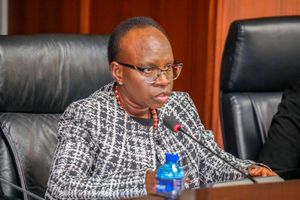
Former Meru Governor Kawira Mwangaza.
Photo credit: File | Nation Media Group
“The mission is clear: leadership for the people, prosperity for all,” the Safina boss added.
The reception of Ms Mwangaza, a vocal and controversial political figure in Meru, is likely to ignite debate within the county’s already tense political landscape.
Political analysts say her entry into Safina could energise the party’s grassroots presence and open up new alliances in the wider Mt Kenya bloc.
Ms Mwangaza rose to national prominence after she clinched the Meru gubernatorial seat as an independent candidate in the 2022 election, defeating established party heavyweights and presenting herself as a populist leader determined to dismantle old political networks.
However, her tenure was marked by constant battles with the Meru County Assembly and sections of the county leadership, leading to a prolonged standoff that threatened to paralyse service delivery.
At one point, she sought refuge in President William Ruto's United Democratic Alliance (UDA) but this did not end her tribulations.
Her political journey has also been characterised by resilience, with supporters portraying her as a victim of political sabotage while critics accuse her of being confrontational and unable to build working consensus.
By joining Safina, Ms Mwangaza now finds herself within a party seeking to rebrand itself as a modern opposition platform focused on economic empowerment, youth inclusion and institutional reforms.
Safina, once associated with veteran opposition politics, has in recent months sought to expand its influence beyond its traditional bases by courting emerging leaders and positioning itself as a “third force” ahead of 2027.
Mr Wanjigi’s remarks suggested that Meru’s political mood aligns with Safina’s ambitions, as he claimed the county was ready to take the lead in redefining the national conversation away from personality politics and toward economic liberation.
“With Meru County leading the way, the people have chosen Safina,” he said.
The party leader further argued that Kenya’s politics must shift from “political bargaining” to “economic transformation”, insisting that Safina would be the platform through which citizens reclaim their voice and demand accountability from those in power.